Wednesday, November 1, 2017

Having 21 Fortune 500 Companies Doesn't Mean NJ has a Strong Economy


There are many ways to assess the a location's business climate, such as quality of workforce, quality of life, quality of transportation, access to capital, cost of living, proximity to professional services, litigation exposure, labor laws, and yes, tax rates.

There are many groups who try to rank states by "Business Climate."   CNBC has a very broad based ranking that depends, in part, on economic growth itself.  US News's ranking relies entirely on innovation and entrepreneurship.  Forbes's ranking goes by low costs for things like energy and labor, lax regulations, and then "quality of life" thrown in too.  The Tax Foundation, for its part, has a ranking entirely focused on tax rates.

New Jersey does terribly in the Tax Foundation ranking, coming in 50th place (dead last) for several years in a row.

Jon Whiten, Vice President of the New Jersey Policy Perspective and NJ's most prolific economics commentator, doesn't dispute that NJ's taxes are indeed comparatively high, but he claims that low taxes can't be identified with "good business climate" and our high taxes aren't hurting the state.

To construct an argument that New Jersey's taxes aren't damaging the state and taxes can go even higher, Whiten points out that 21 Fortune 500 companies are headquartered in NJ.  He adds that Fortune 500 headquarters are concentrated in other high-tax states too and that they are relatively absent from the lowest-tax states.

In sum, Whiten says that the presence of 21 Fortune 500 companies here proves that "High-Tax States Are Great Places to Do Business."

The latest update to the annual Fortune 500 list of the largest American companies was released this week, and 21 Garden State businesses made the list. It�s an impressive showing for a state that usually falls to the bottom of misleading national rankings that claim to measure how attractive different states are to business investment. In fact, most of these so-called �studies� are promoted by organizations that are not advocating for a truly stronger business climate but only for lower corporate taxes.
Perhaps the most popular of these rankings is the Tax Foundation�s annual �Business Tax Climate� index. Business lobbying groups in New Jersey and anti-tax lawmakers frequently cite New Jersey�s perennial dismal ranking on this survey as proof that the Garden State�s taxes are stifling business investment and creating a drag on economic growth.
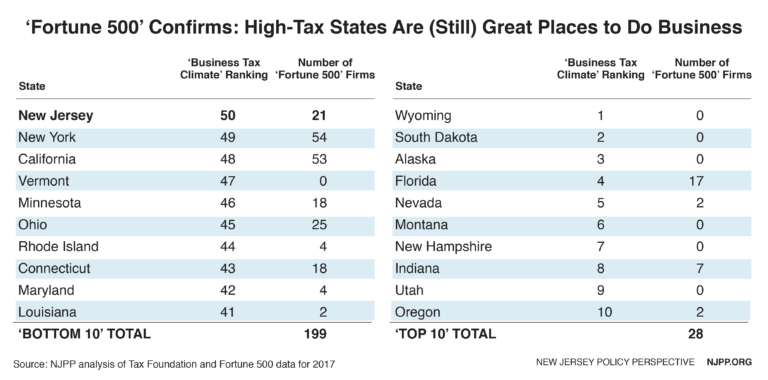
But an interesting trend emerges when one cross-references the Fortune 500 with the �Business Tax Climate� index: The �worst� states in the Tax Foundation�s index have a disproportionate share of America�s largest corporations, while the �best� states hardly have any. ...
In fact, not a single state that ranks in the top 10 of the Tax Foundation�s index has more Fortune 500 companies than New Jersey, which ranks dead last in the index. And the entiretop 10 states, with just 28 Fortune 500 companies, barely have more of these big businesses than the Garden State alone. [Whiten's emphasis]
And then Whiten provides:


While I don't think that tax rates are the end-all-be-all of business climate, neither are they unimportant, and I do see NJ's high taxes creating drag on the economy.  The fact that New Jersey has 21 Fortune 500 headquarters is interesting, but not important when it comes to the real measures of health of our economy.

If having Fortune 500 Headquarters Vindicates High-Tax Economics, What Does Their Absence from South Jersey and Central Jersey Mean?

As Whiten says, is tied for sixth place with Pennsylvania for having the most Fortune 500 companies, after New York (54), Texas (54), California (53), Illinois (36), Ohio (25), and then Virginia (22).

But even if you agree with Whiten and you believe that the presence of Fortune 500 companies vindicates high-tax economics, the distribution of New Jersey Fortune 500 companies exposes NJ's economic weaknesses as well, as well as undermines the NJPP's constant denunciation of tax incentives.

Of the 21 Fortune 500 companies in NJ, all but four are in northern NJ.


NJ's Fortune 500 Companies, 2017
Name & RankLocationFounding Year
Johnson & Johnson, #35New Brunswick1886
Prudential Financial, $48Newark1875
Merck, #69Kenilworth1917
Honeywell, #73Morris Plains1906
PBF Energy, #172Parsippany2008, grew by acquisitions
NRG Energy, #205West Windsor, Op HQ is in Houston1992
Cognizant Technology Solutions, #205Teaneck1994
Newell BrandsHoboken1903
Becton Dickinson, #225Franklin Lakes1897
Bed Bath & Beyond, #233Union1971
ADP, #240Roseland1949
Toys 'R' Us, #244Wayne1957 (is now in Chapter 11)
Celgene, #254Summit1986, spinoff from Celanese Corp.
PSE&G, #306Newark19th century
Avis-Budget, #319Parsippany1940s, 1950s
Campbell Soup, #339Camden1869
Quest Diagnostics, #366Secaucus1967
Ascena Retail Group, #384Mahwah1962
Realogy Holdings, #449Madison1990s, 2006, Spinoff from Cendant
Wyndham Worldwide, #461Parsippany2006, Spinoff from Cendant
Burlington Stores, #463Florence1972

Central Jersey has exactly two Fortune 500 headquarters, NRG Energy (actually a co-headquarters) and Johnson & Johnson.  South Jersey has two small ones, Burlington Stores and Campbell's.

There is contrast between the Pennsylvania-side suburbs of Philly and NJ-side suburbs.  The PA suburbs have seven Fortune 500 companies and Allentown has another two. 

Proximity to New York City might be an asset that companies will tolerate high taxes to have, but the farther away a location is from New York City, the less tolerant businesses are of NJ's tax premium.  The tax rates that Whiten defends do unequal damage to NJ; the parts near New York are less vulnerable than outlying regions.

States are artificial entities and the presence of Fortune 500 headquarters means anything, it means something for the five counties in North Jersey alone that host 19 of them, not the entire state.

Also, several of these companies only stayed in New Jersey or came to New Jersey under the tax incentives that Whiten loathes.  Newell came to New Jersey from Georgia after a $27 million award. Honeywell stayed for $40 million, NRG Energy stayed for $37.5 million, Quest Diagnostics stayed for $18.6 million, Burlington Stores stayed for $40 million.  Campbell's and the Prudential might have been bluffing on their threats to leave, but they have got large tax incentives too.

Job Gains Count

But I think counting Fortune 500 companies misses the forest for the trees because most job creation takes place in small businesses, subsidiaries, US branches of multinational companies, back offices, and the headquarters of big businesses that are below the Fortune 500 cutoff.

Even headquarters themselves do not necessarily have many employees.  Only nine of the 21 Fortune 500 companies in New Jersey even appear among New Jersey's 100 largest employers and that includes retailers like Bed Bad & Beyond and Toys 'R' Us and service employees at Quest Diagnostics.  NJ's biggest company is Johnson & Johnson, but J&J is down to 9,600 New Jersey employees out of 127,000 worldwide.

If you look at comparative jobs gains from the start of this decade, the lowest-taxed states have done better, so the contention that high taxes are "stifling business investment and creating a drag on economic growth" doesn't seem to be invalidated to me no matter how many Fortune 500 company headquarters high-tax states have.

From Q1 of 2010 to Q1 of 2017:

Source, https://www.bls.gov/cew/datatoc.htm. Jobs include public sector + private sector.
Note, WY, AK, and LA are affected by swings in energy markets.

New Jersey actually does even worse if you look at business creation than it does in overall job gains.  According to the Bureau of Labor Statistics's "Establishment Count," New Jersey only gained 2,260 private-sector businesses from 2010 to 2017 (264,287 to 266,547), or 0.9%.  The US gained 10.9%.

The salary of jobs counts as well, and here NJ does terribly. According to Richard Hughes of the Bloustein School at Rutgers, since the Great Recession NJ has approximately 100,000 fewer jobs paying above-average wages and 135,000 more jobs paying below-average wages.

That's great that Jon Whiten thinks New Jersey is still a "great place to do business" despite its high taxes, but real businesses aren't convinced and there are fewer well-paying jobs here than in the past.


Of course the fastest growing states listed here have advantages other than low-taxes, like lower costs-of-living for non-tax expenses, warmer weather, and right-to-work, but the lack of Fortune 500 headquarters seems to not reflect meaningfully on their economic health, nor does the presence of Fortune 500 headquarters reflect health for New Jersey.

Utah's economy grows by over 3% a year, but it has zero (0) Fortune 500 headquarters.  Utah's economy thrives in nearly everything, including high-salary fields like technology and finance.  I doubt the lack of a Fortune 500 headquarters matters to many people there.

Likewise, I don't think that New York State's 54 Fortune 500 headquarters matters to anyone living in Buffalo, since New York City is a world away from that part of New York.  While Upstate New York might be part of the same state as dynamic, booming New York City Upstate New York suffers from significant economic erosion and population loss.

Despite it having the high taxes that Whiten believes lead to growth, Upstate New York is in permanent decline.  Depending on the year, Upstate New York only has 2-4 Fortune 500 headquarters (Corning, Constellation Brands, newcomer Wegman's, and M&T Bank off-and-on).

If Upstate New York were an independent state, it would have fewer Fortune 500 companies than any other state bordering the Great Lakes.

The Disproportionality is Partly a Coincidence

Whiten is factually correct that NJ and the nine other highest-tax states have dramatically more Fortune 500 headquarters than the ten lowest-taxed states, but then again, this is something you would expect based on the fact that the highest-taxed states's population is 240% as large (102 million versus 42 million) as the lowest-taxed states.  On a per capita basis there is still a disproportionality, but not as wide as the raw-numbers comparison that Whiten uses.

This trend of the ten highest taxed states having a lot more Fortune 500 companies than the ten lowest taxed states is also partly a coincidence created by the Tax Foundation's rankings, because if you look at the next five highest-taxed states and the next five lowest-taxed states, the next five-lowest taxed states have more headquarters than the next five highest-taxed states.


Comparing the Next Five Highest-Taxed and Next Five Lowest-Taxed States (ranking by the Tax Foundation)
# of Fortune 500 Comps# of Fortune 500 Comps
Total Ten Highest Taxed199Total Ten Lowest Taxed28
Georgia17North Carolina12
South Carolina1Michigan19
Arkansas7Tennessee11
Wisconsin10Texas54
Iowa2Missouri10
Total Next Five Highest37Total Next Five Lowest106
Total 15 Highest236Total 15 Lowest134


So the next five highest taxed states only have 37 Fortune 500 companies, but the next five lowest taxed states have 106.  To be sure, the fifteen highest taxed states still have more Fortune 500 companies (236) than the 15 lowest taxed states (134), but the gap isn't nearly as wide as between the highest-taxed ten and lowest-taxed ten.

Whiten "Don't even think of cutting taxes!"

Whiten closes his argument with a warning against tax decreases.

The bottom line: Despite the drumbeat of anti-tax groups and politicians, there is a long list of factors � like location, workforce, quality of life and more � that are far more important to most businesses than low taxes. And in a cruel and ironic twist, the more our elected leaders travel down the tax-cutting path, the less money there is to ensure the state is nurturing these far more important assets.
There's a lot to unpack here, but a state can have a good location, good workforce, and a good quality of life without having high taxes.

Location is completely independent from taxes, since states are immobile parts of the North American continent. Raising taxes would not "nurture this important asset" since New Jersey is immoveable.

Contra Whiten, what is mobile is a workforce.  Hence the thousands of New Jerseyans, Illinoisians, Upstate New Yorkers, and Connecticutians who leave every year to get jobs or retire elsewhere.

Of course quality of life counts, but for many workers, quality of life includes the ability to save money for retirement and children's educations, which are better met in lower-taxed states.

The thing that Whiten doesn't like to explain is how New Jersey can already have good schools, already have a good location, already have a highly-educated workforce and yet still have decades of economic underperformance behind it.  
Whiten would probably blame our problems on Christie's neglect of NJTransit, but the parts of New Jersey that are doing the worst - like South Jersey and northwestern New Jersey - don't have train service into New York as it is and New Jersey's economy lagged the nation in the McGreevey-Codey-Corzine years too. 
I agree that NJ is hurt by a high non-tax cost of living and I think Pennsylvania's own stagnation is evidence that taxes aren't the end-all-be-all of business climate, but I find it hard to believe based on NJ's recent economy history, polls of business owners about taxes, and my own anger at our sky-high taxes, that taxes aren't stifling economic growth in this state.
----

See Also:


Sunday, October 29, 2017

Atlantic City Should be an Abbott

In 1990, when the Abbott list crystalized, Atlantic City met the Supreme Court's two criteria for Abbottization, ie, status in DFG A or B and classification by the Department of Community Affairs as an "urban municipality."

Though Atlantic City was demographically poorer and more "urban" than
many districts who were Abbottized, Atlantic City was excluded from the Abbott list by Chief Justice Robert Wilentz himself due to its extremely strong casino-based tax base.

Exclusion from the Abbott list was something that Atlantic City could manage given how enormous its tax base was until the 2010s.

Throughout the 1990s and again in 2008 when its Equalized Valuation peaked at $22.2 billion, Atlantic City had the largest Equalized Valuation in New Jersey.   At its peak in 2008, Atlantic City's school tax rate was only 0.44 and yet it was able to sustain $17,600 per student in spending, a much higher amount than the South Jersey Abbotts like Vineland, Bridgeton, Millville, and Pleasantville.

Atlantic City remained a high-tax base district until the 2010s.

Then, unfortunately, other Mid-Atlantic states got the idea to open casinos, Atlantic City tourist numbers dropped, and Atlantic City's tax base started to implode.

In 2013 alone, the Borgata challenged its $2.3 billion assessment and got it down to $870 million.  Then, in 2015, the Borgota appealed again and got another lower assessment.

Then other casinos started to close altogether like the Sands, the Revel, Showboat, the Trump Plaza, and the Atlantic Club.  Atlantic City mayor Don Guardian predicted Atlantic City's valuation would stabilize around $7 billion.

As Atlantic City's casinos closed and the tax base collapsed, Atlantic City did not cut its tax levy proportionally and the tax rate soared and fell more heavily on residential homeowners.   By 2014-15 the school tax rate had risen from 0.44 to 1.1691. 

In 2015 Senate President Steve Sweeney said that Atlantic City should become an Abbott.
After hearing complaints from residents facing a huge hike in their property taxes, state Senate President Stephen Sweeney (D-Gloucester) today said that the state should consider sending more aid to Atlantic City schools. 
Sweeney, on a South Jersey radio call-in show, suggested making Atlantic City an �Abbott district,� which is named for a series of court cases in which the state Supreme Court said residents of New Jersey's poorest cities have a right to well-funded schools. 
�One of the other things that has to be looked at now is, with all these tax decisions does Atlantic City now qualify or deserve to be an Abbott district?� Sweeney said on the show, Pinky�s Corner. �When the casino revenues were high, no they didn�t qualify. But now the numbers have to look at, the picture has to be reevaluated. That would help the tax base in Atlantic City.�
In 2015 Atlantic City still had an above-average tax base (its Equalized Valuation was $11.3 billion, the seventh largest in NJ), so I disagreed with Sweeney at the time, but by now Atlantic City has fallen farther than even pessimists predicted and Abbott status is merited.

In 2014-15 Atlantic City's school tax rate had been 1.1691, but by 2017-18 it was 1.1911.  For 2018-19, if new state aid does not arrive and the tax levy stays constant at $82 million, the tax rate would be 1.86!  (1.86 = $82 million / $4.4 billion)

Demographics

The first reason Abbott status is warranted is that Atlantic City's demographics are among the most challenging in New Jersey.

Atlantic City's FRL-eligibility rate is in the bottom ten for New Jersey.

1.  Camden City, 95%
2.  Union City, 95%
3.  Seaside Heights, 94%
4.  Woodlynne, 93%
5.  Asbury Park, 93%
6.  Bridgeton,  93%
7.  Passaic, 91%
8.  Paterson, 90%
9.  Trenton, 89%
10.  Atlantic City, 89%

Tax Base

Atlantic City's tax base is well below the state's average, although it is not at the same ranking as its FRL-eligibility.

For 2017-18 Atlantic City's tax base is $8300 per student compared to the state median of $13,300 per student.   (AC = ($55.86 million in Local Fair Share for 6700 students).

That $8300 per student is low, but is only in the state's bottom quarter.

However, the 2017-18 Local Fair Share is based on Atlantic City's $6.4 billion in Equalized Valuation for tax year 2017.

Since then, the tax year 2018 Equalized Valuations have come out and Atlantic City's Equalized Valuation fell from $6.4 billion to $4.4 billion.  That $2 billion drop in Equalized Valuation should diminish Atlantic City's Local Fair Share by at least $14 million, or a 25% fall.

Since the 2017-18 Local Fair Shares are already out of date, I will calculate Equalized Valuation per student for the Abbotts.

This is the Equalized Valuation per student of all the Abbotts, plus Atlantic City.  Although Atlantic City's Equalized Valuation per student is still above the Abbott average, there are several Abbotts whose tax bases are superior and yet do not even have equivalent student poverty.

DistrictEqualized Valuation Per Student (based on tax year 2018 EV)
HOBOKEN$6,194,298
NEPTUNE TWP$1,111,837
LONG BRANCH CITY$950,114
JERSEY CITY$924,101
ASBURY PARK$703,676
ATLANTIC CITY$653,744
HARRISON$596,929
GARFIELD$559,809
BURLINGTON CITY$465,910
VINELAND$407,270
KEANSBURG$371,185
WEST NEW YORK$358,421
NEW BRUNSWICK$346,825
PEMBERTON$345,188
MILLVILLE$329,073
NEWARK$312,648
EAST ORANGE$309,757
UNION CITY$308,499
PERTH AMBOY CITY$301,569
CITY OF ORANGE TWP$298,012
ELIZABETH$289,422
PHILLIPSBURG$279,214
PLAINFIELD$277,555
GLOUCESTER CITY$272,747
IRVINGTON$262,452
PASSAIC$248,136
PATERSON$231,049
PLEASANTVILLE$205,939
TRENTON$165,947
SALEM CITY$135,244
CAMDEN$114,639
BRIDGETON$85,150

Implications of Abbottization?

It's hard to say what becoming an Abbott would mean for Atlantic City.  

SFRA created a unitary funding formula for K-12 aid, but preserved the Abbotts' rights to100% state funding for construction and 100% funding for PreK for all 3s and 4s in the Abbotts.

Due to SFRA's unitary formula for K-12 aid, Atlantic City's problem for K-12 aid isn't that it lacks Abbott status, it is that it is severely underaided anyway.  For 2017-18 SFRA already says that Atlantic City should get $79.3 million, but the state only gives it $56 million (which is $24 million in regular DOE money and another $32 million in "Commercial Valuation Stabilization Aid" which comes from other state agencies.)

Atlantic City already gets $3.3 million in PreK aid, which I can infer is much less than it would get if it were an Abbott.   

I do not know the size of Atlantic City's age 3 and age 4 cohort, but based on proportionality with the Abbotts, Atlantic City is not getting nearly enough PreK money for every child there.

For instance, Pleasantville, which has 3,000 fewer students than Atlantic City, gets $6.9 million in PreK money.  Millville, which has 1800 fewer students than Atlantic City, gets $8.5 million in PreK money.  Long Branch, which has 1600 fewer students than Atlantic City gets $9.8 million.  (source, DOE State Aid Summaries)

Keansburg has only 1400 students total and it gets $2.8 million for PreK.


Although Abbottizing Atlantic City doesn't seem to be on the table anymore, I hope it does come up because a conversation around Abbottizing Atlantic City might also inspire conversation about other updates to the Abbott list, including the deAbbottization of definitely Hoboken and perhaps Jersey City, Long Branch and Pemberton.  

Thursday, October 19, 2017

Overaided Districts Regain $4.8 million and $6 million in Loans


There hasn't been much reporting on this, but the Christie Department of Education has just restored $4.8 million in Adjustment Aid to 23 overaided districts and made $6 million in ten-year loans (or "loans") to another three districts.

So far the only reporting I've seen on this was from Amanda Oglesby of the Asbury Park Press, who wrote an article about the restoration of state aid to five districts in the Asbury Park Press's coverage zone, (Marlboro, Toms River, Brick, Middletown, and Keansburg) on October 17th.

Five Jersey Shore school districts that faced hundreds of thousands of dollars in state aid cuts have learned that the money will be restored, according to the New Jersey Department of Education. 
The announcement came from the department this week that schools in Brick, Keansburg, Marlboro, Middletown and Toms River will receive thousands of dollars more in state support than had been promised last summer. 
Early last spring, each district balanced its budget on a state aid promise that would later prove ephemeral. State Democrats struck a deal over the summer that moved a portion of the districts' promised money to schools that were not receiving their fair share under the State Funding Reform Act.

After a query to Ms. Oglesby and the Department of Education I learned that there were other districts who either got all of their Adjustment Aid back or received a loan to be repaid over ten years out of future state aid. 

These are the districts who are having their Adjustment Aid restored.  


DistrictRestoration
Andover$47,195
Brick$720,507
Burlington City$149,493
Easthampton$56,982
Englewood$160,731
Frelinghuysen$12,367
Hopatcong Boro$227,978
Keansburg$517,808
Kittatinny Regional$121,727
Marlboro$233,031
Middletown$356,772
North Warren Regional$66,201
Stanhope$30,324
Stillwater$36,145
Toms River$1,366,845
Ventnor$42,081
Vernon Township$300,000
Wallkill Valley$94,904
Washington Township$52,765
Weymouth Township$47,472
White Twp$34,902
Wildwood City$104,221
TOTAL$4,780,451

Several of these districts are massively overaided.  Hopatcong's excess was going to be $5,888 per student even before the restoration.  Weymouth was going to be overaided by $9,463 per student.  Brick by $2,703 per student.  

The Department of Education letters do not go into any detail as to what the justifications were for the restorations.  The letters begin like this.  


Pursuant  to  the  provisions  of  P.L.  2017,  c.  99,  the  New  Jersey  Department  of  Education (Department) has performed a review of your district�s application for additional general fund state aid for fiscal year 2018.  Our review has been conducted in the form of a needs assessment; the purpose of which is to evaluate the merits of the district�s request for additional general fund state aid.  Your district�s 2017-18  general  fund  state  aid  was  originally  $2,373,620  and  had  been  reduced  by  $47,472  to $2,326,148. Your application requested $47,472 in additional general fund state aid.  Based upon our review and the recommendation of the Executive County Superintendent, your district�s application is approved for additional state assistance in the amount of $47,472.

Another three districts are getting loans, East Orange (+$3,130,330), Millville (+$811,983), and Vineland ($2,059,792). 

May 2018 Update: The loans were converted to grants in Phil Murphy's FY2019 budget.

I do not know why these districts got loans and not grants.  

Great Meadows's application was denied.  

Although the total new aid ($4.7 million) is a tiny percentage of NJ's deficit against Uncapped Aid ($2 billion without redistribution, $1.328 billion with redistribution), these restorations to the overaided strike me as deeply unfair.

Although it was difficult for overaided districts to make cuts in the summer of 2017, if NJ has new money to give out, it should still have gone into TPAF or, if it had to be spent on opex aid, to the most severely underaided districts such as Bound Brook, with its $9500 per student deficit, Manchester Regional, with its taxes in excess of 200% of Local Fair Share, and Atlantic City, whose tax base has just lost another $2 billion since state aid was calculated.

---

See Also: 
Update:

Since this post appeared, there's been some more reporting on the state aid restorations.


Monday, October 16, 2017

Combined Reporting Won't Increase NJ's Revenues by $290 Million

For the last few years the New Jersey Policy Perspective have been leading a campaign for NJ to change its corporate tax laws to require something called "Combined Reporting."

Combined Reporting is an accounting rule that nullifies a corporation's attempt to avoid taxation by shifting profits from high-tax states to low-tax states via phony subsidiaries.  Under Combined Reporting, all of a corporation's subsidiaries are treated as a unitary, combined unit and then a state taxes a percentage of the entire entity's profits.  Under Combined Reporting, any transfers of money between subsidiaries are disregarded and the whole corporation's bottom line is what gets taxed.

For years, the New Jersey Policy Perspective trumpeted Combined Reporting as a taxation game changer that would increase corporate tax receipts by 10-20%, or $235 million to $470 million a year.   The NJPP's proposal has been adopted by several major progressive groups and politicians in New Jersey, such as the CWA and Senators Ray Lesniak, Linda Greenstein, and Paul Sarlo and most significantly Phil Murphy.

As a matter of tax fairness, Combined Reporting is a sound idea because it levels the playing field between small businesses and multistate businesses, but the revenue estimates that the New Jersey Policy Perspective disseminates (and have been picked up by Phil Murphy) are highly inflated.

The reason why NJ would not see such a big uptick in revenue from Combined Reporting is that in 2002 we already reformed our tax code to make it harder for corporations to set up phony subsidiaries to evade state taxation (eg rental corporations, utilize intellectual property holding companies, transfer pricing, captive real estate investment trusts, captive insurance subsidiaries etc).

NJ already requires Combined Reporting for some businesses, such as casinos.  NJ's "Throwback Rule" requires companies to pay taxes on "Nowhere Income" if the sale originated in NJ.

Owing to the anti-tax avoidance laws already on NJ's books, when the Office of Legislative Services came out with its own estimate in October 2016 for what Combined Reporting would bring in, it was for $110-$290 million, which was a 5-10% increase on NJ's historical Corporate Business Tax receipts. The OLS said NJ's revenue increase would be low because of the reforms already made, especially the Throwback Rule.

That OLS report actually didn't base the 5-10% report on other states' experiences after implementing combined reporting. It estimated that based on their pre-reform projections and then used the 5-10% numbers for NJ.

A 2014 report by the Rhode Island Department of Revenue estimated an approximate 20 percent revenue gain, when isolating combined reporting from other tax law changes involving three-factor and single sales factor apportionment systems. Connecticut�s consensus revenue forecast for FY 2016 estimates a revenue gain of approximately 5 percent from implementing mandatory combined reporting as one part of a major corporate tax reform in that state. In 2008, New York State�s Division of the Budget estimated an increase of 8 percent for combined reporting. However, a report commissioned for the National Conference of State Legislatures in 2010 found little impact in the initial years of combined reporting reforms in New York and Vermont. The Massachusetts Department of Revenue originally estimated 26 percent revenue growth in FY2009 from combined reporting, although total corporate revenues grew by closer to 17 percent that first year and Massachusetts did not isolate how much was due to the tax change compared to economic conditions. Massachusetts also reduced the corporate tax rate during that period. 
Given that the prior New Jersey corporation business tax reforms of 2002 were also intended to limit the use of some corporate tax shelters, it is reasonable to anticipate that the potential revenue impact of mandatory combined reporting may be closer to the low end of the wide range estimated in other states. Accordingly, the OLS believes a potential corporation tax revenue increase ranging between 5 percent and 10 percent annually is possible, but also highly uncertain. 
Since NJ's Corporate Business Tax has historically brought in $2.2 billion to $2.9 billion, the OLS made the $290 million ceiling estimate by taking 10% of $2.9 billion, a double best case scenario. The $2.9 billion amount, however, hasn't come in since 2008.

Source, Page 10.
http://www.nj.gov/treasury/omb/publications/17citizensguide/citguide.pdf

Also, the OLS does not consider that businesses might develop counter-tax planning strategies or even avoid New Jersey altogether.

Note, even the state studies that the NJ OLS used were on the high side.  Maryland's legislative research office predicted no boost.  In 1994 Iowa's legislative research office also predicted "minimal impact."  In an extremely thorough report, Indiana's Legislative Services Agency said that Combined Reporting would only increase revenue temporarily:

We used econometric techniques to examine how state tax policies, including combined reporting, influence state corporate income tax revenue. This method controls for variation in the tax base related to the economic cycle and other tax policies, and separates the impact from combined reporting. The econometric results suggest that combined reporting may have an initial positive impact on corporate income tax revenue but that this impact is not lasting. We estimate that the initial positive impact could potentially be economically significant. However, we also estimate that this impact will only be short term and will decline to zero in the long run.
Indiana also warned that while Combined Reporting more often increases a tax liability, Combined Reporting can reduce a company's tax liability too "In cases where one or more affiliates has a loss, combined reporting could reduce the entire unitary group�s taxable income."

The NJ Office of Legislative Services also used the historic high of NJ's Corporate Business Tax of $2.9 billion, when the most recent FY2017 Corporate Business Tax haul was only $2.4 billion.  Using the 5%-10% parameters on $2.4 billion gives a range of $110-$240 million.

To its credit, the New Jersey Policy Perspective trimmed estimate it used in its publicity from $470 million to to $290 million, but has refused to acknowledge the tentativeness of the OLS's estimate or that the OLS was giving a wide $110 million to $290 million range, not a $290 million target.

Despite obviously being aware of the uncertainties expressed in the OLS's report and even deeper uncertainty expressed in other states' reports, the New Jersey Policy Perspective uses the $290 million confidently, with a only a momentary, unexplained qualifier of "up to."

Here is Sheila Reynertsen caught in half-truth February 2017:
One of the most responsible ways to create a path to financial sustainability is to ensure that corporations and the wealthy are paying their fair share in New Jersey. Closing tax loopholes is one way to do this. Expanding combined reporting in New Jersey would close corporate loopholes and help prevent multi-state corporations from artificially shifting profits out of state. This tax policy could raise up to $290 million in much-needed revenue each year to shore up underfunded investments like higher education and public transit.

Here is Jon Whiten giving the same "up to" half-truth in October 2017:

Other states � 25, to be exact � have combated [corporate tax evasion] by adopting a practice called �combined reporting.� And New Jersey should join them. Limiting the ability of profitable multistate corporations to use accounting tricks to dodge state taxes would help level the playing field for the state�s small and local businesses � and raise up to an additional $290 million a year to help the state pay its bills and make key investments.
For the NJPP to be honest and say Combined Reporting "could bring in $110-$290 million" would actually hardly be more verbose, but "up to $290 million" makes Combined Reporting sound so much more lucrative than estimates say it would be.

Perhaps I have been too critical of the NJPP because they do use that "up to" qualifier, but Phil Murphy does not use the qualifier and the $290 million upper limit has become the actual expectation and the media is clueless. 

* Murphy would raise $290 million in his first year in office by closing a tax loophole that allows corporations to shift profit made in New Jersey to lower-taxed states, an idea based on bill introduced by state Sen. Raymond Lesniak (D-Union) that cleared the Senate budget committee last October, but was never put up for a vote.

 Tom Moran, in complete naivet� and ignorance, rounds that up to $300 million.

Due to the Murphy campaign, that $290 million estimate for Combined Reporting has been repeated everywhere, as if it were just money laying on the table.  (Example 1, Example 2, Example 3)

Tom Moran, in an otherwise good column on how Phil Murphy would not be able to pay for the agenda he laid out, took it as truthful that Murphy's tax increase package would bring in $1.3 billion.

No, the wiggle room in Murphy's plan is on the spending side. He has three top priorities that represent his red lines: He wants to increase aid to local schools, boost pension payments, and begin repairs of our decrepit transit system. His $1.3 billion in new tax revenue will be devoted to those three initiatives, he says.   [my emphasis]

The first journalism I saw explaining that $290 million was the ceiling of a revenue range didn't come out until October 7th, when Samantha Marcus of NJ Advance Media explained

How much money would be generated by [Combined Reporting]? The non-partisan Office of Legislative Services has called the impact of combined reporting "uncertain and variable." It predicted the state could see $110 million to $290 million in new revenue annually.

Murphy's campaign builds its plan on the higher estimate.

The NJPP's near-certainty and Phil Murphy's complete verbal certainty over the revenue increase created by Combined Reporting is reason why we all have to be very skeptical of anything we read about how "closing corporate loopholes" will produce massive amounts of easy money.

The fact that the $290 million estimate became canon in New Jersey media so quickly and easily is another example of how New Jersey is harmed by the lack of a center-right or free-market think tank.  Although a center-right think tank would misrepresent issues too, at least they could be a quick corrective for out-of-context papers from the left.

It's worth noting that the NJPP authors of these op-eds for Combined Reporting are not tax experts. Neither Reynertsen nor Whiten has ever worked in a state's budget agency or Treasury.  Neither is an economist.  Jon Whiten's background is as a journalist. Sheila Reynertsen was a birth coach and hospital anti-merger activist.  Andrew Sidamon-Eristoff, who is a bona fide budget expert since he was NJ's Treasurer, says that Combined Reporting won't even bring in anywhere near $200 million.

(note, I'm not a tax expert either. I just read stuff online, like Whiten and Reynertsen.)

The New Jersey Policy Perspective does some good research, but they are an ideological group, staffed by people who are not experts in their fields, and NJEA-funded.  Their pronouncements should not be taken as factual until further verification is performed.  The NJPP's silence on/opposition to redistributing Adjustment Aid and indifference to spending the state's existing money more efficiently, should be taken as how they are influenced by the big public sector unions who fund them.

Also, given that $290 million is a ceiling estimate, we have to be very skeptical about Phil Murphy's plan to increase revenues by $1.3 billion, of which Combined Reporting is a part.  Between the uncertainty of the Combined Reporting revenue increase and the uncertainty over NJ's ability to tax Carried Interest without Massachusetts, Connecticut, and New York cooperating, Murphy's tax hikes will not bring in $1.3 billion unless there is some simultaneous strengthening of New Jersey's economy.

Combined Reporting is a good idea in terms of tax fairness because it would even the playing field between multistate companies and local companies and because New Jersey needs all the new money it can get, but it will not bring in $290 million per year.

Given that New Jersey's budget crisis will continue under the next governor New Jersey is going to need to redistribute Adjustment Aid more than ever.