Showing posts with label tax cap. Show all posts

Wednesday, March 28, 2018

Yes Education Law Center, Jersey City is Ridiculously Overaided

There is no district that exemplifies the absurdity of the frozen aid allocation more than Jersey City.

Note: Jersey City's Local Fair Share is $375 million for 2018-19.  


Jersey City's derelict wharves have given way to gleaming skyscarpers.  Jersey City's empty factories have become million-dollar lofts.  Jersey City's mayor calls Jersey City "New Jersey's Economic Powerhouse" and realtors and even residents call it "the Gold Coast."

There are several quantitative ways to measure this transformation, but by real estate value alone, since 1998 Jersey City's share of New Jersey's total Equalized Valuation has risen from 1.05% of the state's total to 2.35%.  Were Jersey City's $11.6 billion in PILOTed properties included in Equalized Valuation, Jersey City would possess 3.25% of New Jersey's total real estate wealth.

Note, this graphic was updated in Oct 2018 to reflect release of new Equalized Valuations.

Yet, despite that staggering increase in wealth, Jersey City still receives state aid as if it were the struggling city of the 1980s; getting $410.4 million in K-12 operating aid for 2017-18, an amount that is $151.5 million in excess of the $258.8 million that SFRA's core formulas actually say that Jersey City needs.

Thus, despite a 2018 Equalized Valuation of $28.4 billion, the Jersey City taxpayers only pay $116 million in school taxes, or 20% of the Jersey City Public Schools' budget.  Despite having New Jersey's largest tax base, Jersey City only has the 16th largest tax levy, behind poorer and/or smaller towns like Newark, Cherry Hill, Clifton, and West Orange.

Despite Jersey City's substantial growth in overall population, Jersey City's gentrification appears to have actually DECREASED student enrollment, from 31,328 in 2009-10 to a (projected) 30,815 for 2018, as childless residents and private-school families displace children who would have been in the public schools.

As public school families leave Jersey City, they often move to Jersey City's neighbors, contributing to enrollment increases and budget problems in most of the non-gentrified towns of Hudson County.

Source:
http://www.nj.gov/education/finance/fp/ufb/
Note 1: Yes, these numbers include charter students.
Note 2: Weehawken and Hoboken have seen enrollment growth since 09-10, but they were thoroughly gentrified in 2009-10 anyway. 


----------

It is obvious to many people that Jersey City's level of state aid is unfair, but not the Danielle Farrie of the Education Law Center.

The Education Law Center's case against redistributing Jersey City's Adjustment Aid isn't an argument so much as a redefinition of the words "overfunded" and "overaided" to mean "above Adequacy."  The Education Law Center denies the legitimacy of the common usage of the term, which means that a district receives more state money than SFRA's core formulas say it needs.

Here's the core of the Farrie/Education Law Center argument/redefinition:
JCPS receives more state aid for its adequacy budget than the formula would provide because of its allocation of transitional Adjustment Aid under the SFRA. However, this does not mean that the district is �overfunded,� �overaided,� or spending in �excess� of what students need for a thorough and efficient education. In fact, Adjustment Aid does not fully cover the district�s $253 million local levy gap.  
Adjustment Aid in Jersey City does not fund spending in excess of the level required under the SFRA for a thorough and efficient education for all district students. Even with Adjustment Aid, the district is spending $100 million below its adequacy target. A reduction in Adjustment Aid would have a severe impact on the district, further eroding the resources that are required to adequately educate all students to the state�s academic standards. For example, using average district compensation levels ($99,158 annual salary plus benefits), the total loss of $151 million in adjustment aid would require the district to cut over 1,500 positions, or one-half of all certificated staff.  [my emphasis]

Essentially the Education Law Center claims a monopoly on the right to define the words "overfunded" "overaided."  Instead of allowing those words to refer to state aid only (hence my preferred "overaided"), they say they must refer to spending relative to Adequacy.

In the Education Law Center's logic, since Jersey City's schools are only spending $17,149 per student and its full Adequacy budget calls for spending of $20,321 per student, therefore the Jersey City Public Schools cannot be "overfunded" or "overaided."

QED.

(note, Jersey City actually spent $23,466 per pupil in 2014-15, but SFRA's definition of spending excludes several significant revenue sources and spending categories, hence Jersey City's "spending as defined" is only $17,149.)


The Erasure of the Rest of New Jersey

There are many aggravating things about the Education Law Center's defense of Jersey City's aid hoarding, mostly that it sees the Jersey City Public Schools in isolation, ignores the budgetary needs of other school districts, ignores New Jersey's chronic budget crisis, and denies that the motivation to redistribute Jersey City's Adjustment Aid is to GIVE IT TO OTHER DISTRICTS WHO ARE UNDERAIDED AND FARTHER BELOW ADEQUACY THAN JERSEY CITY.

The Education Law center worries about cuts to Adjustment Aid, but it does not worry about what harm will be caused to non-Jersey City students whose schools remain badly to severely underaided (and below Adequacy) due to the state's failure to redistribute Adjustment Aid.

The Education Law Center's argument is only logical if you erase from your consciousness the children of Bayonne, Clifton, Plainfield, New Brunswick, Freehold Boro, Kingsway, Atlantic City, and other underaided districts.  It only works if you assume a profound selfishness on the part of Jersey City's taxpayers not to make up for Adjustment Aid losses with local taxdollars.

To show how acute need is outside of Jersey City, just look at Hudson County alone, since there are eight districts in Hudson County who were underaided, higher taxing and farther below Adequacy than Jersey City and who would benefit from the redistribution of Adjustment Aid from Jersey City and other overaided districts.


DistrictActual State AidUncapped SFRA AidAid GapLocal Tax LevyLocal Fair ShareTax GapAdequacy Surplus or DeficitAdequacy Excess or Deficit Per Student
Hoboken $10,468,870$3,166,333$7,302,537$42,502,765$204,865,488-$162,362,723$7,820,582$2,949
Secaucus $1,130,674$2,756,466-$1,625,792$33,987,669$49,980,321-$15,992,652$547,026$261
Weehawken $2,668,254$1,637,823$1,030,431$19,127,272$35,287,202-$16,159,930-$734,970-$551
JERSEY CITY$410,696,575$258,849,750$151,846,825$114,404,361$370,261,455-$255,857,094-$97,547,549-$3,172
Harrison $25,459,593$27,530,776-$2,071,183$9,229,913$16,876,180-$7,646,267-$9,374,329-$4,416
Kearny $33,119,896$66,094,340-$32,974,444$50,681,091$46,112,551$4,568,540-$27,160,572-$4,640
North Bergen $58,323,031$76,240,347-$17,917,316$46,734,214$69,500,758-$22,766,544-$38,730,930-$5,352
Union City$181,270,544$221,997,208-$40,726,664$15,418,637$49,554,960-$34,136,323-$74,133,383-$5,936
Bayonne $56,916,073$105,009,173-$48,093,100$62,876,035$76,982,891-$14,106,856-$60,551,038-$6,484
West New York $95,592,169$120,944,172-$25,352,003$16,061,559$44,357,307-$28,295,748-$52,605,527-$6,757
East Newark $3,578,845$6,251,466-$2,672,621$1,453,439$1,924,110-$470,671-$3,076,326-$8,011
Guttenberg$5,784,546$14,244,681-$8,460,135$11,099,825$13,897,013-$2,797,188-$10,972,862-$8,152

Indeed, Jersey City is $3,172 per student below Adequacy, which is the 49th biggest deficit in New Jersey, but most of Jersey City's neighbors are significantly worse off and five Hudson County school districts are in New Jersey's bottom ten of below-Adequacy spending.

Guttenberg and East Newark are, in fact, $8,152 per student and $8,011 per student below Adequacy, respectively, making them the two most under Adequacy districts in New Jersey.

West New York is $6,757 per student below Adequacy, the 6th worst in New Jersey and worst-off of any Abbott.  Bayonne is $6,483 per student below Adequacy, the 7th worst.  Union City is $5,936 per student below Adequacy, the 10th worst.

Nearby is Fairview Boro, in southern Bergen County, is the fifth most under Adequacy district, with a deficit $7,167 per student.

With the exception of West New York, all of the exceptionally under-Adequacy districts of Hudson County are hurt more by insufficient state aid than they are by insufficient local tax effort.  New Jersey underaids Guttenberg $3 for every $1 Guttenberg taxes below Local Fair Share. New Jersey underaids East Newark by $11 for every $2 East Newark taxes below Local Fair Share.  New Jersey underaids Bayonne $7 for every $2 Bayonne does not tax itself.  For Union City underaiding is more of a factor than undertaxing, though not as dramatically as for Guttenberg, East Newark, and Bayonne.

Fairview taxes at 100% of Local Fair Share, so its $7,167 per student sub-Adequacy spending is entirely the state's fault.

The Education Law Center's no-redistribution position is also eased by constant lies about what New Jersey's state aid deficit is, using the statutory (but artificial) deficit of  $1 billion and not the authentic Uncapped Aid deficit of $2 billion it was for 2017-18.  The Education Law Center, quite
The JCBOE doesn't want to close its Adequacy Gap
literally, says that "Capped Aid = full funding."


Jersey City's BOE Does Not Want to Raise Taxes Above the Tax Cap

The Education Law Center repeatedly presents an image of a Jersey City Board of Education that yearns to close its spending gap against Adequacy but is prevented by the tax cap.
"Jersey City has increased local revenue every year since 2008, but the state�s 2% annual property tax cap limits JCPS�s ability to make more progress towards closing the large local levy gap."  [my emphasis]
And:
"In other words, Jersey City is increasingly reliant on Adjustment Aid because it is unable to increase the local levy to keep pace with its growing adequacy budget and its increasing obligation to fund its budget through local revenues. "  [my emphasis]
And:
"Contrary to much speculation, JCPS has largely been living up to its obligation under the SFRA to increase local revenue for schools, but it is constrained by the state�s property tax cap. Year after year, the SFRA requires Jersey City to support a greater portion of its budget, and yet at the same time it will not allow the district to raise more local revenue."

The Education Law Center states that Jersey City's taxes remain low due to the tax cap, but the Jersey City Board of Education has not even consistently raised taxes at 2.0%.  In 2013-14 the Jersey City BOE only raised taxes by 1.78% and in 2014-15 the Jersey City BOE only raised taxes by 1.5%.

These are not the actions of a Board of Education that is determined to reach its Adequacy budget with local taxes.
http://www.jcboe.org/boe2015/images/pdf/depts/bueinesstech/budget/Proposed_Budget-2016-041715-FINAL1.pdf

The 2% Tax Cap is not an Insurmountable Barrier to Raising Taxes above 2% 

The Education Law Center concedes that the Jersey City BOE has not used the existing allowances in the tax cap for medical costs, admitting that the BOE has "failed to capture some available revenue. For example, the district could have raised an additional $4 million in 2018 to offset increases in health care costs."

A Board of Education already has the power to ask its voters to raise the tax levy.  It is problematic that the higher levy, if approved, would not go into effect into the middle of the next school year, but nevertheless, the power to hold a referendum exists and is costless to a school district.  The Jersey City Board of Education has yet to show a desire to do so.

So this claim by Danielle Farrie/the Education Law Center, "increases in local revenue from
The voting booth already gives a school
district the power to exceed the tax cap and state
aid reformers have hinted at changing the tax cap
to make exceeding 2% even easier.
year to year are statutorily capped at 2% of the prior year�s revenue amount" is not completely true.

Jersey City Can Afford to Raise Taxes More Easily Than Almost Any Other Town in NJ

Jersey City has the state's strongest real estate market, gaining 38.4% in Equalized Valuation from 2010-2016 and continuing since then.

So the refusal to raise taxes by more than 2.0% can best be explained by a lack of any desire to do so.  

The Jersey City BOE would gladly spend $20,321 per student - or whatever New Jersey says it should spend - if the state were paying.  But once Jersey City taxpayers themselves would have to pay, the Jersey City BOE begins to see the decreasing utility of spending above $18,000 per student.  I'm sure the Jersey City BOE wants the best for Jersey City children, but in their hearts, the Jersey City BOE members do not agree with the Abbottist doctrine that spending needs to be $20,000 per student to provide a "thorough and efficient education."

This reluctance to employ the allowances within the existing tax cap or go to a referendum exists despite Jersey City's school tax rate has fallen by a third since 2013-14 alone.


Sometimes towns with strong real estate markets see their tax rates fall due to the appreciation of the existing housing stock, while individual tax bills increase, but in Jersey City tax rates are falling due to appreciation and new construction, thereby actually reducing the average homeowner's tax bill itself relative to inflation.

Source:
http://www.state.nj.us/dca/divisions/dlgs/resources/property_tax.html#1
Tracking the all-in school+municipal+county tax produces the same pattern of
tax bills lagging inflation and even falling in some years.


As the Education Law Center says, it is true that Jersey City has increased its tax levy since 2009 by more than the average NJ district (35% vs 24%), but Jersey City was starting at an abnormally low levy ($86 million) that was lower than what it paid in 1989-90.  The average New Jersey district already had high taxes in 2009 and is so smashed by stagnant property values and already high taxes, that even an increase of 24% is a much larger sacrifice than Jersey City.

Jersey City's Trend of Falling School Tax Rates will Likely Continue into the Future.

Jersey City sees a constant stream of new developments and escalating housing prices of the existing housing stock.

One development, 99 Hudson Street, will be New Jersey's tallest building, and will alone will create a palpable reduction in the average Jersey City taxpayer's property taxes.

Conservatively estimated,
99 Hudson Street alone
will offset Jersey City's muni+school
taxes by 2.5%.
99 Hudson will have 780 apartments plus 15,000 square feet of retail.  The apartments will start at $770,000, so we can conservatively estimate that the total Equalized Valuation of 99 Hudson will be $700 million, or 2.5% of Jersey City's current Equalized Valuation.

Given the rapid pace of redevelopment in Jersey City and the expiration of PILOT agreements, even if Jersey City lost $30 million in Adjustment Aid per year and made up for those losses with local taxes, the tax rate increase would not be proportionate and individuals' taxes would not increase so dramatically.  In fact, for 2018-19 Jersey City's Local Fair Share grew to $399 million from $370 million.

For Jersey City to lose $151 million in state aid and make up for all those losses with local revenue it would be equivalent to a 130% increase in school taxes.  I admit that that would be a hardship for some people, but there are solutions for at least senior citizens in the form of NJ's property tax freeze and reverse-mortgages.  Jersey City residents would still be better off in taxes than people in most other towns, whose school taxes are often higher and real estate appreciation less (or negative.)

Undoubtedly, while paying higher school taxes might be very difficult for some Jersey Cityans, my greater sympathy will always be with people who have to pay higher taxes on depreciating houses, not appreciating ones.  (The median NJ town's Equalized Valuation has lagged inflation for years.)

Also, the Education Law Center has no right to worry now about taxes rising so fast, since in the early 1990s it supported a state aid plan that would have taken all state aid - include pension payments - away from a quarter of New Jersey's school districts.  Among the school districts slated to lose most or almost all of their state aid were working class and middle-class districts like Belleville, Hackensack, and West Orange.  (see the NYT article  "Jim Florio's Dream is One Town's Nightmare")

Hints of Changing the Tax Cap for Aid-Losing Towns

A more significant omission from Danielle Farrie and the Education Law Center is not acknowledging that Steve Sweeney's state aid reform plan has always had a provision in it to change the tax cap anyway.

For instance, the Senate 2016 resolution to create a school funding commission contained this language to have the committee evaluate the tax cap.
  1. (2) the tax levy growth limitation as established and calculated pursuant to section 3 of P.L.2007, c.62 (C.18A:7F-38) and its impact on the ability of school districts to adequately fund operating expenses;
In September 2017 when the Senate passed the concurrent resolution identical language about the tax cap was included.

Changing the tax cap for aid-losing districts also came up in the Senate state aid hearings in 2017, so the idea has already been discussed.

Steve Sweeney has studied SFRA and the aid distribution very closely and we can assume that he and his allies know that the tax cap needs to be changed to allow Jersey City and other aid-losing districts to tap their tax bases.

The Corzine-era 4.0% tax cap allowed a school district to increase the local tax levy if it lost state aid.  So reviving this provision would not be revolutionary.

Nonetheless, I concur with the Education Law Center that it might be necessary to require local tax increases for Jersey City and not leave it to the discretion of Jersey City's anti-tax Board of Education.

PILOT Exploitation

Another facet that makes Jersey City's state aid level especially objectionable has a long and aggressive history of using PILOT arrangements to increase municipal revenue, cut Hudson County out, and continue to leave statewide taxpayers with the bill for the school system.

The way this exploitation works is that in a Payment In Lieu Of Taxes arrangement the municipality gets 95% of the PILOT fees and the county gets 5%. (it used to be 100% municipal). Thus, it is possible to structure a deal where a developer pays less in taxes than under normal taxation, but a municipality gets more. Because PILOTed properties do not count toward a town's Equalized Valuation, they are "invisible" to the formula for Local Fair Share, legally equivalent to a non-profit owned property, like a cemetery. (see "The Problems of PILOTs")

In 2017 Jersey City's PILOTed properties were worth $11.6 billion, or a third of the total tax base.  If that $11.6 billion in property were part of Jersey CIty's Equalized Valuation, Jersey City's Local Fair Share would be $76 million higher than its $351 million for 2017-18.

I assume that all Jersey City politicians understand how PILOTed properties hurt taxpayers in the rest of Hudson County and sustain an artificially low calculation of Local Fair Share, but most of them don't say anything about it in public.

There are exceptions though.  For instance, Jersey City councilwoman Candice Osborne recently defended PILOTization because it
[Sic] He meant "[receive] less in
state aid for our schools."
means more state aid

"When it comes to the funding for schools. I have gone though the numbers multiple times and I've said this many times...The math to me makes sense for both the people getting the abatement as well as traditional taxpayers - because of the state aid."  (see 2:49:30)

Another instance of Jersey City politicians admitting that they grant PILOTs because of county taxation and school aid skews was in 2016, when Jersey City's former mayor (and convicted felon) Jerry McCann defended PILOTization not as a necessary development tool, but precisely because the use of PILOTs allows Jersey City to pay less in county taxes and [get] more state aid.

There is No Budget Pathway to Full Funding without Redistribution

Worse than the Education Law Center's defense of Jersey City's Adjustment Aid is that its repeated assertion that the deficit is only $1 billion per year and not the ever-growing $2 billion (against Uncapped Aid) it was 2017-18. 

Unlike politicians and journalists who use that $1 billion number because they are ignorant of how SFRA works and wouldn't know where to find Uncapped Aid, the Education Law Center does understand how SFRA works and does know how to get Uncapped Aid from the Department of Education.  Prior to the development of the state aid reform movement, the Education Law Center used to release deficits against Uncapped Aid.  (example 1, example 2, example 3)

The use of that simple, round number, "$1 billion," is itself a concealed argument, since it is imaginable for New Jersey to increase K-12 aid by $1 billion over several years, and therefore there is no need to redistribute state aid.

However, if the Education Law Center admitted that the deficit was really an ever-growing $2 billion the possibility of full funding without redistribution would look impossible, and the state's ability to expand PreK would also be called into question.

The reason redistribution is necessary is because New Jersey's economy does not deliver the growth it delivered in the 20th century.

In the late 1990s, New Jersey's income tax increased by 10% a year.  From FY2013 to FY2017, New Jersey's income tax only increased by 15% over five years, from $12.1 billion to $13.96 billion.  FY2018 saw an unanticipated 7.5% surge due to changes in the federal tax code and capital gains that is likely not repeatable.

For FY2019 income tax revenue will increase, but mostly due to a (proposed) rate increase that is certainly not repeatable.

Worse, the massive unfunded liability for the Teachers Pension And Annuity Fund and post-retirement medical for teachers claims the bulk of new income taxes.

For FY2016 TPAF payments increased by $387 million and post-retirement medical increased by $45.5 million.  For FY2017 TPAF payments increased by $324 million and post-retirement medical increased by $48.1 million.  For FY2018 TPAF payments increased by $411 million and post-retirement medical increased by $69.6 million.

Source for 2010 http://www.state.nj.us/treasury/omb/publications/10bib/BIB.pdf
Source for 2019 http://www.state.nj.us/treasury/omb/publications/19bib/BIB.pdf


For FY2017 Phil Murphy has proposed a $757 million income tax increase, but even that plus natural revenue growth only leaves $283 million left over for new K-12 opex aid.  Debt and indirect aid are still taking the bulk of new education-related spending.


For FY2019 TPAF payments from income taxes will increase by $392.5 million, with a few hundred million more from lottery profits, and post-retirement medical will increase by $51.8 million.

Equality is a Goal in and Of Itself


For 2018-19 Jersey City is slated to receive $175 million more than SFRA's core formulas say it needs, or $5,716 per student, the 8th largest state aid surplus in New Jersey. In percentage terms, Jersey City will receive 174.6% and is on a trajectory to receive 200% of its recommended state aid for 2020-21. 

Meanwhile, the median district is underaided by $419 per student and receives 85.4% of its Uncapped Aid.

To me, having equal aid, according to need, is a goal in and of itself.  

If justice is equal treatment under law, and a formerly poor district like Jersey City is allowed to get 200% of its recommended aid, while 75 districts get not even 50% of their recommended aid, than New Jersey's distribution of state aid is savagely unjust.


-----------------------

See Also:


Why is the ELC so Supportive of Adjustment Aid?

The Education Law Center gets over a third of its budget, something above, $550,000 per year - from the NJEA and the NJEA, by virtue of being a teachers union has a bias in favor of higher education spending and an indifference to spending the state's money at its maximum efficiency.  Furthermore, the NJEA's largest local is the Jersey City Education Association.  (the Newark teachers are represented by the AFT).   So the Education Law Center's largest funder has a direct financial interest in sustaining Jersey City's Adjustment Aid.

I have to point out that the Education Law Center is not a disinterested organization. 

Thursday, June 15, 2017

Kim Guadagno's Circuit Breaker: Positives and Negatives


Kim Guadagno is making a property tax relief proposal she calls a "circuit breaker" the centerpiece of her campaign for governor.

Guadagno's proposal is that all New Jersey residents have the school portion of their property taxes capped at 5% of income, with taxes due in
excess of that now assumed by the state.

As Guadagno's campaign explains it:

This innovative program would cap the school portion of a homeowner�s property tax bill to 5% of their household income, ensuring no New Jersey family would have to leave our state due to untenable property taxes. For instance, if a household makes $100,000 in income annually, they would not pay more than 5%, or $5,000, towards the school portion of their property tax. Any amount owed in excess of the 5% circuit breaker threshold will be applied directly to the homeowner�s property tax bill as a credit. So if the same family making $100,000 a year has a school property tax bill of $6,000 annually, they would receive a $1,000 credit. The school districts would then receive increased state aid to cover the cost of the credit so no school districts lose funding. 
Under this program, a family making New Jersey�s median household income of $72,000 will save an average of $895 on their property taxes annually. This proposal will apply to primary residences only and be capped at $3,000 annually. While the Homestead and Senior Freeze programs will remain in effect. homeowners will only be able to qualify for one program at a time and be able to choose the relief program that best meets their needs.
The state reimbursement would be capped at $3,000, so it is possible that certain households who have high property:income ratios would still pay over 5% of income in school taxes, but for most non-renters, taxes would be capped at 5%.

Overall, Guadagno's proposal would make NJ school funding more income-tax based than property-tax based, since the "Property Tax Relief Fund" comes from income taxes, and so make school taxation more progressive.

Guadagno's own staff estimates the cost at $1.5 billion, which Guadagno says could come from "auditing Trenton," eliminating existing property-tax rebates, and economic growth.

Since Guadagno came out with her circuit-breaker in April 2017 most of the criticism of it has been that Guadagno has underexplained where the state money would come from, since Guadagno rules out any tax increases (although that criticism applies to Phil Murphy and his agenda.)

Anyway, this is a look at some of the positives and negatives of Guadagno's proposal that I feel haven't gotten any attention.

The Good Things

It hasn't been independently verified that the circuit breaker would cost $1.5 billion per year, but assuming that amount is indeed the cost and assuming that Guadagno actually could find that $1.5 billion, this proposal would deliver real tax relief to the most overburdened taxpayers in New Jersey.

If a governor poured another $1.5 billion into SFRA the tax relief would probably be extremely limited, since Boards of Education would spend a large portion of their new money and/or teacher contracts would gradually consume whatever new revenue exists too.  If the money actually were directly given to households, people would end up with more money in their pockets.

The Bad Things

The Circuit Breaker's Not Looking Good,
Even if Guadagno Could Fund It
Since, under Guadagno's proposal, the state pays taxes in excess of 5% of income, Boards of Education would likely lose restraint in tax levy increases, since now their most overtaxed non-renters are protected by the state.

Very few Board of Education members are economically conservative, but they are aware that their communities have residents who can barely afford their homes and weigh that fact in determining what the tax levy increase should be.

Under a state-funded circuit breaker, Boards of Education now have a blank check to be cashed on the state's bank account and that restraint is gone.

Although NJ has a tax cap, tax increases are still not limited to 2% due to health care and enrollment adjustments and an electorate can vote to increase taxes to whatever amount it wants.

This means that the costs of the circuit breaker would increase fairly rapidly from the initial $1.5 billion.

What if there is a recession?

If the state started to put at least $1.5 billion into this tax rebate program it would have less money available to fund school districts, as well as other obligations.  Guadagno does support reducing Adjustment Aid and making cost-savings reforms to PreK and Abbott construction, but still, New Jersey's 369 underaided school districts have a deficit of $2.1 billion for 2017-18, so redistribution alone is not enough to create budgetary adequacy.

Moreover, New Jersey will eventually face another recession and have a revenue crash.

Every state loses revenue in a recession, but New Jersey's revenue fall is always more than the average state's since our income distribution is so unequal and our income tax structure is so progressive.  In the Great Recession NJ's revenue fell by 19%, whereas the average state's only fell by 12%.

The permanence of New Jersey's ongoing debt crisis plus the inevitability of another recession means that sustaining the "circuit breaker" is an iffy proposition for the bankrupt Garden State.


Kim Guadagno deserves credit for coming up with an idea that actually would lower property taxes for many people, but it may be the Right Plan for the Wrong State, since New Jersey is broke anyway and New Jersey's Boards of Ed are likely to lose what little fiscal restraint they possess.

Tuesday, December 13, 2016

Education Spending and NJ Taxes

If you are a glutton for pain, the following is just how insane NJ property taxes actually are.

Source:
http://www.thefiscaltimes.com/2015/08/14/10-Worst-States-Property-Taxes
Our taxes are even more extreme if you look at absolute dollars paid per household and not tax rate.

Source: https://wallethub.com/edu/states-with-the-highest-and-lowest-property-taxes/11585/
(These data are out of date.)  

Why are our taxes so high?

It's the (School) Spending!

NJ's municipal and county spending are high too, but education taxes are greater than municipal and county government combined, so when it comes to NJ's tax levels, school spending cannot be ignored.

These data are more recent than the state-by-state comparisons used above, hence
the higher median property tax bill.


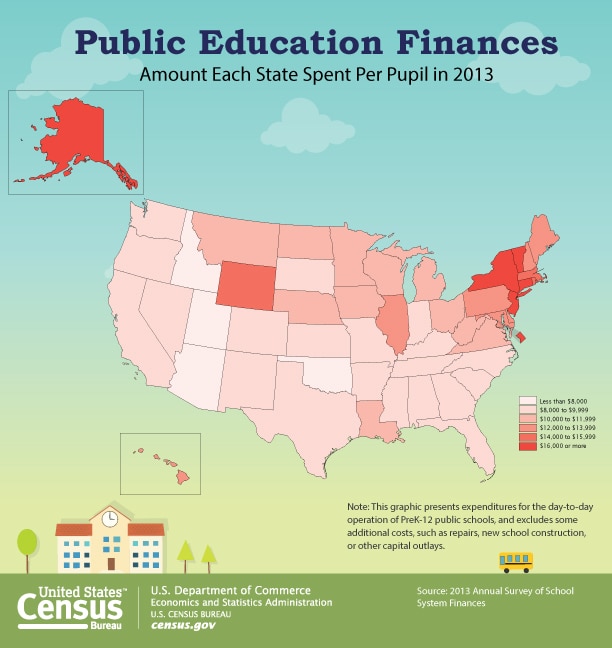
What's rarely definitively discussed in the same context of NJ's excessive taxes is that our education spending is among the country's highest, with only New York State and Alaska outspending us.

Highest Spending States, 2013-14

  1. New York, $20,610 per student
  2. Alaska, $18,416 per student
  3. New Jersey, $17,907 per student
  4. Connecticut, $17,745 per student
  5. Vermont, $16,988 per student
  6. Wyoming, $15,797 per student
  7. Massachusetts, $15,087 per student
  8. Rhode Island, $14,767 per student
  9. New Hampshire, $14,335 per student
  10. Maryland, $14,003 per student
  11. Pennsylvania, $13,961 per student
NJ's exceptionally high spending is even more of a factor in our tax burden when you consider that our peer states in spendding have a higher percentage of school money deriving from non-residential taxpayers.

Alaska has oil revenue and New York State gets $6 billion per year in income taxes paid by commuters who work in New York State but live elsewhere, usually New Jersey.  New Jersey has no equivalent outside source of revenue.

Alaska, Vermont, Wyoming, Rhode Island, and New Hampshire are all small states that receive much larger amounts of federal education aid per student than New Jersey due to the Small-State Minimum in federal aid formulas.  (Indeed, NJ is in DEAD-LAST for the percentage of education spending coming from the federal government, getting only 4.1% of its education spending from the feds, compared to a national average of 9.1%.)

If New Jersey spent as much on K-12 education per pupil as
other high-wealth states, our taxes would be substantially lower.

  • If New Jersey spent as much as Connecticut per student we would $221,839,398 less.
  • If New Jersey spent as much as Massachusetts per student we would spend $3,861,648,780 less.
  • If New Jersey spent as much as Maryland per student we would spend $5,346,055,616 less.
  • If New Jersey spent as much as Pennsylvania per student we would spend $5,403,569,534 less.
(Since NJ had 1,369,379 public school students in 2013, I just multiplied the difference in per pupil spending by 1,369,379.)

It's simple but it's ignored:


New Jersey's Taxes are High Because We Spend A Lot. 
Mostly on Schools.  

Some accounts that recognize that NJ's taxes are high because our spending is high attribute the spending to the seemingly large number of school districts and municipalities in New Jersey, implying that if it weren't for so many districts, Boards of Education, and superintendents our spending and taxes would be normal.

For instance, this NJSpotlight piece titled "Why Property Taxes are So High" by Collean O'Dea blamed the multiplicity of school districts and said that the balance of local funding/state funding for schools was the problem:

Why are taxes so high?
New Jersey relies heavily on the property tax to fund local governments and schools. The tax pays for municipal services -- police, roads and the like. It pays for local and, sometimes, regional public schools. And it pays for county government -- roads, parks, elections and more. Depending on the municipality, there may also be open space, library or fire service taxes. 
Last year, local governments levied more than $27 billion in local property taxes. The bill is so high, in part, because New Jersey is a high-cost state. 
The state has 565 separate municipalities and even more school districts, nearly all of them led by their own administrators and support staff � who are often doing similar jobs in very close proximity. Officials say state mandates add to municipal costs, as well. 
At the same time, exclusive of federal aid, the amount of assistance the state gave to municipalities to defray their expenses represented just 15 percent of total spending,. What�s more, only about one-third of school spending is covered by state aid.
The New Jersey Policy Perspective recently said that NJ's municipal fragmentation caused NJ's high taxes.
There are many explanations for New Jersey�s historically high property taxes such as its population density, the excessive number of municipalities and school districts and its traditions of local control. 
Although I agree that there is some explanatory power in NJ's municipal fragmentation, this frequently-made argument that New Jersey's multiplicity of governmental units causes us to have high taxes is demolished in this Rutgers University Report "Size May Not be the Issue."

First, on a per capita basis, New Jersey is just average for governmental units.
Asking the question about having too many governments from a different perspective may yield an entirely different conclusion. How many �general governments� does New Jersey have on a per capita basis? The answer is: surprisingly few. In fact, New Jersey ranks 34th in the number of general governments per capita. When all �special districts� (fire, water, sewer, and so on) are also considered,New Jersey ranks 36th of the 50 states.
Second, on the NJ municipal level at least, there is no correlation between the size of a locality and its per resident spending.  On the municipal level, the lowest spending towns are actually ones with 3,601- 5,150 residents.
Source: http://assets.njspotlight.com/assets/14/1116/2244, page 25
Note: Jersey Shore resort communities are excluded.
If having fewer and larger localities led to economies of scale, then New Jersey's largest municipalities would have low taxes, but New Jersey's largest suburban towns do not have low taxes (as a general rule).

New Jersey's average equalized all-in tax rate for 2016 is 2.333, but
  • Woodbridge's tax rate is 2.685.  
  • Edison's is 2.193.  
  • Clifton's is 2.984.  
  • Lakewood's is 2.109.  
  • Hamilton's is 2.643.  
  • Cherry Hill's tax rate is 3.384.  
  • Brick, whose schools are overaided and where school spending is below-average, is 2.022.  
Of NJ's largest non-urban towns, only Toms River has significantly below-average taxes, but Toms River's rate is still 1.846, which still very high by US standards.

Yet Toms River is the exception the proves the rule of school spending being central to our high taxes, since Toms River only spends $15,587 per student  (counting pensions + FICA), which is about $3,500 per student below NJ's average.  Toms River's school taxes are only 76% of Local Fair Share.

General Administrative Spending in NJ is 2% of Spending

The theory is that NJ's (seemingly) large number of school districts leading to high taxes is that having a small number of districts leads to inefficient central office administration.

Insofar as New Jersey might have more administrators than states with fewer and larger districts, this theory fails to account for very much of NJ's exceptional tax burden since "General Administration" is only 2% in NJ of district spending.

The US government actually keeps track of administrative spending and the additional spending in New Jersey in the Administration category is not that high.

NJ's administrative spending per student was $367 for general administration in 2013-14.  The national average for general administration was $210.

So NJ is only $157 per student above the national average.  Yet our taxes are more than $5,000 per household above the national average and literally double the national average in terms of tax rate.

If you compare New Jersey's average district spending to national numbers, it's obvious that New Jersey school districts spend more on every category, including the categories that are independent of district size, like "Instructional Salaries" and "Instructional Benefits," ie, "teachers."

Source:
http://www.governing.com/gov-data/education-data/state-education-spending-per-pupil-data.html

Given how low Maryland's administrative spending is ($125 per student), I think there is some truth to the "too many districts, too many administrators" theory, but it is a minor cause of NJ's tax burden.

Not every explanatory article about NJ's obscene property taxes is as bad as that NJSpotlight piece or the New Jersey Policy Perspective's claim.

This piece from the Asbury Park Press, titled "Why are our taxes so high?," has a lot of invaluable information and gets the cause of the property tax crisis partly right, but even it misses the centrality of education spending in NJ's outsize tax burden:

It's no secret that New Jersey is a high-tax state. But few stop to think about the precise reasons why, other than the vague and altogether accurate notion that public employee salaries and benefits are too generous, and that there are too many government workers collecting them. Or that there are two many towns and school districts. Or that the high cost of living here explains why government is so costly....
On the revenue side, the problem lies less with layers of government and excessive numbers of government workers providing services than with the generous salaries and benefits of those who are on the public payroll. Average state worker salaries: highest in the nation. Average teacher salaries: third highest. Public employee health benefit costs: second highest in the nation. 
Yes, the cost of living in New Jersey is high. That is necessarily reflected in public employee salaries and benefits. But New Jersey, which ranks first or second in so many tax and spending categories, has the fourth-highest cost of living in the U.S., behind New York, Hawaii and Alaska. Other states with far lower tax burdens have similarly high costs of living.
Although it's worth pointing out where there exists inefficiency and superfluousness in municipal and county spending (like police officers making $200,000), the fact is that over half of New Jersey's property tax levy - $14.5 billion out of $27.7 billion - is for schools, so inefficiency and superflousness in schools is really what drives New Jersey's extraordinary property taxes.

The Income Tax Reallocation Distraction

Another theory I often see that avoids discussion of spending is that NJ's property taxes are so high because income taxes are too low.  This notion then becomes the premise for an argument for reallocating taxation, where income taxes would rise and property taxes would fall.

Indeed, there are some seemingly cogent arguments for this.

The property tax in New Jersey brings in twice as much revenue as the income tax, so mathematically, reallocation would lower property taxes in the short term. While New Jersey's top bracket, 8.97% on income above $1 million, is the fifth highest in the US for 2017, on low-income earners, NJ rates are low and on middle-income earners NJ rates are only average.

(CA, OR, MN, and IA now have higher top brackets than NJ. Maine was going to have a higher to have a higher bracket through "Question 2," but that was repealed by the legislature and Maine's top bracket is lower than NJ's.)

The problem with this approach is that it isn't a net help for New Jerseyans if they exchange the country's highest property taxes for the country's highest income taxes.  If just half of the $27.7 billion in property taxes were shifted to income taxes, New Jersey's income tax levy would literally double (in FY2016 NJ's income tax brought in $13.8 billion).

If all-in taxes were to drop for middle-income and lower-income New Jerseyans, more money would have to come from the wealthy.

This is an idea I support, but raising the $1,000,000 bracket from 8.97% to 10.75% would only bring in $615 million.  Raising taxes on incomes above $500,000 per year to 10.25% would bring in $155 million.

Combining the two upper-income tax increases would bring in $770 million, which is only 2.7% of NJ's $27.7 billion property tax bill.

Could New Jersey increase taxes exceed 10.75% for $1 million+ incomes in order to produce real property tax relief?  In theory yes, but if the top rate were increased by only 50%, NJ's top bracket would exceed California's 13.3%.  If NJ's top rate were increased by only 10%, we would have the country's third highest top rate.

More importantly, our top rate would easily exceed New York State's 8.82%, Connecticut's 6.99%, and Pennsylvania's 3.07%.  The combined New York State+New York City top bracket is 12.4%, also within reach if NJ attempted a massive property tax/income tax reallocation.

I don't feel sorry for the rich, but the departure of only a small percentage of ultra-high-income individuals is a permanent fiscal risk for New Jersey since the ultra-rich pay so much in NJ income taxes:

One half of one percent of New Jersey taxpayers account for almost a third of income tax revenues, and only 600 filers - many of whom may already have second homes outside of New Jersey - account for about $1.4 billion in income tax payments.
The New Jersey Policy Perspective often points out that despite NJ's income taxes already being very high, the number of high-income filers in New Jersey constantly increases, so, they argue, NJ should not base policy on fears of outmigration.

Ok, point taken, but the New Jersey Policy Perspective does not attempt to evaluate the counterfactual; ie, what New Jersey's population of millionaires would be if our taxes were more moderate.

Also, although NJ's number of high-income filers may constantly increase, New Jersey's top-bracket is barely higher than New York State's.  If the NJ top-bracket were to become substantially higher than New York State's, the constant growth of the millionaire population may slow down or reverse.

Finally, there are two practical problems with relying on income taxes:
  • income tax collections are volatile.
  • income taxes can be evaded and avoided more easily than property taxes.
Tax Reform in New Jersey Can't Ignore the Spending Side

School district/municipal consolidation and shifting more taxation to income taxes are good things on their own merits, but these approaches neglect the real cause of NJ's tax crisis, which is our extraordinarily high spending, particularly on education.

Over the years, NJ has repeatedly tried to supplant property taxes with income tax-derived state aid , but most state aid has always gone to poor towns & districts - leaving the non-poor without much state support. Indeed, the state's attempt to give income tax money to middle-class and affluent districts was ruled unconstitutional by the NJ Supreme Court in 1990 in Abbott II as "counterequalizing."

Not all explanations for why NJ has such high taxes are as bad as the ones that kick off my blog post.

Andrew Sidamon-Eristoff eruditely pins the causation where it belongs here:

At the risk of gross oversimplification, the sum and substance is this: Given New Jersey�s relatively high state and local spending (the latest census figures) suggest that New Jersey�s state and local unit direct spending is approximately 11 percent higher than the national average), the limited revenue-generating capacity of our income tax base, the relative lack of federal revenue supporting local spending, and the fact that fiscal redistribution will always be a higher legal if not political priority, it is highly unlikely that New Jersey�s state government will ever have the discretionary fiscal capacity to meet the rising cost of education and local government, let alone offset the related heavy reliance on property taxes, on anything other than a temporary and unsustainable basis. 
Why does this matter? The systemic overselling of �property tax relief� distorts the public policy debate. We dissipate too much of our political energy arguing over funding levels for local aid and popular direct-benefit programs that have no real impact on property taxes as such, leaving our long-suffering taxpaying public disillusioned and cynical. After decades of hackneyed bipartisan dogma, perhaps it�s time to focus on the only thing that will actually make a real difference to property taxes over time: controlling the cost of education and local government in New Jersey.

This post of mine has clearly targeted spending itself - chiefly for education - as the cause of NJ's extraordinary tax burden, but, IT'S OUR OWN FAULT.

If New Jerseyans really wanted lower taxes, they would vote in anti-tax politicians, but New Jerseyans almost never do this, hence Democratic domination of the legislature, many town councils, and, off-and-on, the governorship.

If the majority of New Jerseyans wanted lower taxes, they would vote for politicians who want that too.

New Jersey is a democracy and at a certain point the voters themselves are accountable.


---

Update, New Jersey's school spending is also the second highest in the United States as a percentage of state GDP:

Source: Education Law Center/Rutgers Graduate School of Education
https://drive.google.com/file/d/0BxtYmwryVI00VDhjRGlDOUh3VE0/view