Showing posts with label NJEA. Show all posts

Monday, December 11, 2017

Seven State Aid Predictions for the Murphy Era


New Jersey is only one month away from the inauguration of Phil Murphy as governor. 

Murphy has never held elective office before and he typically avoided talking about the details of state aid during most of the campaign.

Most of Murphy's opinions on the details of SFRA are unknown.  Murphy has said he supports "tweaks" to SFRA, but never explained what that means.

However, the stances of people in Murphy's circle, like Sheila Oliver, as well as constituencies within the Democratic Party, are known.

My predictions are based on what Democratic constituencies and Sheila Oliver have said.


Prediction 1: $200-$300 million in Adjustment Aid will be redistributed. 

Basis: Phil Murphy said this at a town hall in Maplewood, NJ and again in a televised forum with Tom Moran. It is budgetarily necessary as well.

  • Sub-conjecture: There will be some complex mechanism of cutting Adjustment Aid. The districts to lose Adjustment Aid will be ones who are above Adequacy and/or severely under Local Fair Share.
  • Basis for Belief: The Education Law Center, which is NJEA funded, only (with extreme reluctance) accepts the loss of Adjustment Aid to above Adequacy districts.  Politically it will be necessary to cut Jersey City's state aid, since it taxes at one-third of Local Fair Share, but is below Adequacy.  
A few Adjustment Aid districts do not have the capacity to pay higher taxes and East Orange is one of them (the EOPS is overaided by $22.5 million, but the town has a 4.638 all-in tax rate, so making up that money will local taxes would be impossible). East Orange is Sheila Oliver's home.

The Education Law Center only wants districts that are below Adequacy to receive additional state aid "State aid increases must be directed to under adequacy districts" but this is such an extreme stance and contrary to what the legislature will want that I don't see Murphy completely denying over-Adequacy districts.

On the other hand, I would not be surprised if under-Adequacy districts get larger percentage state aid increases, which is what SFRA already calls for.  Underaided districts that are nonetheless above Adequacy due to their own high taxes, like Cherry Hill and West Orange, may not receive very much new aid.

Prediction 2: The Distribution PILOT Revenue Will be Changed So that the Money is Apportioned in the Same Way Regular Taxes Are:

Basis: This is something Steve Sweeney wants to see happen, it is something many Republicans (like Mike Doherty) want to see happen, and there isn't anyone visibly opposing this change. Even Steve Fulop of Jersey City is willing to let the Jersey City public schools have 10% of PILOT revenue (instead of 25% of regular taxes)

NJ's Urban Mayors Association met in November 2017 and endorsed this.

At present, 95% of PILOT revenue is given to the municipality and 5% goes to the county.  The local public schools get 0%.


Prediction 3: There will be an Attempt to Reduce Local Fair Share for Districts with High Municipal Taxes:

Basis: It makes fiscal sense, it would satisfy the powerful urban constituency within the Democratic Party, and it an Education Law Center demand.

EG, here is the Education Law Center's demand "Lawmakers must consider providing relief for school districts facing municipal overburden. These districts have high tax rates, but low rates of local school funding due to the high costs of other municipal obligations."

I agree that some urban districts have municipal taxes that are too high to allow them to meet their Local Fair Shares. New Jersey's average municipal tax rate is 0.694, but Newark's muni rate is 1.642, Trenton's is
A town like East Orange cannot pay
its full Local Fair Share.
3.329, Paterson's is 2.578, Elizabeth's is 2.206. East Orange's muni rate is 3.353, which is one of the highest in New Jersey.

It isn't a surprise then that these districts have school taxes that are so far below Local Fair Share. Newark's tax levy is $45 million below LFS, Trenton's tax levy is $16 million below LFS, Paterson's is $51 million below LFS, Elizabeth's is $36 million below LFS, East Orange's is $20 million below LFS.

IMO, factoring in municipal tax rate into the calculation of Local Fair Share would create an incentive to have high muni tax rates.  A fairer solution would be to condition Local Fair Share on a place having a low-income, since that is outside the control of politicians.

Prediction 4: The state will increase its reimbursement of districts for their charter students.

Basis:   Sheila Oliver does not like the principle of "money following the child" and neither does the NJEA.

In August 2017  at a forum with Randi Weingarten of the AFT Oliver said:
Oliver reaffirmed her support for [traditional] public schools. 
�The expansion and growth of charter schools has hurt our public schools,� she said. �We will make sure that our public schools will be front and center on our agenda.� 
Oliver said that although she embraces all kinds of schools, funds should not be diverted away from public education. 
�We can�t take funds out of district budgets to support them," she said.

If "we can't take funds out of district budgets to support" charters, then charters ought not to exist or districts should be double-funded for charter students.

Oliver has also said "What I am vehemently opposed to is using the money that goes to our public school system to support charters."

The NJEA does not appear to want "money to follow the child" either.  If a child goes to a charter school, the NJEA wants at least a portion of that money to stay in the residential district.

The NJEA has been a little more vague though, but it has demanded some change.

�NJEA has consistently supported the proposal by Assembly Speaker Vincent Prieto to gather the appropriate stakeholders to develop a plan to transition back to the current funding formula. In addition, we have called for that group to study the funding mechanism for charter schools, as the current mechanism is causing drastic program cuts in the districts from which charters draw their students.
And:
New Jersey should follow a similarly thoughtful and deliberative process for reviewing the current aid formula and recommending reasonable adjustments. That should include an honest look at the adverse financial impact that charter schools have on host district schools and ways to alleviate that harm.

Even the Christie administration has sent extra state aid to districts with growing charter school populations through a unilaterally-created aid stream called "Host District Stabilization Aid," a $27,653,005 expense for 2017-18.

If funds aren't leaving district budgets for charters, then the students have to be kept in districts or the state has to reimburse districts for their charter transfers.

It's also possible that we will see the Department of Education give money directly to charter schools rather than route that money through local school districts.  This might relieve some tension between traditional public schools and charters, but it would be a gimmick in terms of any real budgetary assistance since now school districts would have less money to begin with.

Prediction 5: SFRA will move away from the Census-weighting for Special Education Students in the Calculation of Equalization Aid.

Basis for Belief: It's superficially common sense. Even some politicians already want to do it.

It's a benign demand by the NJEA:

Blistan also highlighted the plan�s commitment to providing relief to districts that have been harmed by the current approach to special education funding. 'Districts should be not be punished for providing students with the special education resources they need. This approach will bring fairness to districts while continuing to meet the needs of students,' said Blistan, who is also a special education resource center teacher in Washington Township.
At present, NJ assumes that every district has 14.69% of its students classified, when everyone knows that classification rate would vary, like all populations vary.

The Department of Education opposed using Census weighting during the Corzine years and Christie years for seemingly sincere reasons, but that may change under Murphy.

Unfortunately, changing the calculation of Adequacy Budgets in Equalization Aid is meaningless as long as the overall distribution is out-of-whack and the state cannot come up with the additional money to fund it.

So this is like renovating the kitchen in a house that is falling into a sinkhole anyway.  

Prediction 6:  There will be a Loosening of the Tax Cap

Basis: Steve Sweeney's state aid reform commission proposed some amendment to the cap, presumably to allow aid-losing districts to tap their tax bases.

The NJSBA supports loosening the cap to allow automatic tax authority to districts with high Out of District tuition costs.

Prediction 7: The State will Expand PreK Disproportionately

Basis: It's something the Democrats all say they want to do and there are well-funded lobbies in place to support PreK expansion, with support from VIPs like Jim Florio and Tom Kean.  From 2011-2016 basically all Democrats in the legislature were more interested in PreK than K-12. 
In a Zero-Sum Budget Enrivonrment, PreK Expansion
Comes at the Expense of Everything
Else

Although Steve Sweeney is more sensitive to New Jersey's tax stress and indebtedness than most other Democrats, PreK expansion is something he strongly supports nonetheless.

I say the PreK increases will be "disproportionate" because the increases will be much larger percentage-wise for PreK than K-12 education.  NJ's PreK funding was going to be $655 million for FY2018, but the legislative Democrats got it a $25 million increase, or 3.8%.  The legislature's (net) last-minute increase for K-12 aid and Extraordinary Aid was only $125 million, a 1.6% increase.
The Wild Cards

1.  The Republican tax plan.
If the SALT deduction is capped at $10,000 per taxpayer and the Mortgage Interest Deduction is capped at $500,000, real estate values in middle-class and affluent suburbs will decline by perhaps as much as 10%.  

If real estate values fall, then it would reduce those towns' Local Fair Shares and SFRA would, in theory, send them more Equalization Aid.

NJ already has a severe outmigration problem and its suburbs are already in decline, but the capping of the SALT deduction would likely accelerate those trends.


2. The Janus decision

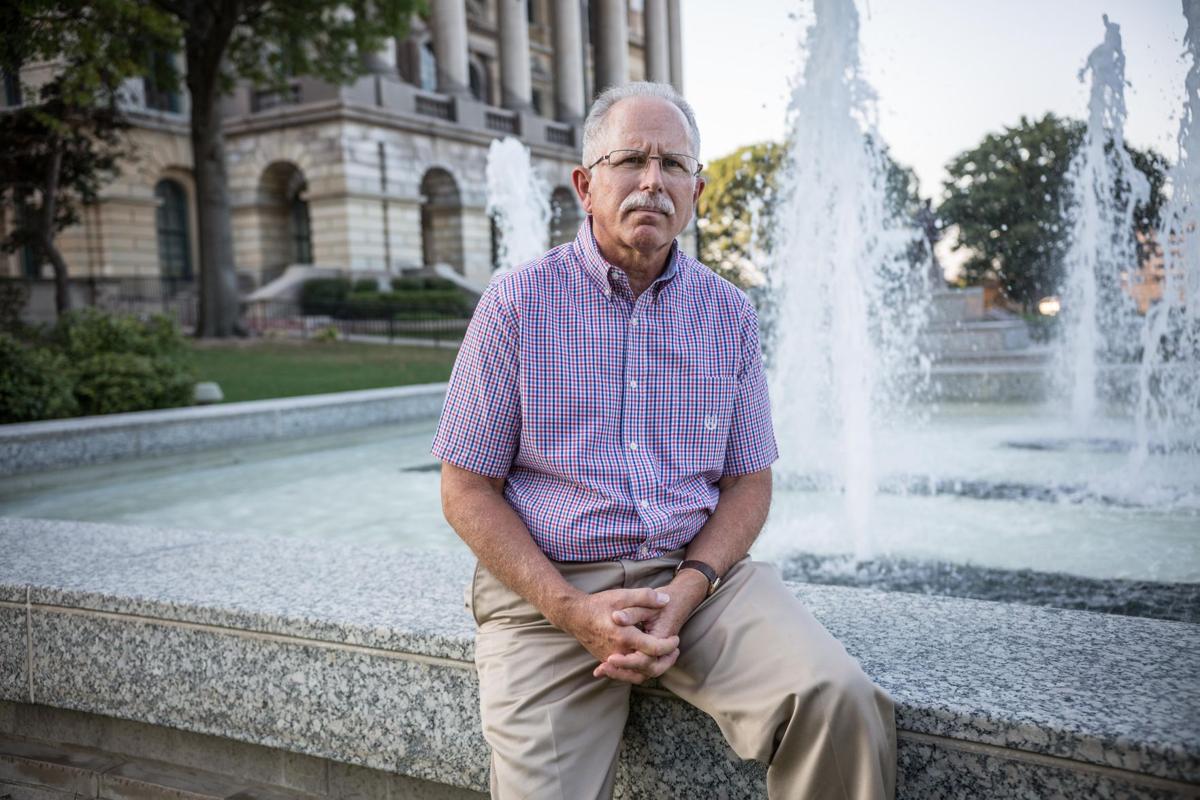
Mark Janus, Illinois Child Care Specialist &
Petitioner in Janus v AFSCME
In June 2018 the United States Supreme Court is expected to rule that mandatory agency fees for public workers are unconstitutional as "compelled speech" and a violation of the principle of free association.

This means that NJ's public sector will become right-to-work and the 20-30% of teachers and other staff who are discontented with the NJEA can stop paying dues. At a 30% dropoff, that would mean a loss of $40 million out of the NJEA's $140 million budget. (see this for NEA affiliate financial resources)


Since NJEA dues will now be voluntary, the NJEA will have to invest more of its remaining money into membership retention and keep dues lower so that more members do not quit. At present NJEA state-dues are $897 per full-time teacher, plus a few hundred dollars more for the national organization, county organization, and local organization.

The NJEA will still be very powerful even if 30% of members leave, but it will not be colossus it is now and the Democrats may have more latitude to side with taxpayers and not the NJEA and other unions.

Tuesday, May 30, 2017

Minority, Liberal Groups Defense of Prieto Shows NJEA Power

As the chances of Vincent Prieto being toppled as Assembly Speaker by Craig Coughlin start to look real, various minority and liberal groups are now demanding that Prieto be kept as Speaker because Prieto is Latino.
Why is No One Saying that Vincent Prieto
is white?

Never mind that Prieto is looks totally white to me, and he is an admitted male, the following minority groups are denouncing any attempt to remove him as Speaker.  


A coalition of liberal groups spoke out in support of Assembly Speaker Vincent Prieto on Tuesday, arguing that Democrats need more diverse leaders in New Jersey and that ousting Prieto from the speakership would remove the only minority official with real clout in Trenton. 
Prieto (D-Hudson), who hails from Cuba, has announced he�s seeking a third term as speaker after the November elections. But a challenger, Assemblyman Craig Coughlin (D-Middlesex), has the edge right now and appears on track to defeat Prieto if Democrats perform as expected in races for all 80 Assembly seats this fall. 
Coughlin is of Irish heritage, as is Senate President Steve Sweeney (D-Gloucester), who has the votes for another term as the leader of the upper house. And the front-runner for the Democratic gubernatorial nomination is Phil Murphy, a former U.S. ambassador who also comes from Irish stock. 
�The time of counting on the support of diverse communities in order to win an election but completely ignore it when it matters is over in New Jersey,� said Chris Estevez, president of the Latino Action Network. �Our demand is simple, take us into account or lose our support when it counts.� 
�We reject a system that produces homogenous leadership and targets the one diverse member in a leadership body created to represent the voices and interests of diverse constituents,� said William Colon, head of the Latino Institute... 
�Our state is in crisis and those at the helm are sadly unfocused, unperturbed and seemingly unconcerned,� said Richard Smith, president of the New Jersey NAACP. �We stand united in the demand that our leaders not only represent our interests, they represent the broad diversity of our state in both makeup and progressive values.� 
Analilia Mejia, director of the New Jersey Working Families Alliance, said �the rest of the state has looked in horror at the push to roll back health care coverage� in Washington while in New Jersey �mostly white and mostly male �leaders� have been busy dividing up Senate and Assembly leadership in order to oust the one person of color in one of the most diverse states in the nation.� 
Prieto said he was heartened by the support and added that the state�s leadership �should reflect the multitude of people who make New Jersey such a vibrant and exciting place.�

What's really going on here is that these groups speaking up for Prieto are all NJEA funded and the NJEA is pulling in some favors, since the NJEA wants Prieto to stay in power due to Prieto's opposition to redistributing state aid.

For 2014, the most recent year available, the NJEA gave the Latino Institute $200,000, the NAACP $10,750, and Working Families United $10,000.

http://www.guidestar.org/FinDocuments/2014/210/524/2014-210524390-0ba0fa83-9O.pdf

What's most troubling is that the Latino Institutute is opposing the interests of most New Jersey Latinos, since most of New Jersey's most underaided districts are heavily Latino.  An injustice to non-Abbotts even Bruce Baker recognizes.

While the teacher unions have a great deal of power through their lobbying, political donations, advertising campaigns, and superPACs, it's underappreciated how much power they have through their largesse towards liberal and minority "activist" groups and think-tanks.  

The NAACP, Latino Institute, and Working Families United purport to speak for hundreds of thousands of people and thus have prominent voices.  In getting them to line up behind a state aid status quo Assembly Speaker, the NJEA is exercising a power that few realize it even has.

---

See Education Next's "The Long Reach of the Teachers Unions." 

Sunday, March 26, 2017

Why NJ Can't Wait Until the Next Governor to Change State Aid

NJEA President, Wendell Steinhauer

After it became public that Chris Christie, Steve Sweeney, and Vincent Prieto were having some private conversations about state aid reform - and had actually would have met on Wednesday, March 15th if a snowstorm hadn't intervened - NJEA President Wendell Steinhauer released an op-ed demanding that any changes to state aid wait until New Jersey's next governor takes power.

Here are the most important parts of "Leave School Funding to the Next Governor":


Now the same governor who robbed public schools of $8 billion over seven years wants to move at break-neck speed to blow up SFRA, which is New Jersey's best hope for restoring fairness and adequacy to school funding. 
Here's why that should not happen under this governor.....
The governor is now audaciously using his neglect of SFRA to say we need a new formula. We don't. We need a transition back to the sound funding formula we have.

That's not something the governor and legislative leaders should cook up in a back room over the next 100 days -- as the governor has suggested. ... 
New Jersey should follow a similarly thoughtful and deliberative process for reviewing the current aid formula and recommending reasonable adjustments. That should include an honest look at the adverse financial impact that charter schools have on host district schools and ways to alleviate that harm. It must also create a pathway back to implementation and full funding of SFRA. 
We should not abandon the notion of a formula, as Christie has proposed, or pit students and communities against each other in a fight over inadequate resources, as some other funding "reform" proposals being floated would do. Instead, we must live up to the promise of SFRA to provide every student in every community the resources needed for the thorough and efficient public education our constitution promises.

There are several parts of this I disagree with (and think are factually wrong), but I'll focus on Steinhauer's major point that we must wait until 2018 (at the earliest) to address school funding.


  1. The FY2018 budget process is not completed, so it is possible that a deal made now could mean help for certain districts 2017-18.
  2. If we wait until winter 2018 and the new governor  it's possible that new aid could be distributed fairly, but even if the new governor were inclined to accept some redistribution, it would already be too late for redistribution for the 2018-19 school year since the aid-losing districts would have so little time to prepare.
  3. There is no guarantee that Steve Sweeney will remain as Senate President after this year and his replacement might not prioritize state aid as much, might support Adjustment Aid, or might not understand the problems of SFRA as well.


Don't Give Up on 2017-18 Yet (or 2018-19 either)

I agree with Steinhauer that Chris Christie has been a bad for New Jersey and state aid.  He's been a disaster in progressive terms for ignoring districts in acute financial need; he's been a disaster in conservative terms by making no attempt to update the Abbott list or pare back the most extreme Abbott privileges, like the lack of means-testing for PreK and 100% state construction funding.

Yet, it would be a huge mistake for New Jersey to miss this chance at reform.

Steinhauer is rejecting sight-unseen a proposal that doesn't even exist.  It's possible that Christie will follow his recent (post June 2016) history and dig his heels in for something like his "Fairness Formula," but if that's the case, why worry? since Sweeney, Prieto, and the legislature would never agree to that.

Christie cannot "blow up SFRA" unilaterally and Steinhauer knows it.

Although Christie has been at his worse on state aid since June 2016, previously Christie was more erratic, even good at times.  When Christie rebuilt school aid after the 2010 aid cuts he basically followed SFRA's principles.  In 2012 Christie's Department of Education actually endorsed halving Adjustment Aid for districts that are above Adequacy and for 2012-13 Christie actually did redistribute $40 million in Adjustment aid.  In the 2016 Education Adequacy Report, Christie's Department of Education recommended lowering the weights for at-risk students, but it did not remotely suggest that all districts have equal spending or equal state aid.

In 2016 Christie also came through for Freehold Boro and had his DOE agree to give $25 million for expansion costs, even though as a non-Abbott Freehold Boro had no legal standing to demand this money.

I'm not letting Christie off the hook.  His method of cuts in 2010 - in which every district lost aid equivalent to 5% of its budget regardless of it being overaided or underaided - is unforgivable.  Christie's refusal to redistribute aid for the 2016-17 and 2017-18 aid cycles is terrible too, since there was legislative support for doing so.


So Christie is terrible overall, but there are glimpses of common sense in his record too. Christie-Sweeney-Prieto process should be given a chance to produce something decent.  If they can't agree or their proposal is bad, reject it, but don't reject something that doesn't yet exist.


So what's Steinhauer's real worry?  And what should our worry be about waiting until 2018?

First, Steinhauer hates Steve Sweeney in the first place over Sweeney's support for pension reform, but second, his policy worry is that Christie will agree with Sweeney to cut Adjustment Aid and then pressure Vincent Prieto to go along.

 The NJEA is strongly against cutting Adjustment Aid, denouncing the concept as "divisive" and that would "pit students and communities against each other in a fight over inadequate resources."

The NJEA, rather than seeing the stark differences between Sweeney's proposal and Christie's "Fairness Formula," see's Sweeney's proposal as "the lesser of two evils."

[NJEA Vice President] Blistan criticized two competing school funding proposals, one from Gov. Christie and one from Senate President Steve Sweeney that purport to address problems with school funding. Both proposals would reduce funding to hundreds of thousands of students. While Christie�s proposal is more draconian, Sweeney�s would reduce aid to approximately 715,000 students across the state. Both proposals would pit communities against each other and reduce funding too. Blistan was adamant that �choosing the lesser of two evils is not acceptable here.� She urged legislators to support a proposal championed by Assembly Speaker Vincent Prieto that would preserve the existing formula while also studying it to determine where it could be more effective.

The NJEA also gives the Education Law Center a third of its funding too and has two members on the ELC's board, so the ELC's staunch opposition to cutting Adjustment Aid must also be interpretted as an NJEA stance.

So the NJEA is against reform too, even though it screws over the majority of NJEA affiliates and NJEA members who live in underaided districts.

Although it's difficult to make predictions for what Christie, Sweeney, & Prieto might actually agree on, we cannot afford to reject a proposal that hasn't even been made and that we are months away from even seeing.

Perhaps my optimism dies hard, but part of a deal could be an increase in K-12 aid for 2017-18 and that money could be channeled through a formula and go where it's needed most.

And even if there is no help for 2017-18, I want a fair framework in place for 2018-19.

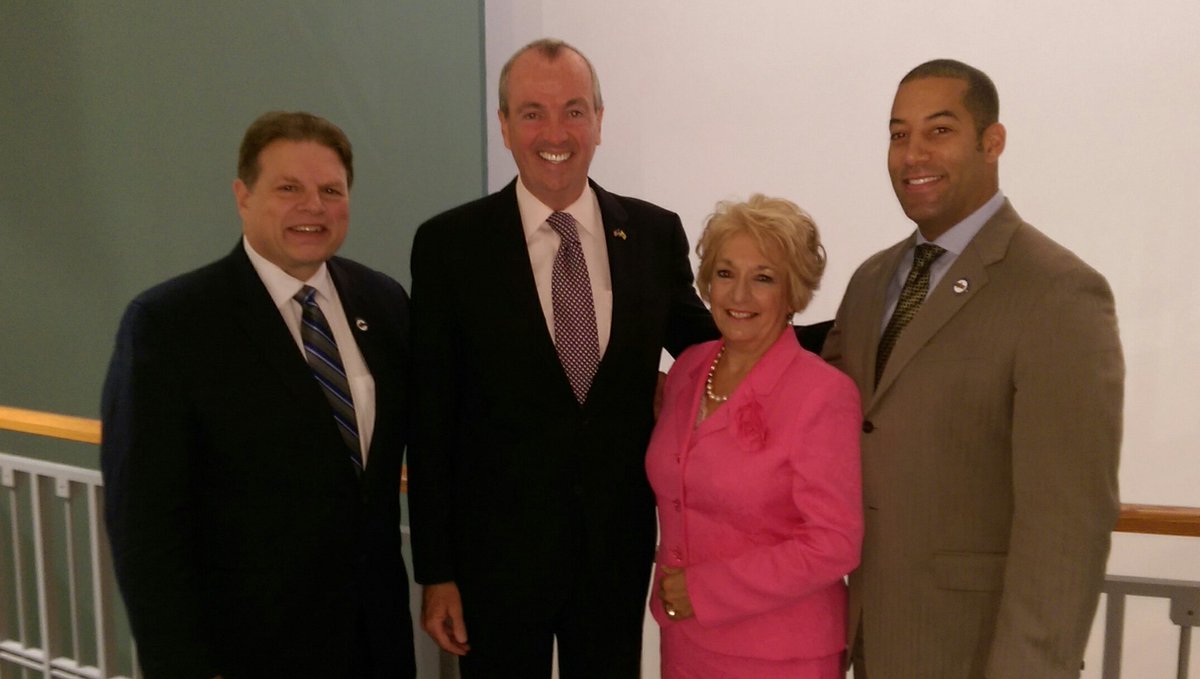
Murphy with NJEA Leadership
2.  Phil Murphy is a Utopian, Not a Realist

Murphy rarely talks about state  and when he does, he shows no emotional feeling about how bad the crises are in many districts, even though Murphy strongly reacts against most of Christie's other misdeeds and accuses Christie of quite a bit Christie isn't responsible for.

Murphy also says inaccurate things about how SFRA even works, like a claim that it has extra weights for kids from single-parent families.  Like the NJEA, he also uses the misleading Capped Aid deficit, which is $1 billion instead of $2 billion.

In his August 2016 interview with Larry Mendte, Murphy refused two point-blank questions on whether or not he would redistribute aid and more recently in Murphy's endorsement of Steve Sweeney for the LD-3 Senate seat, he did not endorse Sweeney's Senate Presidency, nor did he mention state aid as something that he and Sweeney had in common.

I am pleased to endorse Senator Sweeney for re-election, and look forward to running together on a platform of growing our middle class and creating a new economy based on innovation, good-paying jobs, and fairness for workers � including equal pay for equal work.

Steve and I share many of the same goals for the years ahead: raising the minimum wage, repairing our dangerously outdated infrastructure, creating �green� jobs in the alternative energy field, and fully funding Planned Parenthood and ending Chris Christie�s politically motivated war on women.

I look forward to working with Steve to make New Jersey a state that once again works for all of us.�
The fact that Murphy doesn't mention what has become Sweeney's signature issue is very revealing in my opinion.  Murphy could change, but so far, everything indicates that Murphy will defer to the NJEA on funding and preserve aid hoarding.

I'm sure that the most severely underaided districts would benefit under Murphy, but since NJ is not going to have the (at least) $2 billion it would take to fully fund SFRA, that means that NJ will still have a situation where districts get 150%, 200%, even 1000% of what they are supposed to get while others are significantly underfunded.

3.  Sweeney May Not Remain Senate President

We in the general public never really find out how someone becomes a legislative leader or how much longer someone will be in that post, but various NJ political websites like PolitickerNJ do speculate that Sweeney could be forced out of the Senate Presidency.

The NJEA is openly vowing that it will do everything in its power to defeat Steve Sweeney for the Senate, or failing that, as Senate President:

�We�re looking for a new governor and a new Senate president,�

For the last two years Steve Sweeney has been, without peer, the state's #1 champion for fair aid.  Our movement has no money behind it, nor any institutional support like from the NJ Policy Perspective.  The NJ School Boards Association is neutral and the Garden State Coalition of Schools is ineffective.  The Superintendents Association, led by Patrick Fletcher and Ken Greene, has been very vocal, but other than them, it's just Steve Sweeney.

It's possible that the next Senate President could also be in support of reform.  Paul Sarlo is sometimes spoken of as a Sweeney successor and Sarlo is quite good on aid.

By the same token , Vincent Prieto could be forced out too and be replaced by someone with whom Steve Fulop doesn't have "significant clout" too.

And although Phil Murphy is the frontrunner and has bottomless money plus affability, he might be defeated too and a strong reformer like Jack Ciattarelli could be elected. 

HOWEVER, there is no guarantee that either of the next Senate and Assembly leaders will support aid reform and might instead be perfectly content to allow Jersey City, Hoboken, Asbury Park's etc aid hoarding to continue forever.  They might be inclined to go along with the NJEA and double-fund districts for charter students as well, which would subtract from the aid available to other districts.

And even if the next leaders do favor reform, they might not prioritize it.

Chris Christie has already said that he has burned Steinhauer's editorial.  Let's hope that he, Sweeney, and Prieto can work out a fair plan because right now that's the only hope we've got.  

Tuesday, March 21, 2017

Phil Murphy Stuck on Repeat Mode


Phil Murphy has done an interview with Steve Adubato in which he again got a question about state aid and again failed to answer the question in any substantive, accurate way.  I do recommend you watch the interview, but if you don't have the time, don't worry about it, because Murphy gives the same exact substance-free answer on state aid he gave to interviewer Larry Mendte back in August 2016.

Larry Mendte had framed his state aid question to Phil Murphy in terms of "districts
being overfunded or underfunded with no rhyme or reason."  Steve Adubato framed his state aid question with a specific query about the problems non-Abbotts have, and referred to the fact that residents are often badly overtaxed and cannot stay in their homes.

Murphy's answer isn't just a rerun of his Larry Mendte answer, it's internally repetitive itself.

From 4:15.
Murphy: The good news is thank God the governor abandoned his so-called Fairness Formula. Which is the ultimate us-versus-them proposal. 
The bad news is we have a funding formula. It was blessed by our Supreme Court, it�s the only formula that has been Blessed. It was a national model... I want to go back and fund that formula.


This governor has under by over $8 billion. It�ll be over $9 billion by the time he he leaves. Let�s fund the formula.


If we fund the formula which again was viewed to be one of the most innovative formulas in the country. If we fund that formula and get our priorities straight again we find our way to answering the question you�ve asked.

Adubato: You�re convinced the funding formula as it exists makes sense. It�s a good plan?

Murphy: It�s a good plan. It needs to be updated.

It was blessed in 2008 and it�s never been funded.
Murphy three times praises "the formula" and three times says he will "fund the formula."  He makes zero references to where he would get the money to do this from and without acknowledging any flaws that might exist in the formula.

Murphy does, implicitly, give the amount he thinks is the deficit when he says that the formula has been underfunded by $1 billion a year by Chris Christie. That $1 billion deficit is accurate only so far as Capped Aid is concerned, but Capped Aid is an arbitrary, artificial, and yet statutory funding target that limits a district's aid growth to 10% or 20% of what it got in 2007-08.  The real full funding of SFRA is Uncapped Aid and for 2016-17 alone, the 379 underaided districts had a deficit of $1.93 billion.

(See "Phil Murphy Doesn't Understand State Aid")

Murphy does say that some "updates" are needed, which is a replay of his state aid statement at the NJEA conference when he said that some "tweaks" were needed to the formula.

Like in the Larry Mendte interview, Murphy gives the same inaccurate description of how SFRA works, claiming that it gives more money to districts with more single-parent households (it doesn't) and more money to districts with more special ed kids (it doesn't because SFRA assumes all districts have the same percentage of kids in special ed.).

Unfortunately Adubato didn't ask a follow-up question on aid per se, but he did ask questions about how Murphy would pay for his agenda in general, to which Murphy answered he would increase taxes on millionaires, cut hedge fund investments, and also a vague "you prioritize."

Sure.  New Jersey can prioritize, but the problem for us is that Murphy's priority isn't K-12 aid.  His priority seems to be pensions and post-retirement healthcare, and then transportation and a slew of initiatives including loan forgiveness for STEM majors, a child care tax credit, an increased senior property tax rebate, affordable housing, and grants for high-tech.  Within education, Murphy mentions PreK and higher ed far more than he mentions K-12.

Since the pension deficit alone is $2.5 billion for FY2018, the question for Murphy has to be "IF YOU DO NOT REDISTRIBUTE ADJUSTMENT AID, WHERE THE HELL ARE YOU GETTING THIS MONEY?"

NJ needs to increase taxes on high-earners and Murphy supports this, but if the income tax for people making more than $1 million a year is raised to 10.75% it still only brings in $600 million.

Phil Murphy implicitly indicated in the Larry Mendte interview that he would not redistribute Adjustment Aid and Phil Murphy has given clearer indications of his support for aid hoarding and his differences with Steve Sweeney:

Phil Murphy, ever a pragmatic politician, did quietly endorse Steve Sweeney for the State Senate on March 20th, but in his endorsement, Murphy did NOT mention state aid reform as an issue they had in common:

I am pleased to endorse Senator Sweeney for re-election, and look forward to running together on a platform of growing our middle class and creating a new economy based on innovation, good-paying jobs, and fairness for workers � including equal pay for equal work. 
Steve and I share many of the same goals for the years ahead: raising the minimum wage, repairing our dangerously outdated infrastructure, creating �green� jobs in the alternative energy field, and fully funding Planned Parenthood and ending Chris Christie�s politically motivated war on women. 
I look forward to working with Steve to make New Jersey a state that once again works for all of us.�
State aid reform has become Steve Sweeney's signature issue and Phil Murphy doesn't mention it. The question has to be "why?"

In September 2016, after the State Auditor came out with a blistering report condemning the unfairness of the state aid distribution, Murphy was similarly SILENT.

Yet, whenever any other example of Christie-misgovernment comes up, Murphy condemns it immediately:
Murphy isn't wrong about public transit, but when there are ZERO equivalent statements from him on state aid he shows he doesn't consider state aid that important.
 
Phil Murphy has never retweeted a state aid editorial by Steve Sweeney, but Phil Murphy retweeted


on March 21 a (significantly inaccurate) state aid editorial written by NJEA president Wendell Steinhauer which demanded that New Jersey wait until the next governor to change anything about state aid, demanded that charter school funding be part of any change, and which criticized Steve Sweeney's aid proposal as something that "pit students and communities against each other in a fight over inadequate resources."

A retweet does not imply that the person retweeting the statement agrees with everything he or she is retweeting, but when Phil Murphy rarely mentions state aid at all, never talks specifics, repeatedly gives inaccurate depictions of how SFRA is supposed to work, doesn't know what the real funding deficit is, never shows any emotion about the disasters occurring in districts like Bayonne, Freehold Boro, Egg Harbor Township, Chesterfield, Paterson, and has never shown any disagreement with the NJEA, my belief that Phil Murphy will not do the right and fair things on state aid.


I don't want this blog post to be entirely negative.  Jack Ciattarelli (who actually is a public school parent) also did an interview with Steve Adubato and, in a very short space of time, laid out a comprehensive, realistic vision for state aid. Unlike Murphy, Ciattarelli talked specifics and even used terms like "Adjustment Aid," "Local Fair Share," "Adequacy," and "PILOTs."  See Minute 4:55.

Although in that Adubato interview Ciattarelli doesn't give any examples of school districts facing crisis, he has done so on numerous other occasions, and the districts he mentions aren't Republican bastions for whom Ciattarelli is trolling for votes from.

So, if state aid is your priority issue, the best candidate appears to be running on the Republican side.

-------

See Also:

See Also:

Bury Pensions take on Phil Murphy's vapidity.

Sunday, January 29, 2017

The NJEA is Against Reform Too


The NJEA Opposes Reform Too.

On this blog, I've repeatedly criticized Vincent Prieto for betraying his own  severely underaided constituents by blocking state aid reform.  I've criticized Phil Murphy repeatedly too for his deafening indifference to state aid reform.

Prieto's real reasons for opposing reform aren't public, but much evidence points to Prieto's relationship with Jersey City Mayor Steve Fulop.

Fulop, who showed his hostility to fair taxation through his strenuous and years-long opposition to a desperately-needed property tax reval for Jersey City, openly brags "I have significant clout with Speaker Prieto," repeatedly dismisses the significance of state aid reform and has confidently said "there's a long road" before any loss of Jersey City's state aid happens.

Insiders have reported to me that Fulop sees the potential of aid losses for Jersey City as intended to "hurt" hims personally and Jersey City as a whole.  As his opposition to a reval showed his lack of concern for working class parts of Jersey City, he has an even less of a concern for school children who live outside of his Gold Coast Abbott bubble.

Fulop's belief that aid reform is intended to hurt him personally is a strange belief for an informed New Jerseyan to have, but then again, Steve Fulop also said that the push for a property tax reval in Jersey City was "motivated purely by hatred for me," so Fulop's reasoning is more self-centered than a normal person's would be.

Not every Jersey City politician (and resident) is as bad as Steve Fulop is.  Jersey City's state senators, Sandra Cunningham and Brian Stack, appear to accept reform, but Steve Fulop and his clique certainly are absolutely indifferent to any taxpayer or student who lives outside of Jersey City.

I focus on Jersey City's role in opposition to state aid reform because it is so much more powerful than any other overaided district.  Other overaided districts are in the same legislative districts as underaided districts and so their opposition is neutralized.  For instance, Asbury Park is in the same legislative district as Freehold Boro and Red Bank Boro, and so Asbury Park's three representatives (Sen. Jennifer Beck, Asm. Eric Hougtaling and Asw. Joann Downey) are strongly pro-reform.  Pemberton has even publicly accepted state aid redistribution.

HOWEVER, Steve Fulop isn't the only special interest Vincent Prieto is listening to.

New Jersey's most powerful lobby, the NJEA, is also against reform and is making that opposition clearer.  The NJEA's opposition to aid reform goes back decades; the NJEA originally opposed the aid increases+redistribution that Jim Florio wanted as part of Abbott implementation in the early 1990s.

Since Steve Sweeney started fighting for reform, the NJEA has been conspicuously absent from the struggle for fairness, even though it would benefit tens of thousands of teachers in underaided districts.

The NJEA already called the concept of state aid redistribution "divisive" but at last week's legislative hearings on state aid, it put its power firmly against reform and for Vincent Prieto's nebulous plan for another committee.


NJEA Vice President Marie Blistan today called on members of the Joint Committee on Public Schools to commit to fully funding the state�s existing school funding formula, known as SFRA. She pointed out that since 2010, SFRA has been underfunded by approximately $1 billion per year by the Christie Administration. As a result, school funding across the state has been distorted, leading to what she called �gross inequities� among districts. 
Blistan also noted that it is incorrect to say that the SFRA formula itself is the problem, because it has been neglected for so long. She told legislators that talk about how to �fix� the formula is a diversion, because the real problem is that it�s never been funded. 
Blistan criticized two competing school funding proposals, one from Gov. Christie and one from Senate President Steve Sweeney that purport to address problems with school funding. Both proposals would reduce funding to hundreds of thousands of students. While Christie�s proposal is more draconian, Sweeney�s would reduce aid to approximately 715,000 students across the state. Both proposals would pit communities against each other and reduce funding too. Blistan was adamant that �choosing the lesser of two evils is not acceptable here.� She urged legislators to support a proposal championed by Assembly Speaker Vincent Prieto that would preserve the existing formula while also studying it to determine where it could be more effective.
What the NJEA should be doing is supporting reform, but also favoring an amendment to the tax cap law so that the BOEs of aid-losing districts have the automatic power to raise their tax levies without a referendum to make up for lost aid.   This provision is already in Steve Sweeney's state aid reform bill, but the NJEA ignores it.

As usual, the NJEA demanded that the state change charter school funding and impose a moratorium on charter school expansions and approvals.
Blistan also called on the legislators to recognize the need to address charter school issues in any examination of school funding, calling for much greater transparency in how they report their finances. �Charter schools were never intended to create a separate system,� Blistan told legislators. She reiterated NJEA�s call for a moratorium on charter school approvals and expansions until a full study of New Jersey�s charter school law and its effects over the last 20 years can be completed. She lauded Assemblywoman Mila Jasey and Senator Ron Rice for sponsoring a bill to put that moratorium in place.
The charter school notion is a pathetic distraction.  Most of New Jersey's underfunded districts are not affected by charter schools in any way or any substantial way.  A change in charter school funding would do nothing for Bound Brook, Manchester Regional, Dover etc.

Several NJ districts who are affected by charter schools, such as Hoboken, Vineland, Camden, and (of course) Jersey City, are OVERFUNDED.  

Clifton is Devastated by Underaiding and Huge Cost
Increase for the Passaic County Technical Institute.

The NJEA Doesn't Give a F*^k. 
As usual, the NJEA ignores the negative financial affects of any school choice model that doesn't include charters.

For instance, the NJEA is silent on the deleterious affects of the Passaic County Technical Institute's expansion for Passaic County districts.  The expansion of the PCTI has been a large growing expense for districts like Clifton, since the Clifton BOE must pay $18,000 per student for each Clifton student at the PCTI and Clifton had an additional 70 students enroll for 2016-17.  The cost increases for the PCTI were a very large cause of Clifton's devastating 2016 budget cuts in which 50 teachers were laid off from a district whose class sizes were already very large.  

The NJEA's opposition to aid reform is also a likely explanation for Phil Murphy's indifference and silence on state aid.

Murphy, who was UNANIMOUSLY endorsed by the 125 member NJEA politburo back in October, has been extremely evasive on whether or not he thinks redistribution is appropriate. and his official stance is that he will "fully fund the formula," despite the state's budget crisis and Murphy's own clear prioritization of pension, post-retirement medical, higher ed, PreK, EITC funding plus a slew of new tax credits.

VINCENT PRIETO's opposition to state aid reform is blatantly political and is a true betrayal of PRieto's own severely underaided constituents in District 32 (including North Bergen, East Newark, Fairview, Kearny, and Guttenberg).

Yet, Prieto's opposition is motivated by more than just his subservience to Steve Fulop.  The NJEA's opposition likely plays a part as well.

If you are not an NJEA member there is no hope in persuading the NJEA to be realistic.  If you don't live in Jersey City there's nothing you can do to influence Steve Fulop.  But if you have not already called Vincent Prieto's office about state aid reform and Assembly Education Chair Marlene Caride's office, please do so now!

Prieto's number is (201) 770-1303

Marlene Caride's number is 201- 943-0615

The Assembly Democrats' office number is (609) 847-3500

Call them as soon as you can!

Wednesday, January 25, 2017

What Trump Might Mean Budgetarily for NJ Public Schools


Since Donald Trump's election, there's been a lot of commentary and speculation on what his election means for education in general and New Jersey.

Last week the NJSpotlight looked at Trump's and Betsy Devos' records in a piece titled, "DECODING DEVOS: WHAT NEW EDUCATION SECRETARY COULD MEAN FOR NEW JERSEY."  The piece focused on Trump and DeVos' support for charter schools and school vouchers:

No doubt, DeVos will bring a very pro-charter orientation to the federal Department of Education.
Although the Obama administration always opposed vouchers for private schools, the NJSpotlight said it might not be that big a shift after all:

That�s hardly a big shift; President Barack Obama and his education secretaries were also supportive of charters. But a Trump administration appears to want to step that up a notch, including a possible infusion of tens of billions of dollars into the choice movement. One promise from Trump was a $20 billion grant program, although how that would work has never been detailed.
For New Jersey, that could mean some mobilization of what is already a strong charter movement of more than 80 schools and 40,000 students. A massive grant program to further expand charters or even bring back private-school vouchers could force the state to move in some novel directions.

I don't disagree with these conjectures, but I think they are missing two indirect changes which will have profound consequences for New Jersey in the realm of school budgets.

  1. The Abood decision will be overturned and NJ's public sector will become right-to-work. Right-to-work will disempower the NJEA and the fiscal tug-of-war between teacher interests and taxpayer interests will shift in favor of taxpayers and, arguably, students.
  2. The reduction of taxes on high-earners and retreat from Wall Street regulation will be an economic stimulus for New Jersey, improve the state's fiscal situation, and give the state more room to increase its own taxes.

We do not know what Trump's education budgets will look like, although I expect them to be less generous than a Democratic president's would be. It's possible that Trump will cut Title I spending, which would harm high poverty schools, although federal money for education is very small compared to state and local.

It's also possible (likely?) that Trump will lower federal payments to states, forcing states to cut services and/or compensate for the loss of federal dollars from other budget categories.

However, I think that expansionary fiscal policy through taxation and labor deregulation overturning Abood will have significant long-term effects on New Jersey school finance that should not be overlooked.


Antonin Scalia's replacement will
likely be part of a 5-4 decision that will
disempower public sector unions.
1.  Reversing Abood

Abood v. Detroit Board of Education is a 1977 Supreme Court decision that said in a union-shop state (like New Jersey), public employees could still be required to pay "agency fees" even if they disagreed with the union's agenda and never wanted to be a union member.

The rationale is that since unions are required (and want to) negotiate for all employees, if certain employees did not pay "fair share fees," they would be free riders.

The Abood decision was a compromise because it said that workers could be required to contribute to negotiations, but not be required to contribute money for political activities, even in a "union security" state.

Abood was challenged from the right in 2015's Supreme Court case Friedrichs v. CTA, a case that union supporters called "a dagger at the heart of the trade union movement," although it would only affect the public sector.

(See this by Jersey Jazzman for a critical look at the Friedrichs plaintiffs and their case.)

Legal experts and unions themselves had expected the Supreme Court's five conservative majority to overrule Abood and make the entire country right-to-work for the public sector, but Antonin Scalia's death in January 2016 deprived conservatives of their majority and the Supreme Court's eventual 4-4 decision upheld a lower court decision affirming Abood and mandatory fair-share fees.

Presumably Donald Trump's Supreme Court nominee will vote with Alito, Thomas, Roberts, and Kennedy to overturn Abood when the Constitutionality of mandatory agency-fees in the public sector is re-heard.  (the legal vehicle for overturning Abood is now Janus v. ASFCME, a case out of Illinois.)

The relevance of Abood to New Jersey is that the NJEA's fees for full-time teachers and other school staff are $866 per year and the NJEA has 200,000 members.

(The $866 is a constant head tax -- it does not depend on salary.  That $866 amount doesn't include county and local education association fees either.)

In New Jersey, the NJEA determines that 82% of its expenses are spent on negotiations, so if a staff member wanted to not join the union, the reduction in fees would be very small, about $155.   As a consequence of the smallness of the savings, 99% of eligible school staff in New Jersey are full-paying NJEA members, although I am sure that the NJEA's leadership does not have a 99% approval rating from members.

As a consequence of a 200,000 membership paying so much, the NJEA has a $160 million budget and over 1,000 employees.

Without peer, the NJEA is New Jersey's lobbying giant, easily outspending all other groups:

Labor unions � particularly the New Jersey Education Association � have dominated special interest spending on New Jersey elections over the last 15 years, according to an analysis released today by the state�s campaign finance watchdog agency. 
The Election Law Enforcement Commission (ELEC) found that the state's top 25 special interest groups � which include unions, business advocacy organizations, ideological organizations and regulated utilities � spent $311 million from 1999 to 2013 on campaign contributions, independent spending and lobbying lawmakers and the executive branch. 
Unions, both from the private and public sector, accounted for more than half of that, spending nearly $171 million. And of those unions, none came close to the NJEA, which represents nearly 200,000 teachers and school staff, making it the largest public workers union in New Jersey.

The NJEA has spent $57 million since 1999 � including $19.5 million in 2013 alone, when it largely propped up the underfunded and unsuccessful gubernatorial campaign of Democrat Barbara Buono. 
�NJEA is considered a powerhouse in Trenton and for good reason,� wrote Jeff Brindle, ELEC�s executive director. �Few special interest groups come close to matching its financial clout,� said Brindle.

Moreover, the NJEA is also a major contributor to scores of activist groups ($553,500 to the Education Law Center, thousands to the NAACP, thousands to the Latino Institute, thousands to NJ Citizen Action), think tanks ($5,000 the Eagleton Institute of Politics, $125,000 to the NJ Policy Perspective), and completely apolitical charities (eg, Friends of Drumthwacket, the Brain Injury Alliance, Boys & Girls Clubs, Komen Breast Cancer Foundation etc etc).

(see this article about the NEA's reach)

The NJEA is the Education Law Center's biggest single contributor. Two of the ELC's twelve trustees - Vincent Giordano and Edward Richardson - are NJEA executives.

Whether or not agency fees are appropriate or constitutional, the relevant consequence for New Jersey is that if teachers were not required to pay agency fees, many would quit the union completely and pay $0 to the NJEA.  Whether or not this should be called "freeloading" or a principled disagreement with the NJEA's orientation is not the point, the point is that union membership falls in a right-to-work environment.

As a former teacher myself, it is an open secret that numerous union members do not like their unions and would stop paying fees if they could.  Among teachers, the discontent is always highest among new teachers, who are put at the bottom of salary scales, subject to first-firing in Reduction In Forces, and disadvantaged by the pension system's design.

How steep might the NJEA's membership dropoff be if the NJ public sector became right-to-work?

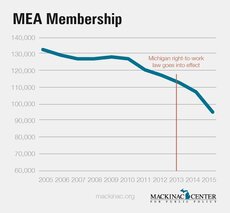
Membership of Michigan's teacher's union has fallen
since Michigan became right-to-work.
In newly right-to-work, Michigan, since 2012, teacher union membership has already fallen by 20% (continuing a pre-right-to-work trend).  However, that is just the beginning because in Michigan many teachers contracts grandfathered-in union-shops.  Once those contracts expire, more and more districts in Michigan will become right-to-work and union membership will fall further.

In Wisconsin, 2011's Act 10 went much farther to disempower public sector unions than a reversal of Abood would, but teacher union membership fell from 98,000 to 40,000 from 2011 to 2015.

If 20% of NJEA members refused to join the join, the NJEA would lose over $30 million.  If the NJEA's dropout rate equaled Wisconsin's, the loss of revenue would be $80 million per year.

A less well-funded NJEA would have less clout within the Democratic Party and less financial muscle to get Democrats elected.  A weaker NJEA would have less money to contribute to officially non-partisan, but pro-spending, organizations such as the Education Law Center.

Although even a weakened NJEA might still fund the ELC and the ELC may not need the NJEA's $550,000 per year anyway, the NJEA's lobbying would be less likely to get the Democratic Party to heed it in areas like banning outsourcing, opposing vouchers, preserving LIFO, and increasing education aid rather than redistributing it. (the NJEA opposes Sweeney's aid redistribution plan as "divisive.") Democrats who want to reduce post-retirement health care benefits would become confident making their voices heard since the NJEA's ability to retaliate would be reduced.

Lower teacher salaries might mean that fewer highly-qualified people go into teaching, but in the short term, having to spend less on staff salaries would give districts more budgetary space than they have now and give them greater flexibility in firing decisions. 


2.  Effects of Tax Cuts

Discussing the fiscal consequences of Trumpism is more difficult than what the legal consequences will be.

Originally I thought Trump's tax cuts would be good for NJ revenue or allow NJ to raise taxes higher than previously contemplated, but now I don't know if those boosts will compensate for cuts Trump will make.

Cutting taxes on high earners would explode the federal deficit, but in the short term it would probably help New Jersey's state finances.

New Jersey has a lot of high-earners, with 7.5% of households being worth over $1 million, the second highest percentage of millionaire households in the US.

Any tax cut targeting the rich will disproportionately benefit New Jersey:
Consider that Blue States send much more money to Washington than they receive, while the reverse is true for Red States, which tend to favor Republicans. Blue States also enjoy significantly higher per capita income than Red States and are home to a disproportionate share of the nation�s highest earners. The upshot is that if the Trump administration cuts taxes on top earners as expected, the federal tax burden on Blue States will fall especially sharply. Those states will thus have new fiscal flexibility, should they choose to offset other aspects of the Trump agenda.
So, if federal taxes are dropping, New Jersey's next governor and legislature might feel they have more leeway to increase NJ's own taxes.
The experience in California is reassuring. Facing budget shortfalls and cutbacks in essential public services, the state�s voters approved Proposition 30 in 2012, which raised the state�s top marginal income tax rate to over 13 percent, significantly higher than that of any other. Opponents predicted that wealthy California taxpayers would flee in droves to Nevada, Oregon and beyond. 
But the Institute on Taxation and Economic Policy in Washington reports that these fears were overblown, citing a recent Stanford University study. It found that million-dollar income earners are actually less likely to move than Americans earning only average wages; fewer than 2 percent of the tiny fraction of those millionaires who did move cited taxes as a factor.
Although I think the article above dismisses too lightly the risk of outmigration of retirees from a small state like New Jersey, there's no better time for a state to raise taxes than when the federal government is lowering taxes.

It's possible that the Fed's actions will end the bull market and this revenue boom may not materialize, but throughout the 1990s the stock market rose despite rate increases, so I would bet on the bull market at this point.

Also, if the mortgage-interest deduction were capped and/or the deduction for state and local taxes were reduced or eliminated, the consequences would be negative for New Jersey.

The second way Trump could help New Jersey's revenue picture is by deregulating Wall Street.  

Like large tax cuts, deregularing Wall Street could be disastrous for the economy in the long-run and would definitely exacerbate inequality, but since New Jersey has a large finance industry (180,000+ employees) that contributes a disproportionate share of GDP ($35 billion), since New Jersey has many additional residents who work in finance in New York, and many more residents who don't work in finance still have relatively large capital gains and dividends, it could be good for our short-term budget picture at least.

(New Jerseyans who work in New York pay income taxes to New York State, but they pay taxes on investment income to New Jersey)

Conclusion

Are these steps right or not?  I do not think so.  I think the federal government should concentrate on shoring up existing programs, not cutting taxes.

While I would personally welcome the outcome of New Jersey's public sector becoming right-to-work, I do not think fair share fees are unconstitutional.  The US Constitution was written decades before anyone had the idea of a union, so ascribing any intention to the Founders regarding unions is impossible.  In my opinion, when the Constitution is silent, the legislation is (usually) constitutional.

BUT if there is a stock market rally and Wall Street grows disproportionately to the rest of the economy, the state will have more money that it could spend on state aid.  If Abood is overturned, the NJEA is disempowered, and teacher salaries and benefits start to increase more slowly, NJ school districts will be in a different place budgetarily and education policy-making will shift dramatically.

---

(Of course, overturning Abood isn't the only decision the US Supreme Court will make regarding education.  It's just the one I focused on because this blog is on NJ education aid and fiscal policy.)

This article looks at some other major education-related cases that are in progress.


Wednesday, November 23, 2016

Phil Murphy Speaks About State Aid and Says Nothing

Phil Murphy just gave a speech at the New Jersey Education Association's annual conference at which he came down on several major issues in state education, such as his plans to eliminate the PARCC, implement a moratorium on new charters, veto any renewal of Chapter 78, and to fully fund the pension system without any changes to employee and retiree health care. 

The key moment of Murphy's paean to the NJEA was
As my mother would say, you are known by the company you keep, and I�m keeping really good company right now � It means a lot to me to be on the same team as NJEA.
Phil Murphy with his "team," the NJEA Leadership
Same team as the NJEA?  Did Murphy seriously say that with a straight face? does he realize his own kids go to the Rumson Country Day School and Phillips Andover, which have no union representation whatsoever?

Anyway, Murphy expressed his allegiance to the NJEA very clearly, but when it came to state aid, Murphy spoke without saying anything.

On school funding 
There is one (school-funding) formula that has been blessed by the state Supreme Court, and that�s where I�d go back to start. I know it needs to be tweaked and updated, but I�d go back to that. This governor has underfunded that formula to the tune of about $8 billion in his seven years in power, and whether by coincidence or by design, that is about the same amount of money he has put out in tax incentives to come or to keep them � He has clearly put corporations and their tax rates ahead of kids and their education. We need to turn that back on its head.
"TWEAKS"?  How can a system that allows 52 districts to get over 200% of their recommended aid while 141 get 50% or less just be in need of a "tweak"?

It needs a total upheaval.  

What "tweaks" and updates does Murphy think need to be made?
  • Does he want to make the NJEA's preferred "tweak," which is having the state pay for charter students and cutting district transfers to charter schools? 
  • Does Murphy agree with Abbott extremists like the Education Law Center and Bruce Baker, who believed that SFRA's weights for high-FRL districts were too low?
  • Does Murphy agree with Vincent Prieto and some special education activists, who want the state to fund special education based on the number of special education students a district claims? 
  • Does Murphy agree with Steve Sweeney, Jack Ciattarelli, the NJ Senate, the superintendents and support redistributing Adjustment Aid?
  • Does he agree with Jack Ciattarelli and Steve Sweeney on the need to end how tax abatements distort state aid?  
We have no idea.  Murphy is speaking without saying anything. As usual, he doesn't even use the term "SFRA."

Murphy's statement echoes Vincent Prieto's equally vacuous statements on state aid, where he emphasizes that the current school funding law has the Supreme Court's "blessing."

Why New Jersey Has No Choice on Tax Incentives

So we have no clue about how Murphy wants to "tweak" state aid, but Murphy, echoing the NJEA itself, does suggest something of a funding source - the elimination of tax incentives.
Goldman Sachs Put Itself Before NJ
Schoolchildren and Took $160
Million in Tax Credits from NJ
Alone. It has taken hundreds of
millions more from other
states.

Murphy's rhetoric that Christie has "put corporations and their tax rates ahead of kids and their education" is powerful, but it is a highly mendacious promise since, as governor, Murphy will not be able to eliminate tax incentives.

First, as I've written before, New Jersey's tax subsidies are often urban- and transit-specific, so ceasing tax incentives means redevelopment in Paterson, Trenton, Camden, and Newark would cease.  Eliminating tax incentives is

"GOVERNOR TO NEWARK REDEVELOPMENT:
DROP DEAD."

Second, the reason it is necessary for New Jersey to offer tax incentives is because states are at war with each other for jobs right now and their weapon is tax incentives.

New Jersey in particular has to offer tax subsidies because our tax rates, overall, are the country's highest.

New Jersey has poached businesses from other states (mostly New York) and other states have poached businesses from us. Hertz' departure from New Jersey to Florida was facilitated by $84 million in incentives. Sealed-Air's move to North Carolina was facilitated by $36 million in tax incentives.  Georgia got Mercedes for cheap -- only $23 million.

In all of these cases the savings aren't just taxes, but overall costs of employment. Mercedes will save 10% - 20% a year in Georgia on non-tax costs.

Businesses (especially in services) are mobile and, either through the necessity to compete against businesses in low-tax states or else their CEO's ideological preference for low taxes, they can and do migrate to or expand in low-tax environments.  The tendency to move or expand in low-tax environments exists in businesses that purport to be enlightened and not just about their profitability. Tesla opened its "Gigafactory" in Nevada because it got $1.3 billion in subsidies.   Apple took $1 billion to build a data server farm in North Carolina. The New York Times is quite a liberal paper, but it took $29 million in tax breaks for its Midtown headquarters.

Elon Musk, interestingly, said that the $1.3 billion Tesla got for its "Gigaplex" didn't really matter so much as it fulfilled an emotional need, ie "Nevada cared."

First of all, it is important to point out Nevada is not paying for [the Tesla Gigaplex]. The $1.3 billion or so which is the maximum tax incentive that Tesla could get over 20 years, so an average of, like, maybe, $50 or $60 million a year, is a tiny fraction of what this factory�s output will be. So at the 50 gigawatt level this is like a $5 billion a year factory output. We think it will probably be at least two, probably three times that number. So that�s like $15 billion a year. You compare that to the tax incentive of $50 million, it is point-three, point-four percent. It doesn�t move the, I mean, it was important that Nevada offer that package just to show that they cared. It doesn�t move the needle on economics. I hope people understand that. I try to belabor this point ad nauseum because some of the articles that have been written give the impression that Tesla got this $1.3 billion check from Nevada. No, what we got was a concession that sales and use tax on equipment in the building, we are not going to be charged that for some period of time. So, it is really a very tiny affect on the economics of the factory. But if the state didn�t do what it could then does the state really care? So that package was more about Nevada showing that they cared about Tesla being here than anything else.

IF New Jersey didn't have a system of corporate tax breaks more businesses would leave New Jersey or not locate here in the first place and the Treasury wouldn't have any net gain.

So when a business threatens to leave, the Treasury is screwed either way:
  1. Either the state offers the tax incentive OR
  2. It watches the business leave and take all its taxes and employee spending power with it.
Yes, there are some NJ businesses that are bluffing about relocation/expansion elsewhere and would stay in New Jersey or expand in New Jersey even if they didn't get tax credits, but not all businesses that threaten to leave/expand elsewhere are bluffing.  The expansion of tax incentives in New Jersey since 2013 (when the law was rewritten) was a result of a free-for-all of tax incentives in other states.  (compare how low NJ subsidies were to NY & PA in 2012.)

Even America's Most Profitable Businesses Want Low Taxes

GS has kept expenses low by putting
employees in low cost, low tax locations.
Source:
http://bit.ly/2isMZ3n
The need to be in a low-tax environment is most obvious if a business has a low profit-margin, but even America's most profitable businesses - such as finance giants like JP Morgan and Goldman Sachs - make decisions on taxes.

I bring Goldman Sachs up not to say that Murphy is a hypocrite, but to show that even if Goldman Sachs, whose annual profits are now $7 BILLION, goes where it is offered tax incentives, just imagine the pressure on low-profit and medium-profit businesses are under.

Goldman Sachs is one of the country's most notorious exploiters of tax subsidies and loopholes, taking $593 million from New York and New Jersey alone.

Maybe Phil Murphy, as a Goldman Sachs insider, thinks that even if Goldman Sachs hadn't received at least $164 million in state and local tax subsidies it would have put employees in Jersey City anyway, but I wouldn't be so confident, since Goldman Sachs also has thousands of employees in Salt Lake City, Dallas, Warsaw, and Bangalore, India.  Despite its enormous profitability and need for highly educated workers, even Goldman Sachs makes decisions based partly on taxes and costs.  (even Goldman CEO Lloyd Blankfein brags about it.)

Goldman Sachs Loves Salt Lake City for the Mountains,
Workforce, and Tax Incentives


If Goldman doesn't care about state taxes, why did Goldman Sachs start expanding in Salt Lake City around 2007-2009, at a time when its Jersey City skyscraper was underused?

Certainly the high-quality, multilingual Utah workforce played a part and taxes that are already fairly low, but Goldman didn't move to Utah until it got Tax Incentives.

Goldman Sachs ranks as the second-biggest beneficiary behind Procter & Gamble Co of Utah's tax-break program, having inked a deal in 2009 to receive an estimated $47.3 million worth of rebates over 20 years. In exchange, the bank committed to investing $51 million in Utah, maintaining at least 1,065 employees and paying them at least 50 percent above the average Salt Lake County wage. [ed. GS now has 2,000 employees in SLC] 
The deal built upon a previous $20 million tax break deal Goldman received two years earlier under Herbert's predecessor, Jon Huntsman. 
Goldman agreed to the sweetened package after an entourage of Utah public officials -- including Gov. Herbert, Salt Lake City Mayor Ralph Becker and local business leaders -- came to the bank's headquarters in lower Manhattan to make a personal sales pitch to senior executives.
Goldman Sachs even is expanding in Salt Lake City while it cuts jobs elsewhere.

Goldman Sachs Group Inc has been quietly moving thousands of jobs from pricey places
like New York and London to cheaper cities like Salt Lake City in recent years, and executives said on Thursday those efforts are finally starting to show up in the bank's results.......
The bank added a net of 500 employees to its payroll of 32,900 in 2013, but it added many more than that to lower-cost cities and cut staffing in higher-cost cities, they said. Besides Salt Lake City, Goldman has also built staffing in cities like Dallas and Bangalore, India. 
"I've been covering this company for 10 years, and I can't remember the last time they were cutting compensation at this level," said Tom Jalics, a senior investment analyst at Key Private Bank, whose clients own Goldman shares. "They're really ratcheting them down."..
Ten years ago, Goldman had only a handful of employees in Salt Lake City. Now it has about 1,800 employees, with nine of the bank's 11 divisions represented there, in functions ranging from research and credit analysis to trade settlement and compliance.

HIGH VALUE OR LOW COST?
The migration of jobs to lower-cost centers has created some tension between employees in New York and Salt Lake City, who get paid different amounts for similar jobs and are often culturally at odds. 
New hires in Salt Lake City cost 30 percent less, on average, than employees in the same roles in New York, according to a consultant who has helped grow Goldman's Utah operation but was not authorized to talk to the press. A Goldman employee fresh out of college in Salt Lake City, for example, might earn about $45,754 a year, on average, while those in New York earn about $67,334, according to jobs website Glassdoor.com.

Sure, Utah has the "Mormon Factor," ie, a high-quality, sober, multilingual workforce, but Utah had to offer the tax breaks because Goldman Sachs still threatened to move somewhere else.

The inconvenient truth for progressives is that businesses do respond to tax rates and tax incentives.  If super-profitable Goldman Sachs moves to Utah because of tax subsidies, then lower-profit businesses face an even bigger pressure to relocate to low-tax states.  Democratic governors in the US, like Andrew Cuomo and Dannel Malloy, deploy tax incentives all the time because they know it's necessary to compete with other states.  New York State actually gives out $23.9 billion in tax incentives in 2015 alone.

Philosophically, corporate tax incentives are impossible to defend, but when every state has its own incentive program New Jersey cannot unilaterally stop giving tax incentives out.

So it's a lie of Murphy's that he is going to be able to fund schools with money saved by abandoning tax incentives.  Murphy will not be able to cut tax incentives unless he is willing to accelerate business departure and further inhibit business growth.

I doubt Murphy will make that tradeoff.  Even aside from how dependent Camden, Paterson, Newark etc are on tax incentives, I doubt even the Democrats would let him due to business-exodus and non-expansion fears.

In conclusion, Murphy continues to not show any understanding of how off-formula New Jersey is with state aid, with hundreds of districts overaided or underaided "with no rhyme or reason."  He shows no compassion for towns like Bayonne, Bound Brook, Freehold Boro, and Belleville who face the awful choice between taxing themselves into decline or letting their schools become badly underfunded.

Unlike Jack Ciattarelli and Mike Doherty, he shows no outrage at the fact that the children of investment bankers and lawyers in Jersey City and Hoboken get "free" PreK while the children of cashiers and landscapers in Dover and Bayonne get nothing.

This is a huge contrast to Assemblyman Jack Ciattarelli, who is extremely concerned with NJ's most underaided communities and kicked off his gubernatorial campaign at Manville High School.

Murphy talks about "fully funding" SFRA but presents a funding source that cannot be tapped.  It's like "scientist" claiming to power something with zero-point energy.

Yet again, Phil Murphy spoke on state aid, missed the real victims of the status quo, and said nothing.


----


See Also: