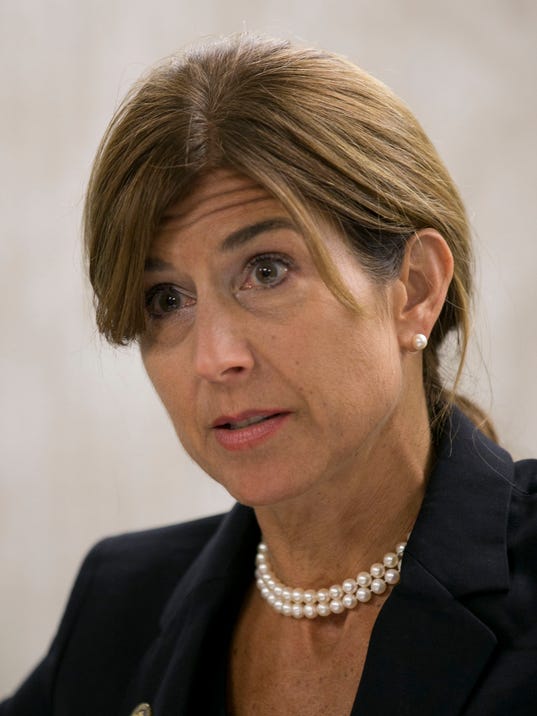
Showing posts with label Jennifer Beck. Show all posts

Tuesday, June 13, 2017

Jennifer Beck: Take Politics Out of State Aid (Unless Monmouth County Benefits)

Senator Jennifer Beck has again released misleading statements on state aid in an incoherent,
analytically incomplete op-ed where she defends Adjustment Aid, criticizes attempts to redistribute it from most districts, and yet says that the state should help districts that have had surging enrollment.  

There aren�t a lot of details being provided on [Sweeney's] plan, but estimates suggest that it could end up costing Monmouth County schools over $100 million in state school aid. This plan, if estimates are true, isn�t a fair or equitable solution to our school funding crisis.\ 
In New Jersey, we are supposed to fund our schools in a way that gives all of our children an opportunity to succeed. We all know the problems that exist under the current school funding program: 
It�s led to municipalities like Jersey City, which has the tax base to support their local schools but underfunds them by $255 million � while pocketing more than $418 million a year in state aid. 
It�s led to New Jersey underfunding schools where student enrollment has exploded. In fact, state aid for our schools has remained essentially flat since the School Funding Reform Act (SFRA) was enacted in 2008, leaving property taxpayers on the hook to pay more. For example, Freehold Borough is 527 students over capacity and Red Bank�s enrollment has grown by 267 in the last five years. But the state has not pulled its weight.
It�s led to a system where 421 school districts throughout the state overpay in property taxes to fund their schools. Property taxpayers are paying more than they need to because the state has failed to live up to its end of the deal. In Ocean Township, local taxpayers are paying $8 million more in property taxes for their schools than they are required to by the state....
While I am grateful to see that some of our [meaning Monmouth County's] underfunded schools would be among those that get more funding (because they need it), I noted that his area seems to be getting quite a bit more than Monmouth County and other counties. Politics can�t play any part of such an important process that impacts both our property taxes and our children�s education.

What Beck is saying is that she doesn't want "politics" to impact property taxes and education unless Monmouth County benefits.

Admittedly, Beck is correct that Monmouth County would be a net loser in any likely aid redistribution.

FIRST, for 2017-18, Monmouth County has 26 districts with a grand total of $99.7 in excess aid, but Beck omits multiple key facts on that, Monmouth County also has 28 underaided districts with a total deficit of $51.9 million.  These underaided districts include poorer districts including Freehold Boro, Red Bank Boro, and Long Branch,  plus some middle-income and affluent districts including Rumson-Fair Haven, Holmdel, and Freehold Township.

SECOND, half of the $99.7 million in excess aid in Monmouth County only goes to two districts, Asbury Park and Freehold Regional, each of whom has $25 million in excess aid.

Asbury Park's state aid exceeds $24,000 per student, of which nearly $11,300 per student in excess of SFRA's target.  Asbury Park's grotesque state aid amount has led to to PILOT virtually all of its new development, for a grand total of perhaps $1 billion in hidden PILOTed wealth.

THIRD, many of the aid-losing districts in Monmouth County are resort towns on the Atlantic Ocean that have gigantic tax bases relative to their student populations.

Belmar has $29,571 in Local Fair Share per student. Lake Como has $23,424 per student. Deal has $98,708. Allenhurst has an astronomical $1,706,505 per student.

Several of the non-resort towns have large tax bases too.  Tinton Falls has $19,550 per student in Local Fair Share.  Henry Hudson Regional has $23,262 per student. Middletown has $16,405 per student.  

FOURTH, more than $2 million of that excess is in Interdistrict Choice money that is not subject to redistribution.  This Choice money mostly goes to Deal, which gets $1.8 million alone.  (Monmouth County's total Choice Aid is over $3 million, but some of that goes to districts who are still underaided despite that infusion).

FIFTH, New Jersey is the country's most indebted state.  Thus, the state cannot increase K-12 aid very much and so budgeting is zero-sum.  The more aid hoarding that Jennifer Beck can preserve, the less new aid there is available to NJ's underaided districts, including Red Bank and Freehold Boros.

Beck also says she favors some redistribution, but says we should start with the statutorily overaided districts for whom the existing statute of SFRA allows aid reductions.  These are 46 districts who, despite Adjustment Aid, get more money than the SFRA dictates they should due to post-2008 enrollment loss.

Let�s start the reform with the 46 school districts that are overfunded in state dollars.

Ok, that's a good idea and is better than nothing, but barely.  These 46 districts only get $11 million total in extra aid.  

And silliest of all, Beck says at her conclusion what she had already said a few paragraphs previously:


Any school funding reform plan should be one where decisions aren�t based on politics, but rather on what is best for our students, parents, taxpayers and teachers.
Decisions aren't based on politics?

What on earth is Beck herself doing but appealing to the naked self-interest of Monmouth County itself?  

Although SFRA is complex, Sweeney's plan is quite simple: to give each district in New Jersey 100% of its recommended funding, no more, no less.  

That's not politics, that's justice according the old definition of equal treatment under law.  


Wednesday, May 3, 2017

How Overaided Districts Would GAIN Money if SFRA is Not Changed


Recently Senator Jennifer Beck has been disseminating misleading, incomplete
Jennifer Beck is Confused About What
She Wants
information about state aid in order to slow the redistribution of Adjustment Aid.

Part of her campaign in defense of Adjustment Aid is pointing out that 157 districts that now get Adjustment Aid should not lose state aid because SFRA says they actually should get MORE state money than what they get now!

She has now twice said something to this effect.

Example 1:
It�s not clear, that redistributing Adjustment Aid is going to be as uncomplicated as some have suggested .... 157 of those districts are also underfunded relative to what SFRA says they should get in state aid,� the senator added.
Example 2:

Sen. Jennifer Beck, a Republican member of the committee, cautioned against unintended consequences with the removal of adjustment aid. She said 157 of 181 districts receiving the aid remain underfunded by the state, and abruptly taking away funding would hurt those communities. The place to start, she said, would be to redistribute the roughly $11 million from 46 districts that are overfunded by the state.

Yes, how can a district getting Adjustment Aid "remain underfunded"?

When Beck refers to Adjustment Aid districts getting _less_ than SFRA says they "should get," she is indeed statutorily correct, but she is conflating what Adjustment Aid says a district should get legally with what it actually needs.

Verification of Beck's legal claim be easily seen in the Alternative Aid Scenarios that the Department of Education produces to show how much aid districts would get if SFRA were followed, with Adjustment Aid and the State Aid Growth Limits preserved. A quick glance at even Asbury Park will reveal that is is getting $2,056175 less than SFRA says it should get (!!!!)

Giving Asbury Park more money? How can SFRA do this?

This is a consequence of the fact that SFRA does not let any district receive less than 102% of what it got in 2007-08 and the fact that in 2010 and 2013 Adjustment Aid was cut.

Due to this the Adjustment Aid 102% promise, SFRA is blind to what a district's contemporary economic needs are; unless it has a large post-2008 enrollment loss, it can never receive less than 102% of its 2007-08 funding.

The first violation of the 102% promise was in 2010, when Chris Christie cut every district's aid by an amount equivalent to 5% of its budget. These cuts affected underaided districts and overaided districts alike, but the overaided districts lost some of their Adjustment Aid while the underaided districts lost Equalization Aid, Special Education Aid etc. (Christie's cuts were later reversed for the Abbotts.)

The second violation of the 102% guarantee was in 2013 when Christie, as part of a now-obscure fair-minded phase, actually did cut $40 million in Adjustment Aid from Adjustment Aid districts who were over Adequacy.

The 2010 cuts:
EG

The 2013 cuts were allowed to occur for all affected districts, including Abbotts.
EG

Any budget that passes the legislature is automatically legal, but these cuts were contrary to SFRA's stipulation that no district receive less than 102% of what it got in 2007-08.

Even though these districts are all overaided according to what SFRA's core formulas say they should receive, SFRA still contains the 102% provision and thereby it has a zombie-like determination to reverse the cuts of 2010 and 2013.

For instance, Asbury Park's aid is $25 million higher than its SFRA target (ie, Uncapped Aid), but according to SFRA, Asbury Park is owed another $2 million.

  • This is because Asbury Park's peak aid was $57.7 million in 2008-09 and the Adjustment Aid mechanism of SFRA wants to bounce it back up to that amount.
  • Pemberton's aid is also $25 million higher than its SFRA target, but SFRA wants to give it another $1 million. 
  • Keansburg is overaided by $7 million against its real real need, but is underaided by $500,000 against Capped Aid. 
  • Brick is overaided by $23 million, but would get another $2.2 million under SFRA. 
  • Marlboro is overaided by $5.3 million, but would gain another $800,000. 
Most NJ districts are slightly underfunded against Capped Aid and significantly underfunded against Uncapped Aid, but for 157 Adjustment Aid districts, they are underfunded against Capped Aid, but overfunded against Uncapped Aid.

If SFRA were followed as it is currently written, 157 of New Jersey's overaided districts would actually gain a total of $84 million!! Asbury Park's gain would actually be larger than Red Bank Boro's in per student terms. Toms River would gain $3.4 million, even though it is already overaided by $21 million.

Particularly ridiculous is that Allenhurst, who has $5.1 million in Local Fair Share for only three students, gain another $10,612 in state aid.

There are another 46 districts who are now slightly underaided, but whose aid in 2008-09 was greater than what SFRA calculates they actually need.  Since the 102% promise in Adjustment Aid applies to these districts as well, their Capped Aid is higher than their Uncapped Aid.  For Passaic, Capped Aid is $20 million higher than Uncapped Aid; for Perth Amboy it's $11.6 million.  For Montclair, the Morris School District, and Princeton, Capped Aid is about $1 million each higher than Uncapped Aid.

If these 46 districts got their Capped Aid they would become overaided by $43 million.

Projected Gains Per StudentUnder the Adjustment Aid/State Aid Growth
Limit Status Quo of SFRA
See: http://bit.ly/2pGkPTq and http://www.nj.gov/education/stateaid/1718/scenarios.shtml


If Asbury Park and Pemberton are brought back to their peak aid levels, as Adjustment Aid dictates, the amount of aid available for truly underaided districts, including Red Bank Boro and Freehold Boro in Jennifer Beck's own district, is reduced by $84 million.  If the 46 slightly underaided districts are brought back to their peak aid levels the amount of money to give to districts like Red Bank Boro and Freehold Boro is reduced by $43 million.

Jennifer Beck is UNDERMINING the cause of fairness by making any references to the 102% promise within SFRA.

We cannot cut Adjustment Aid and keep the 102% guarantee. Since Beck purports to be an ally of Freehold and Red Bank Boros, Beck's self-contradiction here is off-the-charts.

The solution to perverse consequences of SFRA that would pour more money into overaided districts is to eliminate Adjustment Aid.

Beck, who in the past I liked, doesn't know what she wants, other than that she likes to get photo opportunities with Freehold and Red Bank Boros.

---

See Also

Tuesday, May 2, 2017

Loss Of Adjustment Aid Only Rarely Would Be Damaging


One line of argument against redistributing Adjustment Aid is that the loss of Adjustment Aid would be very hurtful to aid-losing districts.

For Sen. Jennifer Beck of Monmouth, an off-and-on reformer, issued this cautionary note after the May 2017 Senate Budget hearing:


Sen. Jennifer Beck, a Republican member of the [Budget] committee, cautioned against unintended consequences with the removal of Adjustment Aid. She said 157 of 181 districts receiving the Aid remain underfunded by the state [sic, this is a profoundly wrong statement], and abruptly taking away funding would hurt those communities. ....
�The Legislature needs to address the school funding disparity in this budget cycle, but we also must be cautious when considering the complexities of redistributing Adjustment Aid,� Beck, who is in a tough re-election battle, said in a statement after the hearing. �One thing that is certain is that our most underfunded districts cannot wait any longer for relief.�

Although there are some districts for whom the loss of Adjustment Aid would be very painful, on the whole, most districts getting Adjustment Aid either

  1. have Adjustment Aid as a small percentage of their budget.
  2. have Adjustment Aid as a small percentage of their Local Fair Share.
  3. are very high-spending as it is.

As we will see in greater detail below, there are only a handful of districts for whom the loss of Adjustment Aid would result in large budgetary impact who would not make up the lost revenue with local taxes.

(For this study I have attempted to be as accurate as possible and therefore subtracted aid excess that is the result of Interdistrict Choice money.  While the total amount of excess aid distributed for 2017-18 will be $696 million, $27 million of that amount is actually from Interdistrict Choice and therefore not subject to redistribution based on any proposal currently under discussion.  The 2017-18 Uncapped Aid figures are here.)

For the median district that is overaided, Adjustment Aid represents 10.2% of Local Fair Share.

There are 61 districts Adjustment Aid is not even 5% of the Local Fair Share.  Since the Adjustment Aid would be eliminated over five years, it's difficult to imagine why the loss of it should be difficult.

For another 38 districts for whom Adjustment Aid equals 5-10% of Local Fair Share.  For these districts there could be some difficulty adapting to reduced aid, but not enormous difficulty.

Hoboken (5% of budget but 2.4% of LFS, ), Upper Freehold (7.7% of LFS), Middleton (14% of budget but 3.8% of LFS), Weehawken (5% of budget but 3.1% of LFS), Hillsborough (6% of budget, 7.7% of LFS), and the Jersey Shore overfunded districts are among the districts who should not have a major problem adapting.

Then, admittedly, there are 105 districts for whom Adjustment Aid exceeds 10% of Local Fair Share, including 52 for whom it exceeds 20%. Asbury Park's $25.3 million of Adjustment Aid equals 184% of its Local Fair Share (39% of the budget), although Asbury Park is the outlier here.


Some readers may consider tax increases, even over five years, equal to 20% of Local Fair Share to be too onerous for voters to accept and therefore oppose cuts in Adjustment Aid because the reductions would force programming cuts.

It's true, if a district gets a large amount of Adjustment Aid, then losing that money would force cuts, but the complicating fact here is that these districts tend to already be very high-spending.  For them to lose significant money in Adjustment Aid would require cuts, but the cuts would be coming off of a level of spending that average and severely underfunded districts in New Jersey are nowhere near.

Let's look closely at the Budgetary Cost Per Pupil for the 52 districts for whom Adjustment Aid exceeds 20% of Local Fair Share.  (excluding non-operating districts)

My mistake. Brooklawn should NOT be on the list because its excess aid comes from Interdistrict Choice.
This strengthens my case.


These spending figures are almost always substantially above New Jersey's average.  The districts whose spending is the lowest Ocean Township (Ocean County) are districts who voluntarily keep their taxes very low.  Ocean Township's taxes are 66% of Local Fair Share.

Let's look at a few large, overfunded districts up-close:

  • Pemberton, a rural Abbott in the heart of the Pinelands, is overfunded by $25 million, for just 4300 students.

    Because of that excess, Pemberton now spends $20,000 per pupil, even though it only taxes at 57% of its Local Fair Share ($12 million against $21.5 million).

    Pemberton's excess aid is $25.7 million, which is far greater an amount than it could possibly make up with its own taxes, but as Pemberton loses its Adjustment Aid, it would be simply falling to the state's average and still be vastly better off than the dozens of high-FRL NJ districts now who now spend as little as $10,000 per student.  As an Abbott, Pemberton would retain 100% state funding for construction projects and two years of "free" state-funded PreK.

  • Brick is overfunded by $23 million for 8750 students.  Brick taxes at 77% of Local Fair Share, or $101 million compared to $131 million.   If it got a waiver and decided to make up for 100% of the lost aid through local taxes, Brick would still be under its Local Fair Share by $7 million.  
Lest I be accused of not acknowledging the impact of budget cuts on aid-losing districts, what also has to be considered is that even if Steve Sweeney's plan to redistribute all of Adjustment Aid and add another $500 million in school spending is implemented, it is not enough to bring every all of today's underaided districts up to 100%, because that would require $2.1 billion, not the $1.1 billion Sweeney is talking about.  So, even after the process of eliminating Adjustment Aid is complete, these aid-losing districts will be at 100% funding while there are many others that remain at 70%, 80% etc.

(See, Is Steve Sweeney Overselling His State Aid Proposal?)

So even if Sweeney's plan is implemented faithfully, there will still be a distribution of haves and have-nots.  Pemberton, Brick, Asbury Park etc will be at 100% funding, while Delran, Clifton,Cherry Hill, Chesterfield, Freehold Boro etc are still below 100% funding.

And most of New Jersey's poorest districts get no Adjustment Aid at all:

2014-15 Data


2014-15 Data


Central Avenue, East Orange.
At the risk of weakening my own case for redistribution, THERE ARE some overfunded districts for whom losing Adjustment Aid would be very difficult.  The district I would be the most worried about is East Orange.

East Orange is overfunded by $25 million, which is equivalent to 12% of East Orange's Total Operating Budget.  East Orange's school taxes are $20.7 million below Local Fair Share, so even if East Orange wanted to tax at its full Local Fair Share, cuts would still occur.

However, there is no way that East Orange could pay its full Local Fair Share because East Orange's municipal taxes are off-the-charts, at 3.5%, as part of an all-in tax rate of 4.6%.  Most New Jersey towns have municipal taxes at about a quarter of all-in taxes, but in East Orange municipal taxes  make up 72% of East Orange's total taxes.

I assume there is bloat in East Orange's municipal government, but much of that extreme tax burden is likely due to unavoidable need.

However, East Orange is an exception, and any painful cuts that other overaided districts will have to make as they lose Adjustment Aid has to be counterassessed against the deep existing budgetary deprivation existing in hundreds of underaided districts and the fact that even if Sweeney's plan is implemented, today's underaided districts will still not be at 100% funding.

For most districts that face losses of Adjustment Aid, the losses are manageable as long as there is some fix to the tax cap passed.

And when New Jersey's fiscal future is so grim, the elimination of Adjustment Aid is necessary.

-----

See Also


Thursday, April 14, 2016

State Aid Dominates Senate Budget Hearing


"They're bursting at the seams. We've got kids being taught in the hallway, on stages, wherever they can find room, and they can't do it anymore. We have to redistribute the state aid."

Senator Jennifer Beck on Freehold Boro:

Finally, the New Jersey State Senate is addressing the savage inequalities that entrap tens of thousands of New Jersey school children in schools nowhere near adequately staffed or equipped and tens of thousands of taxpayers shouldering tax burdens that are beyond the point of fairness.

At a Senate hearing, in front of over 50 community members from Red Bank Boro and Freehold Boro, the Senate Budget committee discussed ways to address the desperate need of some of New Jersey's neediest school districts.

According to the reporting I've read, Senator Jennifer Beck (Red Bank Boro's and Freehold Boro's Senator) was the leading spirit in pushing for a fairer distribution of school aid.

Beck said when [SFRA] first passed, districts poised to lose aid were held harmless and allowed to keep funding that would have otherwise been lost. That aid, meant as a short-term concession, continues even though other districts remain cash-strapped. 
Beck said 111 school districts are considered "over-adequacy" and still receive about $175 million in �hold harmless� aid. Her proposal aims to redistribute these dollars to the districts that need it.

Although it appears that the state will keep Adjustment Aid in overaided districts that are below Adequacy and thus leave over $300 million in excess aid untouched, even $175 million going to the neediest districts in New Jersey is a huge boost compared to what they have gotten in the last five years.  

Senator Paul Sarlo (D, Bergen) spoke in favor of redistribution as a concept. "I don�t think there�s a Republican or a Democrat who disagrees. We have to find some fairness here on this particular issue,� Importantly, Senator Jeff Van Drew (D, Cape May, Cumberland, Atlantic) spoke of redistribution in a balanced way and warned of anger among his constituents, "there are many folks, many constituents, many parents of children, who are going to say that they�re losing out now because there�s been a change obviously. And you know there�s going to be a lot of gnashing of teeth and crying," but stopped short of saying that he would oppose redistribution.


Once the formula stops running, districts that rely on the formula for increased enrollments or increases in the special populations funded in the formula, are treated unfairly... They cannot provide the quality education these other districts can without putting their local taxpayers into an almost impossible situation.�

However, not everyone at the meeting was sympathetic or willing to look at the statewide picture.  Senator Paul Oroho (R, Sussex) talked about "fairness" for districts that had lost enrollment.

We need a new funding formula that would be significantly fairer and more accountable for those specific areas where you have declining enrollment.
Also, if the Christie administration is open to redistribution, why is it waiting for legislation?  The Christie Administration did not wait for legislation to create PARCC Readiness Aid, Student Growth Aid, Professional Community Aid, or, the worst, "Additional Adjustment Aid."  The governor already has the de facto power to ignore SFRA and yet it has preserved the aid packages of overaided districts.

Apparently the aid of under Adequacy/overaided districts will be left in place for the time being, but Jersey City, the poster child for a district that undertaxes so much that it is under Adequacy despite being overaided by $4,272 per student.

Something I was pleased to see is that Senator Beck gets it that some districts are above Adequacy just because they pay high taxes:

One complication is that the amount a district spends is based on both local school tax collections and state aid. Beck and other officials said they want to be careful not to penalize districts that use local taxes, rather than state monies, to fund their schools at close to or higher than the state recommendation. 
�We want to make sure the changes we make don�t have unintended consequences,� Beck said. �There are some districts that are over adequacy, but it very well may be because their local property taxpayers chose to provide additional funding to the district, not that the state is giving them too much money.�

However, if the Sweeney/Beck legislation only takes Adjustment Aid away from districts who are above Adequacy than the amount of money that could possibly be redistributed is nowhere near the $550 million amount that the state distributes in Adjustment Aid. Beck herself gives a figure of $175 million.

The $175 million figure appears to come from the (partly erroneous) Education Law Center Policy Brief on Adjustment Aid, but the ELC was not saying that Adjustment Aid districts were $175 million above Adequacy.  The ELC was saying that districts that were above Adequacy got $175 million in Adjustment Aid.  

This is significant because many Adjustment Aid districts that are above Adequacy still undertax and therefore their "Adequacy Surplus" is less than their Adjustment Aid. For instance, even though Pemberton gets $32 million in Adjustment Aid, it is only above Adequacy by $14 million and many more over-Adequacy Adjustment Aid districts are like Pemberton.

It looks like this round of redistribution will skip Jersey City because Jersey City is under Adequacy (due to undertaxing), but Jersey City did come up and Sen. Sandra Cunningham makes a specious argument in favor of sustaining JC's aid.

[Beck] said the state also needs to account for towns that do not contribute enough in local property-tax revenues to the schools, but still receive adjustment aid. The poster child for that phenomenon is Jersey City, which is �slightly� under adequacy, according to commissioner of education David Hespe. The district receives $114.5 million in adjustment aid, in addition to other education aid, but contributes $224 million less in local taxes than it should according to the state�s �fair share� calculation, Beck said.
�Jersey City has had enrollment growth, but I think some of us would argue that they�re locally not doing what they�re supposed to do to help fund the cost of that enrollment growth -- which is counter to a lot of our other school districts, like Freehold Borough,� she said.
 Jersey City is not contributing enough in part because of its frequent use of municipal tax abatements, which spur development but have the effect of shifting more of the burden for school funding to the state, Beck said.
To the suggestion that Jersey City wasn't paying enough in local school taxes, Senator Sandra Cunningham shot back:

�When we think of Jersey City we think of the tall buildings, the glass buildings, the Citi Bike and all the other crazy things that you see when you hear Jersey City,� she said. �What you don�t see in Jersey City is � most of these minority children who are growing up in crime-ridden areas, they�re growing up in drug-ridden areas, they�re growing up in areas in which some of their schools have been there since Abraham Lincoln. Let�s keep in perspective where the people really are that are really using this money, and it�s not downtown.�

Senator Cunningham was against SFRA in the first place in 2008, even though she also represents Bayonne.

Ok, we all know that JC's student population isn't representative of JC's population at large, but this is irrelevant in discussing Jersey City's aid.  There are parts of many towns, from Cherry Hill to West Orange, and even Summit which have very poor sections, but no one says that Cherry Hill, West Orange, and Summit should get massive amounts of aid.  The common sense reason for this is because it's the overall financial picture which matters.

Here we go again.

What is relevant for state aid is the (weighted) student enrollment compared to the tax base.

So, Jersey City's student population is 70% FRL eligible, but it's a proportionally small population.  Jersey City only has 34,000 students compared to an overall population of ~275,000.   Jersey City's population is almost the same size as Newark's now, but Newark has almost 20,000 more kids.  Jersey City has 120,000 more people than Paterson, but Jersey City only has about 6,000 more students and since Paterson's FRL-eligibility is higher, Paterson actually has more FRL-eligible kids.


More importantly, Jersey City's Equalized Valuation is $21.3 billion, which, combined with Jersey City's Aggregate Income, comes to $330 million in Local Fair Share.  JC's tax base would be at least $9 billion larger if its PILOTed property were included.  Divide that Local Fair Share by the number of students in Jersey City and you get $10,196 per student; an amount which is slightly below NJ's median, but above districts like Bloomfield ($9,366 per student) and almost double higher than what some poor non-Abbotts like Dover ($5,576)  and Manchester Regional ($5,226) have.

In fact, Jersey City's Equalized Valuation is increasing so rapidly that its Effective (aka "Equalized") Tax Rate is dropping:


So Sandra Cunningham's resistance to doing anything that would raise Jersey City's taxes is indefensible.

Sometimes I feel like I write too much about Jersey City on this blog, but its emblematic of the problems of school finance in New Jersey and if the legislature and Christie refuse to redistribute aid out of Jersey City the amount of aid to be transferred is going to be limited.

Again, I'm encouraged by what I've read of the Senate Budget Committee hearing, even though I worry about that the amount to be redistributed will be very limited.  Anyway, I look forward to the Assembly hearing which will take place on Wednesday, April 20th.


Wednesday, March 30, 2016

Sweeney, Beck Propose Help for NJ's Neediest Districts


Senators Stephen Sweeney and Jennifer Beck continue to work on legislation that would redistribute state aid away from overaided districts to districts that are underaided and truly needy.

In an article by Adam Clark that appeared on the cover of the Sunday, March 27th Star-Ledger, Beck and Sweeney explained:

"The hold harmless provision [Adjustment Aid] was meant to make sure there was no losers," state Senate President Stephen Sweeney said. "It absolutely created losers." [my emphasis]
Sweeney (D-Gloucester) and Sen. Jenifer Beck (R-Monmouth) are finalizing a plan that they say would make school funding more equitable. Beginning in 2017-18, the proposal would gradually phase out hold harmless aid [ie, Adjustment Aid] for districts that don't need it and reallocate that money to growing districts that are underfunded, Beck said.

Political Courage

This is truly a brave move on both senators' parts. Both Sweeney and Beck have some overaided districts among their constituents who may oppose any redistribution and this bill faces an uphill struggle through ignorance, selfishness, and parochialism of the legislature.  Remember, SFRA barely passed in 2008 and it was an aid increase (even overaided districts were supposed to gain 2%), not an aid redistribution.

Not to overpraise Sweeney (who I criticized here for talking Pre-K expansion without having a way to pay for it), but I see him as a truly bold politician.  Between being the primary Democratic backer of pension reform, supporting the consolidation of K-8s with their regional high schools, and now state aid reform, Sweeney is someone who is willing to take stances that offend interest groups and some of his own constituents if he believes they are correct.  A sincere bravo to him on this.

Conditioning Aid Distribution on Adequacy = Inadequate Redistribution

Sweeney and Beck haven't released any details of their plan yet, but there are hints that they will consider where districts are relative to their Adequacy budgets.

According to the Adam Clark Star Ledger article:

The districts that would receive less hold harmless money are already "above adequacy," meaning they spend more money per student than the state's funding formula says is needed for a thorough and efficient education, Beck said. Those districts should be able to adjust their budgets, especially if their enrollment has dropped, she said.

Any redistribution of Adjustment Aid is a good thing, but if New Jersey only takes Adjustment Aid away from districts that are above Adequacy the amount of Adjustment Aid that could be redistributed is greatly reduced because 71 Adjustment Aid districts undertax so significantly that they actually below Adequacy.  Important examples of Adjustment Aid districts that are below Adequacy are Jersey City, Brick, and Toms River.

According to the Education Law Center Policy Brief on Adjustment Aid, for 2015-16:

  • The above Adequacy Adjustment Aid districts get $174,024,179 in Adjustment Aid.
  • The below Adequacy Adjustment Aid districts get $381,745,553 in Adjustment Aid.

So, if Adequacy is considered then the potential amount of Adjustment Aid that could be redistributed is only $174 million, not the full $550 million that the state labels as "Adjustment Aid."
(NJ hasn't run the SFRA formula in several years and the amount of money that districts get that is labeled "Adjustment Aid" is divorced from the amount of Adjustment Aid they should get.  For instance, Newark and Atlantic City both get something called "Adjustment Aid," but both are underaided and the Adjustment Aid should be converted into Equalization Aid.  Conversely, since Jersey City increasingly becomes richer and its student population grows slowly, more of its Equalization Aid should be converted to Adjustment Aid.)

Also, the Adjustment Aid districts that are above Adequacy are often only slightly above Adequacy, meaning that because they undertax, their aid excesses are greater than their surpluses above Adequacy.

For instance, even though Pemberton gets $32 million in Adjustment Aid, it is only above Adequacy by $14 million.

  • Asbury Park gets $24.2 million in Adjustment Aid, but is only $13.9 million above Adequacy.  
  • Keansburg gets $8.6 million in Adjustment Aid, but is only $5.9 million above Adequacy.  
  • Phillipsburg is gets $10 million in Adjustment Aid, but is only $125,000 above Adequacy.  

Adam Clark writes about this as a "bipartisan plan to change how that money � more than $500 million � is allocated" but if only Adjustment Aid districts that are above Adequacy lose aid, the amount that could be redistributed would be nowhere near $500 million.

Population Change isn't the Only Factor in Overaiding and Underaiding

Another concern I have is that redistribution will be overly conditioned on population changes.  Although Sweeney and Beck haven't released any details yet, Jennifer Beck has talked often about aid being taken from districts that have lost population and giving it to districts that have gained population.

"The bottom line is that we as a state have not allowed our methodology for funding to keep up with what's actually happening at a district," Beck said. "If you've lost 100 students and the state of New Jersey is giving you the same state aid as you had five years ago... there should be some cost savings along the way."
And, in a statement at a recent Senate budget hearing Beck said:

"According to Beck, school funding needs to be redistributed throughout the state so that districts that have lost enrollment are not getting funding above the adequacy standard at the expense of schools where enrollment has increased. She said that that issue is not only central to the discussion in Paterson, but in a number of schools statewide including those in Asbury Park and Freehold, both of which fall in her district."


I'm a fan of Jennifer Beck, but I do not think she has it totally right about the causation of overaiding and underaiding.

Some districts in New Jersey have always been overaided or always been underaided, even before any recent population shifts.  For many districts, it is difficult to say why they have always been privileged or always been victimized, but it's not like NJ ever was "on formula" for a lot of districts who are now underaided.  


What logic was there ever in giving Marlboro twice as much aid per student as Bloomfield? What on earth justified giving Hillsborough more money than Belleville? Why did Randolph get more money than Hackensack?

Freehold Boro (then DFG CD), whose population growth has been often cited in its underaiding, only got $3,153 per student in 1998-1999, which is not significantly more than what Hillsborough got.

The aid distribution has been unjust for a very long time.  

I am worried that Beck neglects causes of overaiding and underaiding other than population change. Although Asbury Park and Pemberton's extraordinary overaiding are partly due to population loss and the zombie power the Abbott "Parity Plus" Doctrine, there are other districts that are overaided because they have had increases in wealth.

Hoboken and Jersey City represent two districts that are overaided despite gaining population.

Increase in wealth is difficult to quantify because historic Local Fair Share data is not available and even if it were available I would have to adjust it for inflation, but I can use Equalized Valuation (as a percentage of statewide EV) to show that Hoboken (an extreme, but illustrative example) has become overaided because of an increase in wealth, not because it has lost student population (on the contrary, it's slightly growing.)


Were I to go back even farther the effect would be more dramatic.  In the late 1990s Hoboken had only 0.3% of the state's total Equalized Valuation.   (see Divergent Fates of NJ's Big Cities.)

Likewise, some underaided districts haven't had much population change either.  Perhaps they were always underaided, or their population has stayed constant but become poorer.  They could also have seen a decline in ratables.

Atlantic City would be a prime (if extreme) example of a district who was once overaided (hence the Adjustment Aid artifact) and whose population has actually fallen, but has become deeply underaided (-$6,770 per student) because it has had an enormous decrease in wealth.


Will Anything Change?

Sweeney and Beck themselves have said that their proposal will be controversial, but the moral arguments for redistribution are so strong that I have some hope that this legislation will at least pass the State Senate.

The big question marks are the Education Law Center, Vincent Prieto, and Chris Christie.

The Education Law Center, led by lawyer David Sciarra, has opposed redistribution in the past and I consider it to be reactionary and economically blind, but in the fall of 2015 it softened its opposition to cutting Adjustment Aid for districts that were above Adequacy.  The ELC is influential among Democratic legislators and NJ's education activist community, so its support would help tip the scales in favor of justice.

As recently as 2012, Christie, through Chris Cerf's Education Funding Report, supported cutting Adjustment Aid too for districts that are above Adequacy.  Christie actually followed through on this for two years before setting into a flat-aid policy.  Christie, obviously, has become erratic and no one knows what he would think of redistribution.  He even created "Additional Adjustment Aid" to protect Interdistrict Choice districts from ever losing aid.

Prieto is a big unknown. All of Prieto's constituents - East Newark, Edgewater, Fairview, Guttenberg, Harrison, Kearny, North Bergen, Secaucus, and West New York - are underaided, but Prieto is also a close ally of Jersey City and Hoboken politicians whose districts are overaided.  Prieto is known to be a backer of Steve Fulop too and may not want to do Steve Sweeney any favors.


Anyway, I appreciate what Sweeney and Back are trying to do and look forward to learning more about their proposal.