Thursday, July 7, 2016

"Formula4Success" Doesn't Get Capped Aid versus Uncapped aid


I'm worried that Steve Sweeney and his allies are not explaining the difference between capped aid and uncapped aid. I base this on the "Formula4Success" website which shows what percentage of its state aid a district is getting and shows the percentage based on capped aid, not uncapped aid.

Capped aid is not real SFRA full funding. It is an arbitrary amount that is tied to what a district got in 2007-08 (either a 10% increase or a 20% increase, depending on spending relative to Adequacy). Capped aid was intended as an incremental step on the way to uncapped aid, which is real SFRA full funding.

Since 2007-08 was 8 years ago, and many districts have gotten poorer/larger since then, capped aid is even less adequate an amount today than it was when SFRA was passed. Capped aid is going to be even more inadequate in ~2024 when Steve Sweeney's aid plan is fully implemented. (if it passes the legislature, gets Christie's signature, and the state's finances are not wrecked by another recession.)

The fact is, Edison is underaided by $23 million, not $2.5 million.

Sweeney is the Good Guy in state aid, so I have a ton of goodwill towards him, but going for capped aid is worse than a political mistake, it's unfair. If capped aid is the goal, then high-
aid/moderately underaided districts will gain more than low-aid/severely underaided districts.

Compare Red Bank Boro and Newark.  Red Bank Boro now gets $2,164 per student, but its capped aid is only $2,545 per student. The gain is only $381 per student. Newark now gets $14,647 per student, but its capped aid is $16,431 per student. Newark thus gains $1,783 per student.

(See this spreadsheet for actual aid/capped aid/uncapped aid gaps)

For Edison, the difference between capped aid and uncapped aid is $170 per student or $1560 per student.

What Sweeney isn't admitting is that $1 billion isn't enough to fully fund SFRA. If $1 billion is all the state can afford, then fine, there should be a prioritization to give the greatest amounts of money to the most underaided districts.

To be accurate, Sweeney's legislation makes a reference to fixing capped aid in its reference to "aid growth limit provisions," but the Formula4Success website assumes capped aid is the target.  

adjustment aid and State aid growth limit provisions of 40 the �School Funding Reform Act of 2008� (SFRA), P.L.2007, c.260 41 (C.18A:7F-43 et al.), to determine recommendations for revising 42 those provisions in order to bring all school districts to their 43 adequacy budgets as calculated pursuant to section 9 of that act 44 over a period of five school years;

Please write to Sweeney, Ruiz, Houghtaling, and Downey explaining what's wrong and unfair about capped aid targets!

-----

See also this post about Clifton's Fight for Equitable Aid for more explanation of capped aid versus uncapped aid.

See also "The Sweeney Aid Bill: A Preliminary Analysis"

https://twitter.com/NJSenDems/status/751110296446509056

Tuesday, July 5, 2016

Abbott Spending Has Been Ineffective

Hey Education Law Center
& NJ Supreme Court!

I am completely against Chris Christie's proposal to give equal state aid to economically and demographically unequal school districts. Christie's "Fairness Formula" is neither "fair" nor a "formula" and would devastate poor districts throughout New Jersey and ultimately the towns themselves, as they attempt to sustain school spending by taxing themselves to death.

 I'm an adult and I'm used to BS arguments from politicians, but I had a visceral reaction to Christie's attempt to cloak an inequitable idea in equity in his claim that he was "valuing each child and their hopes, dreams and potential the same."

And yet, just because Christie is wrong about the Big Idea of his proposal doesn't mean he is wrong about absolutely everything.

Chris Christie, was right about two things which I hope to explore in this post and a subsequent post.

1.  The NJ Supreme Court "overcorrected" for disparities that existed in the 1980s and Abbott Adequacy targets are beyond the point of effectiveness.

2.  The Abbott spending mandate is one reason (of several) for New Jersey's property tax crisis.

This post is going to be about the marginal effectiveness of "Abbott Remedy." Please note, I'm not saying that the Abbotts and other poor districts don't need superior state aid.  I'm saying that the "Parity Plus Doctrine" and the high Adequacy Budgets for high FRL districts embedded in SFRA are higher than will be effective.

I consider the "money doesn't matter" argument that Chris Christie is making to be ludicrous.  I am neutral on charter schools.  If New Jersey had a flourishing economy I'd want to fully fund SFRA.  I believe that poor districts must receive above-average state aid to make up for their insufficient tax bases and to sustain opportunity for their children.  However, I'm strongly anti-Abbott for three major reasons.  First, I believe it is unfair that the Supreme Court's "Parity Plus Remedy" applied only to an arbitrarily developed list of urban poor districts (later known as the Abbotts) and not equally poor districts who for obscure reasons were never put on the Abbott list.  Second, the amount of money it directs to poor districts is excessive.  Third, the State of New Jersey is increasingly insolvent and spending that it could afford in the 1990s it cannot afford today.

The Scale of the Abbott State Aid and Spending Advantages

Unfortunately, too few people make the rational comparison of Abbott districts to poor non-Abbotts.

Chris Christie himself missed the relevant comparison this when he introduced his "Fairness Formula."  He introduced his "Fairness Formula" at Hillsborough High School, a very affluent district, and he compared Abbott academics to districts that are nothing like them.

Just take a sample of graduation rates. The statewide graduation rate is 90%. How have we done in the 31 districts where we have invested $97 billion over the last 30 years? Asbury Park�66%. Camden�63%. New Brunswick�68%. Newark�69%. Trenton�68%. 27 of the 31 districts are below the state average, despite the exorbitant spending over the last 30 years. There are exceptions and those should be noted right here. In Harrison, Long Branch, Millville and Pemberton they have exceeded the statewide graduation rate. In Union City, the have seen extraordinary growth under very trying circumstances and the leadership in those districts deserve great credit.
Comparing the Abbotts to the state as a whole is idiotic. The Abbotts are 77% FRL-eligible and the state is 38% FRL-eligible (and that includes the Abbotts), so of course the Abbotts are going to lag the state academically. And yet the Abbott/statewide comparison wasn't the only bad comparison that Christie made, because he also compared the Abbott district-run schools to a handful of the highest-performing Abbott charter schools, despite the well-known fact that charter schools have non-representative enrollment.

Many people who are in favor of Abbott spending compare the Abbott districts to poor districts in other states or make a chronological comparison of performance in the Abbotts today to same districts in the past.  Some people will say that Abbotts are "making progress" as if that were evidence of Abbott Funding efficacy and ignore the parallel progress poor non-Abbotts are making too.

Although SFRA was written for the benefit of poor and working class non-Abbotts, journalistically and in blogs, low-income non-Abbotts are the forgotten districts of New Jersey.  Although there are 78 districts in DFGs A and B who are not Abbotts and 64 non-Abbotts in DFG CD, these districts get very little attention and Christie has ignored them, just like the NJ Supreme Court has. Chris Christie spoke of NJ's heavy tax burden, and yet he didn't mention the poor non-Abbotts where the tax burden is the highest, services usually the worst, and where housing values are falling.

The Abbott/low-income non-Abbott comparison should be first in any objective person's mind because the state aid advantages of the Abbotts are tremendous and thus New Jersey presents a judicially-ordered experiment in what the effects of higher school spending are.

The disparities in state aid and spending between Abbotts and poor non-Abbotts are very stark. Of the 37 districts in NJ who have Local Fair Shares below $5,000 per student, 20 are Abbotts and they get $15,600 per student, on average. The 17 non-Abbotts among the poorest only get $10,400 per student.

The Abbotts also get two years of universal Pre-K whereas poor non-Abbotts get nothing. Although not all Abbott facilities are superb, there are more finely built, state-funded new buildings there than there are in poor non-Abbotts.

Yet the Abbott spending advantage is less than the Abbott state aid advantage because 29 out of the 31 Abbotts tax below their Local Fair Share and 14 have taxes below even 50% of their Local Fair Share. Low-income non-Abbotts do not have the luxury of undertaxing and usually accept very high tax burdens. A handful of Jersey Shore resort towns and Atlantic City have high tax bases and have high spending, a handful (like Lawnside) get high state aid despite not being Abbotts.  Nonetheless, most poor non-Abbotts do not have decent tax bases and most do not get high state aid.

Even after SFRA officially ended the "Parity Plus" regime, the flat state aid of the Christie Era, and the Abbotts' own refusal/inability to pay school taxes, the 31 Abbott districts have an average (unweighted) Total Budgetary Cost Per pupil of $17,961 for 2015-16. The 31 demographically poorest non-Abbotts have an average Total Budgetary Cost Per Pupil of $14,067. (see this spreadsheet for more spending information.)


Some of the poorest non-Abbotts are K-8s and their average FRL-eligibility is slightly lower, so somewhat lower spending is to be expected, but the gap should not be of this magnitude.  Even not counting their PreK money and state construction money, the Abbotts have a 28% financial advantage in opex aid.  

Abbott Results?

There are some involved in the Abbott Cause for whom the effectiveness of Abbott has always been secondary because they because they believe that equal spending opportunity is an end in and of itself and without high state aid and high spending, equal opportunity cannot exist.

The goal of Equal Opportunity was how Education Law Center lawyer Marilyn Morheuser parried the argument that high spending would be effective. "The state can't guarantee results. It can guarantee opportunity." Chief Justice Robert Wilentz also deflected the argument that money would not work by saying that the NJ Constitution still required high spending in urban poor districts, anyway whether the kids would benefit or not, "Our constitutional mandate does not allow us to consign poorer children permanently to an inferior education on the theory that they [sic] cannot afford a better one or that they would not benefit from it."

Gordon MacInness, now head of the New Jersey Policy Perpective and formerly the DOE administrator in charge of Abbott implementation, said in 2009 at Teachers College that the Abbott regime was worthy because it narrowed the gap in "life chances," ie, opportunity, but admitted in terms of long term academic results Abbott was a "huge failure."

Gordon MacInnes, a fellow at the Century Foundation who oversaw implementation of theAbbott decisions as Assistant Commissioner at the New Jersey Department of Education from 2002 to 2007, delivered a mixed assessment. The gap in �life chances� between poor and middle-class and wealthy students in New Jersey and across the nation is �still substantial,� he said. �When you get to middle school, eighth grade, high school � forget about it. This has been a huge failure.� 
MacInnes said Abbott, �arguably the most important judicial decision in education since Brown v. Board of Education� in 1954, has resulted in some meaningful changes in individual school districts for certain groups, such as free, high-quality preschools for three- and four-year olds. And some Abbott districts such as Union City, which instituted its own intensive K-4 literacy program and got adequate support for teachers, have done exceptionally well. But it has not produced the hard, concerted effort between students, teachers and parents � and, especially, the support of teachers of low-income students � that is necessary to get poor students on the same footing with wealthier ones.

Nonetheless, there are some researchers who are interested in whether or not Abbott spending has produced academic progress.  Although there are some researchers who claim that Abbott spending has produced large results, others admit that the evidence is contradictory and the gains that have occurred in Abbotts occurred in low-income non-Abbotts too.

The following chart is from a PhD dissertation by Joanne Howard (not online).  It shows that the Abbotts have gained more in percentage terms than low-income non-Abbotts, but that they started from a lower position, so they had more room to improve.


If you examine the chart above you will see that the Abbotts and "other low-income districts" made nearly parallel gains.  The wealthiest districts hit ceiling effects and did not gain.

Another researcher (Alexandra Resch, page 104) who concluded that the Abbotts did gain more than other districts nonetheless found much evidence of parallel gains in other districts.  (Here the comparison group is the entire state, not exclusively poor non-Abbotts)


By high school the Abbotts indeed do very poorly, as I will show below.

Yet the above charts are incomplete because they do not show what the correlation coefficient is.  I.e., they don't show the tightness of the trendline.  Yes there is a general upward trend, but you have no idea what the "noise" is.

If you separated out all the districts, you might have something like this from the Peak Abbott years of 2002-2007, which is what Chris Cerf found in his 2012 Education Funding Report.

Click to Enlarge.  Source, Education Funding Report:
http://www.nj.gov/education/stateaid/1213/report.pdf
What about today and contemporary academic position relative to poor non-Abbotts?

Abbott spending remains very high compared to poor non-Abbotts, but since the state's Adequacy targets are so high, all but six of the Abbotts are technically below Adequacy.

And yet, if we just look at the six Abbotts whose spending still exceeds their Adequacy Budgets and use the Peer Comparison Group percentiles that the Department of Education produces, we see no support for the contention that Abbottists have made that there is a strong correlation between high spending and academic achievement.

If the Abbott Hypothesis were correct, the highest spending Abbotts would outperform their peers and fiscally crippled poor-non-Abbotts would lag their peers.  And yet, when you actually look up the data, the low-spending districts actually outperform the high-spending Abbotts.  

For 2013-14 the DOE compiled an overall Peer and State comparison percentiles that were based on all of the standardized tests taken by students at the school.

In 2014-15 the state did not produce these comprehensive comparisons due to widespread PARCC opt-outs.  Since I do not have as good data for 2014-15, I will rely on 2013-14 data although I will parenthetically provide SAT data from 2014-15.  The Adequacy spending data is from 2015-16.  I admit it is for two years after, but I assume based on flat-funding that the differences in Adequacy Budget would be small over the two years.  If anything, the Abbotts were more above Adequacy then.
  • Asbury Park is $5,617 per student above Adequacy.  In peer performance it was at the 8th percentile.  In state performance it is at the 3rd percentile.  (Its 2014-15 SAT scores it is at the 19th percentile in peer performance.
  • Hoboken is $2,219 per student above Adequacy.  Its peer performance was at the 52nd percenIn state performance it was at the 18th.  (Its 2014-15 SAT scores are at the 52nd percentile.
  • Pemberton is $2,866 per student Above Adequacy.  In peer performance it is at the 31st percentile.  In state performance it is at the 16th.  (Its SAT scores are at the 65th percentile.  Pemberton's peer group is almost entirely non-Abbott and again, the district is 50% white.)
  • Phillipsburg is $981 per student Above Adequacy.  In peer performance it was at the 16th percentile.  In state performance it is at the 38th.  (Its SAT scores are at the 100th percentile, though this seems like an outlier among Phillipsburg's other scores) Phillipsburg High School is 72% white and only 29.8% Economically Disadvantaged.  It should not be an Abbott.
  • Keansburg is $3,475 per student above Adequacy.  In peer performance it was at the 72nd percentile.  In state performance it was at the 16th.  Its SAT scores are at the 84th percentile in peer performance.  Keansburg's peer group is all Abbott except for Manchester Regional and Lakewood, two of NJ's most financially crippled districts.  Also, Keansburg is not typical of the Abbotts demographically because it is 64% white and only 1.1% ESL.  The schools it is compared to have far more African-American students.  Keansburg's strong performance is more an example of the white-black achievement gap as it is of high-spending driving success.
Were I to include Pleasantville and Gloucester City, both of whom were nearly at Adequacy, the same pattern would continue.  

And now let us look at the Academic Achievement of the most financially disadvantaged non-Abbotts in New Jersey.  The schools below all have FRL-eligibility rates above 70%. Demographically these districts are just as poor as the Abbotts and yet spend $10,000-$12,000 per student.

  • East Newark is $10,097 per student below Adequacy.  Its one school performs at the 52nd percentile in peer Academic Achievement and the 20th percentile in state Academic Achievement.  It is so underbudgeted it cannot offer algebra.  
  • Fairview is $7,906 per student below Adequacy.  Its middle school performs at the 67th percentile in peer Academic Achievement and the 29th percentile in state Academic Achievement.  It is also so underbudgeted it cannot offer algebra.    
  • Bayonne is $7,307 per student below Adequacy.  Its high school performs at the 82nd percentile in peer Academic Achievement.  It is at the 40th percentile in state Academic Achievement.  (Bayonne's middle schools are also above average Ex 1, Ex 2, Ex 3)
  • Prospect Park is $7,087 per student below Adequacy.  Its K-8 school is at the 53rd percentile in peer Academic Achievement and the 19th percentile in state academic achievement.  It is also so underbudgeted it cannot offer algebra.
  • Freehold Boro is $7,061per student below Adequacy and has the state's worst crowding.  Its middle school is at the 38th percentile in Academic Achievement and the 22nd percentile in statewide academic achievement.

  • Red Bank Boro is $6,759 per student below Adequacy and has the highest percentage of students who are LEP classified in NJ. Its middle school is at the 80th percentile in peer Academic Achievement and the 19th percentile in statewide Academic Achievement. 

There are studies out there who show that the Abbotts as a whole or some of the Abbotts outperform demographic peer schools who spend less money, but academic comparisons of budgetarily advantaged Abbotts with the most disadvantaged non-Abbotts should give defenders of the high Adequacy budgets some pause.

I compared some unlike schools above since I looked at Abbott high schools and non-Abbott K-8 schools (except Bayonne).  Lest anyone say that this is not a sound basis to conclude that Abbott spending levels are ineffective, I'm also including two graphs of Grade 8 ELA and math scores from 2013-14, plus SAT scores, plus AP/IB course taking.  As you can see, the severely under Adequacy non-Abbotts outperform the Abbotts.


(Note, the Oresko School in Bayonne houses Bayonne's G&T program, hence the high scores, but even Bayonne's other middle schools outperform the over-Adequacy Abbotts.)

Finally, under-Adequacy Non-Abbotts outperform over-Adequacy non-Abbotts in the percentage of students taking at least one AP or IB test.

Note, there was an obvious data error for Belleville in the School Performance Reports. I used the percentage of Belleville students taking an AP test, not taking an AP class.
The gap between the Abbotts and under-Adequacy non-Abbotts in test taking, as opposed to course taking, is not as wide, but I believe that more of the above-Adequacy Abbotts pay for students to take the exam.  AP/IB test taking rates are thus not a fair comparison IMO.

Union City versus Dover

Union City is always brought up as the "Abbott that Works."  Liberals praise it and so does Chris Christie.  There is even a book about Union City, "Improbable Scholars."

Yes, Union City is a very good school system.  Its students are 94% Economically Disadvantaged and 13% Limited English and yet its students have a high graduation rate and perform well on state tests.  Its students are not consistently above average statewide per se, but they outperform their demographic peers and are in the middle third of the state on some tests.

And yet, Union City is a very poor argument for the effectiveness of Abbott.

First, whenever you have 31 of anything, at least one of them is going to be better than the rest. There are 31 Abbotts and statistically speaking, at least one of them is going to be very good.  Union City by itself is no more representative of Abbott effectiveness than Asbury Park is representative of Abbott failure.

Second, while Union City spends $17,500 per student and is above the state's average, it is more than $5,000 per student below Adequacy (due to underaiding and undertaxing), so Union City actually doesn't even spend at the level Abbottists claim is necessary for a district with Union City's demographics.

Third, Union City is not clear-cut as New Jersey's highest performing high-FRL district.

The highest performing high-FRL district in NJ is Dover.   

Dover's FRL-eligibility is about 66%, so it is not as high as Union City.  Dover is 9% FRL-eligible
too, which is lower than Union City's.
Union City HS


Not to disrespect Union City, but Dover's schools are higher performing.  30% of Dover HS students exceed 1550 on the SAT, 10% of Union City's do.  On statewide averages from 2013-14, Dover outperforms 65% of NJ schools, whereas Union City outperforms 24%.  35% of Dover students take at least one AP course, only 13.7% of Union City HS's do.

Dover Middle School is over 80% FRL-eligible and is a peer of the Abbotts demographically. On 8th grade math, Dover is at the 100th percentile in peer performance and the 69th percentile in statewide performance.

On the 8th grade Science exam, 75% of Dover students are Advanced Proficient or Proficient, a figure nearly equalling Montclair.

Dover HS
And Dover's spending is only $10,600 per student.  Union City spends $7,000 per student more than that.

Dover's higher performance is to be predicted based on demographics, but Dover exceeds its peer group by a wider margin than Union City does.

Why is Dover so good?  I have NO IDEA.  I've never read a single article about it.  Dover is just another example of how the media, researchers, blogs, and politicians ignore poor non-Abbotts.  Dover is a national Blue Ribbon school, but compared to charter schools and Union City, it has never gotten any press about it.

Does Dover need more money?  Absolutely yes, but Dover is evidence that the Abbott Dictum "money is necessary, not sufficient" is not consistently correct.

Conclusion

Some Abbottists look at particular studies and say that there has been an Abbott Effect.  Some admit that by high school that Abbott hasn't worked.  Some, like Education Law Center executive director David Sciarra in 2010, said that the data isn't there either way:

�There is a thinness of data over time,� said David Sciarra, of the Education Law Center, which represents the Abbott districts. He said evaluation systems that should have been set up a decade ago never developed. He is concerned that the new funding formula [SFRA] could make the situation worse. 
�There is no real assessment of whether the money is paying off,� Sciarra said. �The Rutgers study never came out.�... 
Sciarra said some Abbott schools have thrived, while others still perform miserably. Better evaluation is needed to hold all schools accountable. 
�We need a lot more research,� Sciarra said. �How long can they just keep blaming the Abbotts for everything?�

And yet, for the sake of argument, even if we accept that there is an Abbott Effect and that money is decisive for poor student population, where does that leave us regarding high-need non-Abbotts?  If money is so decisive then, how long can New Jersey deny sufficient state aid to equally poor and working class non-Abbotts?

And by what budgetary scenario can New Jersey fully fund SFRA while fully funding pensions?

NJ is putting $1.8 billion into pensions for FY2017.  That's a record amount, but over $3 billion less than the actuarial payment.  Yes, New Jersey must raise taxes, but raising taxes enough to fully fund pensions, pay for other state obligations, and fully fund SFRA isn't realistic.  If any person says "millionaires have gained the most in the last fifteen years, let them pay" then they should talk with Gov. Dannel Malloy of Connecticut and ask him if he thinks that tax rates have no influence on business location decisions.

And there will always be another recession too, during which even the $1.8 billion pension payment and $8 billion K-12 aid stream will be endangered.

I've said repeatedly on this blog that Adjustment Aid must be eliminated.  I've said that NJ needs to cut off all aid to ultra-high tax base districts.  I've said that Interdistrict Choice must be reformed.

But the problem is, that eliminating Adjustment Aid, eliminating aid to ultra-high tax base districts, and even halving Interdistrict Choice money only brings NJ to about $600 million.  Fully funding K-12 SFRA (with redistribution) would cost $1.5 billion.  To fairly funding middle-income, working class, and poor non-Abbott districts, we have to lower the Adequacy targets for high-FRL districts. Although this would have a hypothetical effect on poor-non-Abbotts, since non-Abbotts are drastically underaided, in reality, it would only affect the Abbotts.

Democrats have depicted attempts to lower Adequacy weights for at-risk students as a regressive idea and twice rejected proposals to do this (in 2012 and 2016), but when NJ cannot meet financially meet the existing high-Adequacy targets and scores of districts are severely underaided, the high-Adequacy targets seem unjustifiable to me.

When the Abbott II decision came out in 1990 NJ was America's richest state.  We had little debt and a AAA bond rating.  We had had decades of solid economic growth.

Now NJ still has a very high per capita income, but it is closer to the national mean than it was in 1990.  Our bond rating is one of the worst in the country.  Since 2001 our economy has grown at half of the national average.

Even if you believe that Abbott has worked, the effect has been small, and what was affordable in 1990 is no longer affordable now.

---

See Also, "Abbott Ineffectiveness, Elementary School Edition"

See Also, "The Unsung Excellence of Dover"

See Also, "The Non-Results of Abbott Funding", a more anecdotal blog post on this same subject.  

Thursday, June 30, 2016

Christie Already Has the Power to Change State Aid


Since Chris Christie came out with audaciously unfair "Fair Aid" proposal on June 21st, many commentators have condemned the proposal for being brutal to poor districts throughout New Jersey, whose tax bases are woefully inadequate to sustain decently staffed school systems without above-average state help. One commentator, Julia Sass Rubin of Rutgers University and SOS-NJ, has pointed out that Christie's proposal goes beyond moral wrongness to mathematical and budgetary wrongness too, since real K-12 state aid is $8 billion, not $9.1 billion, and to redistribute $9.1 billion in state aid would require eliminating Extraordinary Aid, debt service aid, Pre-K, and much more, among which is private school pass through dollars.

Christie's proposal to give equal state aid to economically unequal districts is so self-evidently bad that I don't feel a need to write a post condemning it, but what shocks me is that Christie already has the power to eliminate the worst excesses that he condemned in his speech. In fact, Christie started to eliminate those excesses in 2012-13 before he changed his mind the next year.

Most of New Jersey's highest aided districts are indeed Abbotts and Asbury Park is an outlier in getting about $24,000 per student in state opex aid, but most of these ultra-high aid districts don't get so much because of the Supreme Court or because of the core formulas of SFRA per se. They usually get so much because of ADJUSTMENT AID.


Were Adjustment Aid to be eliminated, which is what Steve Sweeney wants to do, Asbury Park would only get about $13,500 per student. That's a lot more than the $6,599 per student Christie says he wants Asbury Park to get, but eliminating Asbury Park's Adjustment Aid would still save the state almost $25 million per year.

Unfortunately Christie never even mentioned Adjustment Aid in his speech. Although he condemned Asbury Park and Trenton's aid repeatedly (they aren't representative Abbotts or even similar to each other), he ignored other examples of overaided districts, such as Hoboken, Jersey City, Keansburg, and Pemberton. Ignoring Hoboken and Jersey City surprised me, since conservatives who condemn Abbott usually use Hoboken and Jersey City as examples of Abbott's unfairness.  (Example 1, Example 2, Example 3)

And yet Christie knows what Adjustment Aid is and even cut it in 2012-13 during Chris Cerf's commissionership.

Although Adjustment Aid is, part of a SFRA, any budget the legislature approves is automatically legal, even if it contradicts SFRA. Although the legislature has the power to reject a budget or write its own, in practice, the legislature is usually a rubber stamp. The legislature has approved Additional Adjustment Aid, even though it's not in SFRA, it has approved "Professional Community Aid" even though it's not in SFRA, it has approved "PARCC Readiness Aid" even though it's not in SFRA, it has approved "Student Growth Aid" even though it's not in SFRA either.  In 2013 Christie unilaterally capped Interdistrict Choice and again, the legislature accepted it.

The governor and legislature can also make SFRA cuts to districts that contradict SFRA. In 2010 the legislature accepted Christie's across-the-board cuts even though this contradicted SFRA.

Two years later, Education Funding Report, then-Commissioner of Education Chris Cerf was very critical of Adjustment Aid:

Adjustment Aid was a political add-on .... It served no purpose other than to hold all districts harmless in the transition from the old funding formula to the SFRA...
Today, the result is that a number of districts already funded at their Adequacy Budgets � the level, according to the PJPs, at which a district has sufficient funds to provide its students with a �thorough and efficient� education � receive huge windfalls from the State in the form of Adjustment Aid.  
Cerf, (cautiously) proposed cutting Adjustment Aid for districts that were above Adequacy:

Instead, for all districts at or above their Adequacy Budgets, the Department recommends reducing Adjustment Aid by 50% of the amount the district is over adequacy, and to phase in that reduction, like all funding formula changes recommended in this Report, over five years. So, by FY17, after giving districts five years to adjust to this new reality, the State will have taken a strong step in correcting a gross inequality and undoing a political giveaway of the past. Districts that were used to receiving these add-on dollars will no doubt cry foul, but even with the reduction in Adjustment Aid, they will still have more money to educate their students than called for by their respective Adequacy Budgets, i.e., be over-funded from the perspective of the PJPs.

And Cerf and Christie actually followed through on this for one year and cut over $40 million from districts which was then redistributed.

Since Christie's Adjustment Aid cuts are now so obscure, let me demonstrate:
Hoboken would have had a net loss of aid too, but it gained more money through Interdistrict Choice than it lost.

In all, $40 million was redistributed that year.  Unfortunately, 2013 was an election year, Christie changed his mind, and since then there has been no redistribution.

Christie's "Fair Funding" proposal of 2016 is motivated by a desire to lower taxes in middle class and affluent towns.  Were Christie to follow through on reducing Adjustment Aid, he could use the savings to lower suburban taxes.  The increased state aid for middle-class districts wouldn't be as large as what he would get under his "Fair Funding" proposal, but it's politically realizable and the amount wouldn't be trivial either.

To increase the amount of money that could be freed up for middle class (and even affluent towns), Christie also has the power to amend the Abbott list.

I've met people who say that only the Supreme Court can amend the Abbott list, but this is untrue.

In the Abbott II decision, Chief Justice Robert Wilentz created the guidelines for Abbott inclusion (DFG A or B status combined with being an "urban aid municipality") but he gave the elected branches some leeway on the final list.

The original text by Judge Robert Wilentz in the Abbott II decision shows this:

We leave it to the Legislature, the Board, and the Commissioner to determine which districts are �poorer urban districts.� It appears to us that twenty-eight of the twenty-nine school districts designated by the Commissioner as �urban districts� located in DFGs A and B should qualify. (We omit Atlantic City since its tax base for 1989-90 is far in excess of the statutory guaranteed tax base.) Perhaps more should qualify, perhaps fewer. The assured funding per pupil should be substantially equivalent to that spent in those districts providing the kind of education these students need, funding that approximates the average net current expense budget of school districts in DFGs I and J. In addition, provision will be made, presumably similar to categorical aid, for the special educational needs of these districts in order to redress their disadvantages. Such provision will necessarily depend upon the legislative judgment, informed by the Board and Commissioner

Later, in the Abbott VII decision, the Supreme Court made explicit what Wilentz had hinted at:

Whether the Legislature can remove a school district from its designation as an Abbott district has not before been specifically considered by the Court. The addition of districts, e.g., Neptune and Plainfield, that meet the criteria for Abbott classification certainly suggests that in the happy circumstance in which a district no longer can claim it is typical of poorer urban districts, Abbott II, supra, 119 N.J. at 346 n.21, it could be removed by the Legislature from the Abbott classification. We affirm that principle. When a district no longer possesses the requisite characteristics for Abbott district status, id. at 338-45, the Legislature, the State Board and the Commissioner may take appropriate action in respect of that district.  [my emphasis]

Commissioner of Education William C. Librera also said in 2005 that the Abbott list could be changed, although he believed that academic performance should have something to do with it.


B. Two-Part Test for Designation and Declassification

In order to be considered for Abbott designation or Abbott declassification, a school district must be characterized by both low student achievement and concentrated poverty for designation or the absence of both for declassification. Both Abbott II (page 385) and Abbott VII, as well as legislation (N.J.S.A.18A:7G-4), give the Commissioner the responsibility to determine those districts to include or, as will be discussed, to remove from Abbott status. . ...  [my emphasis] 
The decennial census may validate that some Abbott Districts no longer satisfy Abbott�s economic requirements. After each census, the Commissioner shall document those Abbott Districts, if any, that no longer satisfy the criteria for concentrated poverty. Should these districts also demonstrate satisfactory student achievement, an exit plan will be devised for each no longer qualifying district to permit an orderly financial and educational transition. Funding, for example, might be phased out over four years. These districts will continue to receive 100 percent facilities funding for all projects in the design or construction phase. Districts will be able to make application for adjustment based on hardship.

So a governor, with the consent of the legislature, can deAbbottize a district.

Since no district has ever been taken off the Abbott list there's no telling what this would mean, but it could mean:

  1. that the state does not have to pay 100% of construction costs
  2.  the state would not have to prioritize the district's aid if there is a new version of Abbott XXI, where the NJ Supreme Court orders full funding for the Abbotts and no other district.
  3. the state could stop paying for Pre-K or implement means-testing.

Hoboken is the obvious candidate for deAbbottization.  Since Hoboken has an extremely low tax rate and a tremendous $174 million in Local Fair Share (about four times is Adequacy Budget), the state could probably completely drop its Pre-K commitment there and save $11 million per year on top of savings on not having to pay for Hoboken's capital costs and Adjustment Aid.

Jersey City, Phillipsburg, Pemberton, Long Branch, Neptune, Harrison also should not be Abbotts.  Pemberton and Neptune are in DFG CD.   Other Abbotts might be reclassified in higher DFGs if the DFGs were ever updated.  Long Branch, Harrison, and Jersey City were still in DFG B in 2000, but they have nearly average tax bases and do not have the "municipal overburden" that was part of the justification of the Abbott list.  Phillipsburg has a very low tax base, but its FRL-eligibility is 53%, which is only about the 85th highest in NJ.

I can't say what would happen if a district were deAbbottized.  Technically under SFRA every district where more than 40% of the kids are FRL-eligible should get state-funded Pre-K and all of the less-poor Abbotts exceed 40% in FRL-eligibility, but Christie could plausibly fight for means-testing of Pre-K and save tens of millions of dollars.

Unfortunately, Christie doesn't seem to want to do any of this.  He hasn't even tried to deAbbottize Hoboken.

Christie's reasons for not supporting incremental reform are political.  He's spent the last three years preparing to run for president and wanted to avoid controversy.  He wanted to win an overwhelming victory in 2013 and knew that the aid-losing districts would be angrier about losing aid than the aid-gaining districts would be about gaining it.  Thus, he abandoned the endeavour.

Christie has been asked about what he thinks of Steve Sweeney's proposal and this is his answer:

I don�t think it�s bad, but it�s too small. To say you will have a commission to move $800 million around (in certain aid) in a $9.1 billion aid package, it is not going to solve the property tax problem � We�re talking about a monumental change that needs to be made from a property-tax perspective and an educational perspective.

I think Christie's "Fair Aid Formula" is neither fair nor a formula, but I do agree that taxes in middle-class communities are too high and and even worse in working class and poor communities.    

Since the governor's only real motivation is to lower taxes, he should not make the perfect the enemy of the good and should embrace the politically viable reform of eliminating Adjustment Aid and shrinking the Abbott list.  

(If I were governor I'd go farther and eliminate all aid from ultra-high tax base districts too, but I know that Christie would not want this.)

Christie already missed his chance to make sweeping changes when the Democrats retained the legislature in 2013.  At this point compromise is the only pathway forward for him.


Monday, June 27, 2016

The Phantom Budgetary Salvation: Cutting Tax Incentives


From time to time, one idea that pops up as a pathway out of New Jersey's deep budgetary quagmire is cutting or eliminating corporate tax subsidies.  I've seen this from repeatedly from public sector unions like the NJEA,  the liberal think-tank New Jersey Policy Perspective, and now gubernatorial candidate Phil Murphy.

See Minute 42:40 of the video below for the example of Phil Murphy where he discusses the cumulative underfunding of state aid, juxtaposes it with the roughly equal "cost" of tax subsidies, and appears to suggest eliminating tax subsidies as a solution to chronic state aid underfunding.  Murphy uses the $7 billion he believes NJ has "spent" on tax subsidies as a way to "fully fund" state aid without the more politically difficult choices of raising taxes or redistributing state aid.

Ok, the elimination of corporate subsidies is so extreme that I'll give Murphy the benefit of the doubt that he misspoke and doesn't want to completely eliminate subsidies in order to fund state aid.    Even the New Jersey Policy Perspective doesn't completely want complete elimination of subsidies.  BUT, in case Murphy actually does want to eliminate subsides to fund SFRA, this is a economically unwise, politically infeasible, and would deprive the state of its major mechanism for encouraging Smart Growth and urban revitalization.


October 2016 Update: Phil Murphy again says he will pay for his agenda by cutting tax incentives.  See 1:20 at the Ewing Town Hall.

Background

Indeed, as Murphy says, there has been a surge in tax breaks since Christie became governor, with nearly $7 billion approved (not "awarded") since January 2010 compared to only $1.2 billion in the previous decade.  This huge increase is only partly because of Chris Christie's own embrace of tax incentives; it is because the legislature nearly unanimously expanded the state law on tax incentives in the New Jersey Economic Opportunity Act of 2013.

However, to suggest that NJ would have had another $7 billion if we did not have a tax incentives program is incorrect for multiple reasons and ignores the positive externalities that tax subsidy-facilitated development has.

First, the $7 billion in tax incentives as only been approved, not awarded. The incentives are given out over long durations, usually a decade, and only after certain investment and job creation benchmarks are met.

The amount of tax breaks actually awarded under Christie is far less than $7 billion, as Al Koeppe, the chair of the Economic Development Authority explained in May 2015 (when the amount approved was only $5 billion):

While the [Economic Development Authority] board's approval represents the opportunity for a project to realize tax credits, companies and developers must then prove that they have satisfied specific legislative requirements before they receive any funds. Since all of the programs were designed by the N.J. Legislature to be performance-based, this means that approved projects must first generate new tax revenue, complete capital investments and/or hire or retain employees to receive the approved benefits. 
To date, very few developers or corporations have received tax credits under the state incentive laws. In fact, of the $5 billion EDA has approved for projects under the Urban Transit Hub Tax Credit, Economic Redevelopment and Growth and Grow New Jersey Assistance programs since 2010, a combined total of $63.2 million has actually been paid out to date.
Based on the statutorily-required independent certification of actual capital investment and job creation/retention tied to these projects, this $63.2 million has resulted in private investment of $732.3 million, the creation of more than 1,920 new permanent jobs and an estimated 3,129 construction jobs.  [my emphasis]
These tax subsidies will become a budgetary problem in a few years when the tax breaks mature, but had the companies followed through and left New Jersey, not expanded here, or not relocated here in the first place, New Jersey would not have been able to tax them either, since New Jersey cannot tax nonexistent business activity or a business that is located in another state.  In other words, New Jersey is fiscally screwed either way.

When NJ gives out a tax incentive to get a relocation the loser is the state the company was formerly located in (usually New York).

Even over the long term, the only way someone could believe that a cessation of tax incentives could mean another $7 billion for the Treasury is to assume that every single previously out-of-state business that got a tax incentive to relocate to NJ would have done so without an incentive and every single NJ business that got an incentive to stay in NJ was just bluffing about leaving.  Given the high-profile departures in recent years of BMW, Hartz Mountain Industries, several pharmaceutical companies, (half of) Pearson, and Sealed-Air, I don't think every company that threatens to leave is lying about it  Goya admitted it would have gone to Suffern, NY if it hadn't gotten $90 million in state and local tax incentives; Panasonic has admitted it would have definitely left.  Thomson Reuters would have moved 450 jobs to Carrollton, Texas.  IDT would have certainly left too.

L-R,
Boston mayor Martie Walsh and Mass. gov.
Charlie Baker knew Boston was an attraction
for GE, but they still gave GE record-setting tax
breaks to relocate to Boston.  
Ironically, Phil Murphy often uses the example of GE's relocation from Connecticut to Massachusetts to argue that a "high-tax" state can still thrive if it offers certain things, like a high quality workforce (Massachusetts is actually a medium-tax state, not a high tax state.

What's ironic about this is that even though Boston and Massachusetts thought that Boston would be a good fit for GE, they still gave GE $145 million in tax incentives over 20 years.  

It's also bizarre of Murphy to condemn tax incentives because his own website calls for tax incentives and grants for technology companies (even though NJ already has something like this too!) and a new plan for tax incentives for college loan forgiveness.

Positive Externalities: Tax Subsidies Are Often Urban Subsidies

Don't get me wrong, sometimes the company is lying about wanting to leave the Garden State and New Jersey ends up giving up tens of millions just to get a company to relocate within New Jersey, but sometimes these relocations can have positive externalities anyway.

It's little admitted among critics of tax subsidies that these subsidies are usually urban and Smart Growth subsidies and go disproportionately to New Jersey's struggling cities and/or transit hubs.

For instance, New Jersey gave a $210 million incentive given to the Prudential to get the Prudential to build an office complex on Military Park in Newark.


On economic grounds, this looks like a really bad deal for New Jersey,  at $21 million per year for 400 jobs, this works out to $52,500 per job.   It's especially suspect in economic terms since the Prudential is too invested in Newark to leave. All the Prudential did was move some employees from existing office buildings at the Gateway Complex to Military Park. Although the Prudential did promise to hire another 400 people, it might have done this anyway and just rented more office space in or around Newark.

But those are the bad aspects about this deal.  In exchange for the $210 million in tax incentives, the Prudential built a $444 million office complex for 3,000 employees where there had previously been abandoned buildings and an ugly surface parking lots for decades.  The Prudential donated millions to fix up neglected Military Park into a gorgeous urban space.  The construction of the new Prudential building has spurred redevelopment nearby in Newark, like the historic and abandoned Hahne's Building, whose development was first seriously proposed in 2002 and yet stalled for years until the Prudential itself moved next door and stepped forward with financing.

And if you don't believe me that Newark development needs tax incentives, just go walk up to Broad Street station, where there are literally acres of completely vacant property.


And the tax incentive only lasts for ten years.  It's not like the Pru is going to abandon the building after that or Hahne's will revert to being an empty shell.  The Prudential's headquarters on Broad Street has been in use for fifty years and why shouldn't these new office buildings last just as long?

And the Hahne's building next to the Prudential is another subsidy recipient, getting $40 million in tax incentives.

What does the state get for that $40 million?  First, it leverages that money into a $174 million investment.  The Hahne's renovation closes what was a large gap in Newark's central downtown, northern downtown, and Rutgers-Newark.  The Whole Foods will be stimulative to future development and there will be hundreds of jobs at the Whole Foods and other retail there.  There will also be 160 apartment units, of which 40% are earmarked for affordable housing.  Suburbanites take nice supermarkets for granted, but Newark is a "food desert" and a Whole Foods is a "holy grail."

As Mayor Ras Baraka said at the groundbreaking for Whole Foods and the Hahne's conversion:
The Hahne�s Department Store is one of the legendary buildings of our historic downtown and today�s groundbreaking is another step in the transformation of Newark�s core.  For nearly three decades, this structure has stood vacant, but now it is becoming an integral and dynamic part of our efforts to transform Newark�s downtown into a 24/7 neighborhood.  (source)
[Hahne's has] always been graffiti. It's always been boarded up, representing a phase of people leaving the city of Newark. Reopening it means people are coming back to the city of Newark (source)

The Hotel Indigo in Newark
is in a formerly near-abandoned
office building.

There are many examples in NJ of "corporate welfare" being used for historic preservation.  For instance, the Hotel Indigo, which opened in a Cass Gilbert-designed office building that had been vacant for decades, benefits from large subsidies from the Urban Enterprise Zone Loan Fund, First Mover Loan, a Redevelopment Area Bond, Historic Tax Credits, and New Market Tax Credits.  Since the building is so historic, so underused, and the boutique hotel is an asset for Newark, isn't it worth it?


Camden has also been a major beneficiary of these tax subsidies, where various businesses have gotten over $1.2 billion to relocate and the state is subsidizing a separate $1 billion megadevelopment built by Liberty Property Trust that will provide millions of square feet of office space and hundreds of apartments.

On one hand, this is a negative, we're talking about over $1 billion in lost taxes, but isn't anything that provides jobs in Camden a good thing?  (Does any critic have any better ideas for how else to revitalize Camden?)

Overall, the overwhelming majority of tax subsidy projects by dollar valuation are in poor cities.

New Jersey also gives up a huge amount of tax money to get businesses to relocate or expand around transit hubs, ie, to foster Smart Growth.  (In order to qualify for Grow New Jersey subsidies a project must meet Green Building Standards too.)

Through the state's Urban Transit Hub Tax Credit program, businesses can receive tax writeoffs for locating near public transit in thirteen cities.  After Panasonic relocated from Secaucus to Newark, 60% of its employees started taking the train to work.

Ironically again, Phil Murphy constantly talks about NJ's public transit infrastructure and how expansive our public transit networks are, but just because a place has a public transit infrastructure doesn't mean that people can use it if their workplace is nowhere near public transit.  Smart Growth makes it more likely that people will be able to use PT by encouraging PT business relocation.  It's not enough to have good public transit network, people have to have the ability to use it.  


The Bad Stuff:

Interstate Subsidy War
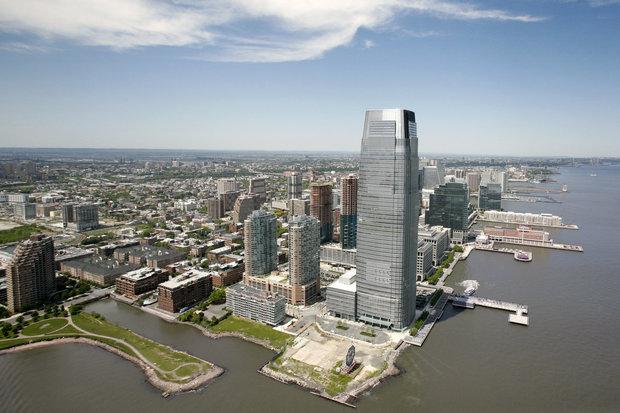
Goldman Sachs got $164.3 million to build
this tower in Jersey City. Goldman got $200 mil
for another tower in NYC.

States would probably be better off if none of them had subsidy programs, but these subsidy programs aren't going away and even if they did, New Jersey would still be at a competitive disadvantage to states that have lower taxes than we have.

I agree that these tax breaks need to be better scrutinized.  I also believe that the destructive interstate job poaching between New Jersey and New York has to be reduced.  Goldman Sachs should not be allowed to repeatedly play New Jersey and New York off against each other to get bigger and bigger tax breaks.  Neither should Pearson.  Neither Should BNY Mellon.

Every time New Jersey offers a tax incentive to a New York business, New York tries to match the incentive.  Fewer New Jersey businesses threaten to go to New York (Goya being an exception), but New York gladly offers them subsidies whenever they ask and New Jersey has to make a counteroffer.  Whenever businesses play the two states off each other, either New York or New Jersey loses tax revenue and other taxpayers have to make up the difference.

Unfortunately, the value of subsidies is increasing nationwide and regionally, meaning that for NJ to cease subsidies would be a dangerous unilateral disarmament.  See below for the increase in Connecticut's subsidies:

Source: http://trendct.org/2016/02/17/tracking-government-subsidies-to-businesses-in-connecticut/


Trenton Picks and Chooses Winners and Losers

It's inaccurate to think that these subsidies are a statewide program.  They aren't.  Trenton picks and chooses where businesses can locate or developers can build to get a subsidy. So it's a program for certain towns and counties of New Jersey and oftentimes the towns that are eligible are politically chosen.  If anyone wants to see the power of George Norcross and the South Jersey Machine, just studying the subsidy laws in New Jersey is enough.

Specially benefiting certain parts of New Jersey might be defensible if this policy always promoted Smart Growth in transit hubs or redevelopment in genuinely distressed cities but that's not consistently true.

These are the "Qualified Incentive Areas" for Grow NJ, the state's biggest subsidy program:

Current areas in which GrowNJ incentives are available are:

  • Priority Area 1 and Priority Area 2 
  • Any urban, regional, or town designated center under the State Development and Redevelopment Plan.
  • An area zoned for development or redevelopment in the Meadowlands.Area owned by the New Jersey Sports and Exposition Authority. 
  • Pinelands regional growth area, town management area, a pinelands village.
  • Military and federal installation area established pursuant to the pinelands CMP
  • Area designated for development, redevelopment, or economic growth within the Highlands Region 
  • Federally owned land approved for closure under any federal Base Closure and Realignment Commission 
  • Vacant commercial building having over 400,000 square feet
Ok.  So this program is about containing sprawl except when it isn't.

I support subsidies for redevelopment in struggling cities like Camden, Trenton, Passaic and Paterson, all of whom have special status under current tax subsidy law.  I even accept subsidies for places which aren't struggling, but are true transit hubs, like Jersey City and Hoboken, but the lists of qualifying towns are not totally rational.

 For instance, Hoboken (!), Harrison, and Weehawken qualify as "Distressed Municipalities," but Prospect Park, Jamesburg, East Newark, and Woodlynne do not.  How does this make any sense?  These towns, as non-Abbotts, are doubly disadvantaged since their school aid is inadequate and their tax rates are high.  Hoboken and Weehawken are also "Urban Aid Municipalities," which qualifies them for subsidies for real estate development.  Hoboken is NJ's richest large town and has a small tax burden, how is this fair?  Harrison and Weehawken aren't that distressed either.

Camden qualifies for the most generous subsidies of any town; projects there have to meet a lower cost:benefit ratio to get subsidies than anywhere else in New Jersey.  The New Jersey Policy Perspective claims that some Camden projects could be net losers for New Jersey.

Special subsidies for Camden may be justified, but there are also special subsidies for Paulsboro which is undeniably an example of Steve Sweeney using his power to enrich his constituents at state expense (Paulsboro is in Sweeney's district.)

Likewise, the list of towns that qualify as "Transit Hubs" is also political and arbitrary: Bridgeton, Camden, East Orange, Elizabeth, Hoboken, Jersey City, Mount Holly, New Brunswick, Newark, Paterson, Salem City, Trenton, West New York.

Bridgeton, Salem City, West New York, and Mount Holly don't have train stations.  Meanwhile, busy train locations like Edison (Metropark), Princeton Summit, Dover, and South Orange are not on the list. Irvington, which has a major bus hub, is also not on the list.

And just because a business is located near public transit doesn't mean that employees will use public transit.  If parking is limited and there are multiple train lines converging at the location,  like there are in Newark, Hoboken, and Jersey City, then a high percentage of employees will take PT, but if these factors are not in place and the business is a half mile from a train station or bus stop, few employees will take public transit.

There is also a blatant South Jersey bias (legally defined as Atlantic, Burlington, Camden, Cape May, Cumberland, Gloucester, Ocean or Salem counties) that I think is unjustified. The number of jobs that a project has to produce to get subsidies in South Jersey is lower than it is in the rest of NJ.   Projects in those South Jersey counties in areas designated "in need of redevelopment" (ie PILOTed) is lower than in the rest of the state.  South Jersey towns with high "revitalization indexes" qualify for extra subsidies too that towns in the rest of NJ with equally high revitalization indexes would not qualify for.

Furthermore, sometimes when a subsidized project provides jobs it doesn't mean there is a net increase in jobs for New Jersey because sometimes the business will be in direct competition with other New Jersey businesses.  The Hahne's/Whole Foods subsidy is defended based on the 200 jobs that will be at the Newark Whole Foods, but these jobs will presumably come at the expense of other supermarkets.  It's not like subsidizing a supermarket makes people buy more food; only new housing development can accomplish that.  Whole Foods is still a massive boost for Newark and perhaps reduce Newark's massive spending-power leakage, but we have to be skeptical about some of the jobs claims made on the project's behalf.

Pre-2013 NJ's tax incentives also disproportionately rewarded big companies since the state would always give into a company threatening to take 1,000 jobs out of New Jersey but might ignore a company threatening to take only 20 jobs out.   From the mid-1990s to 2013, the state gave out incentives to over 500 companies, but half of the money went to only 22 companies.

After the 2013 subsidy reform this tendency may be less pronounced, but I haven't seen any comprehensive data.


Conclusion

Despite the political inclusions, usually this program gives subsidies to Smart Growth locations and poor cities.  As NJ Future summarized:

Since the passage of the Economic Opportunity Act [of 2013], New Jersey's two remaining economic development incentive programs the Grow New Jersey Assistance Program (Grow NJ) and the Economic Redevelopment and Growth Program (ERG) appear to be functioning reasonably well at steering economic growth into "smart-growth" locations where infrastructure is already in place to accommodate it, and away from open space and farmland. They also continue to direct almost two-thirds of their awards (both in terms of number of projects and dollar amounts) to the state's most fically and socioeconomically distressed cities, towns, and inner-ring suburbs. The focus on steering economic development into transit-accessible locations appears to have been somewhat diluted by the loss of the Urban Transit Hub Tax Credit and its exclusive focus on such locations, although part of the explanation for this may be an increase in the number of awards being given to industrial projects, which are not optimal uses for land near transit stations.

What would happen probably if New Jersey stopped giving out tax incentives is that there would be less business investment overall and significantly diminished investment in New Jersey's struggling cities and transit hubs.  Overall, the Treasury might not be in much better shape.

Tax incentives will always be controversial since we in the public can never know if a business really would have left New Jersey had it not gotten a tax break.  The value of Smart Growth and historic preservation are subjective too, but to me they are worth it.  Any walk around downtown Newark, Paterson, Camden, or Trenton will show that these cities have vast swaths of underused property and beautiful, yet decaying, historic buildings.

And as I said before, even the very liberal New Jersey Policy Perspective doesn't appear to support completely eliminating subsidies.  They favor an annual cap, but overall their position is critical, but nuanced.

Ceasing tax subsidies to fund SFRA might make sense in a campaign where a candidate wants to denounce "corporate welfare," but it doesn't make economic and budgetary sense since every state in the country has its own tax subsidy program and for NJ to unilaterally stop is to just to surrender jobs to rival states who have no qualms about giving subsidies to the richest companies in America, as Connecticut just gave $52 million to Bridgewater Associates.

Someone needs to tell Phil Murphy that there is no painless way to produce fair school funding in New Jersey.  Fairly funding schools will take a combination of tax increases and redistribution.  While tax subsidies can be made fairer and maybe reduced, there's no pot of gold in eliminating them.

I'm honestly not sure Phil Murphy wants to do with subsidies, but the NJEA's position is clear that it wants suspension:
NJEA Secretary-Treasurer Sean M. Spiller and NJEA Vice President Marie Blistan joined New Jersey Working Families today in calling for a moratorium on subsidies to corporations from the New Jersey Economic Development Authority (EDA) until it can be demonstrated that such giveaways produce any positive results for everyday New Jerseyans....

This trickle down concept hasn�t worked and we keep going back to it,� Spiller said. �We see 38 percent of our families struggling to meet basic needs. We see the number of students living in poverty skyrocketing�up 20 percent since 2008.�

Spiller noted that while Gov. Christie is busy handing out subsides to the wealthiest in New Jersey through the EDA, he is not living up to his obligations under the pension funding law he signed in 2011. Known as Chapter 78, that law was Christie�s promise to fund the pension systems to their actuarially required levels over a period of seven years. After following the law for two years, Christie stopped paying the legally required amount, thus violating his own law.

Someone should remind the NJEA that other states have subsidy programs too, New Jersey's taxes are high to begin with, not every subsidy is evil "corporate welfare," and businesses do relocate.

And how is the NJEA not saying to Camden "Drop Dead" since redevelopment there would be nil without subsidies?

Phil Murphy ought to be more balanced than the NJEA leadership and he may not be serious but eliminating subsidies, but if he does want to stop subsidies he has an uphill political fight, since eliminating tax subsidies would be opposed by business groups, South Jersey Democrats, urban Democrats, and probably unions.  I thus don't see eliminating subsidies as politically viable.

Sadly, I continue to await a serious school funding (and pension funding) proposal from New Jersey's leading candidate for governor.  

See Also: