Showing posts with label New Jersey budget. Show all posts

Thursday, February 14, 2019

How Education Spending Ate the NJ Budget


One important consequence of New Jersey's 21st Century budget travails is the severe neglect and outright cuts of the state's municipal aid, other local aid, and direct tax rebate payments.

Although we hear often about the underfunding of public education in the
Sourge, FY2002 Budget, Pg 8
https://bit.ly/2EbqKcf
Christie era (including on this blog!), it is the OTHER ITEMS paid for by NJ "Property Tax Relief Fund," from municipal aid to direct tax rebates to library funding to community colleges, that have been much more neglected and gutted.

In the 1990s, municipal aid averaged 30% of school aid, but by FY2019, municipal aid was only 10% of school aid.  

Although the state's municipal aid programs complex and opaque, the overall numbers  appear in the state's Budgets in Brief and show the flat-funding of municipal aid and direct tax rebates from 2001 onwards, cuts in 2010, and continued flat-funding from the new 2010 baseline.

Note, this slide was updated with FY2020 data after I originally wrote this post.


New Jersey's peak year of direct property tax rebates was FY2008, when we distributed $2.8 billion.

New Jersey's nadir was FY2018, when it had shrunk to only $420 million.

New Jersey's peak year for Municipal Aid was also FY2008, when it was $2 billion.  Municipal aid sank to a nadir of $1.3 billion in FY2011 and in FY2018 it was only $1.524 billion.  For FY2019 although Phil Murphy and the legislature increased PreK by over $50 million, increased K-12 opex aid by $350 million, they only increased municipal aid by $12 million, all of which was earmarked as Transitional Aid.

New Jersey also distributes a lot of money referred to as "Other Local
Aid."  Other Local Aid consists of a basket of programs including libraries, reimbursements for sundry administrative expenses, and county-specific spending that might be considered pork barrel.  This category of aid has increased over the years, but at a sub-inflation rate and most of the increase has gone to a category called "Employee Benefits on Behalf of Local Governments.

Library Aid has been cut from $18.5 million to $9.2 million.

County College Aid was $191.1 million in FY2001.. County College Aid  had risen to only $199.8 million in FY2018.


For New Jersey to increase municipal aid and direct tax rebates for inflation (+19% since 2008) would require municipal aid to now be $2.4 billion and direct tax rebates to now be $3.4 billion.  Since New Jersey's population has grown by 3.5% since 2008, the real increases in per capita should be 3.5% higher.

The great contrast, of course, is to education spending, which has increased from $6.8 billion in FY2001 to $14.9 billion in FY2019, despite enrollment K-12 enrollment loss 2001.
*(NJ's enrollment nominally from 1,341,503 students in 2001-02 to 1,369,715 in 2017-18, however that includes PreK students.)

Over the 21st century timeframe, the state's education spending has increased more rapidly than other items funded by the "Property Tax Relief Fund" and the entire state budget.


Of course, the increase in K-12 opex aid has been more modest, but the large increases for the Teachers Pension and Annuity Fund, school construction debt servicing, Whitman-era Pension Obligation Bonds, teachers Post-Retirement Medical, teachers Social Security, and PreK are still real money intended to support education, and that money comes out of the state's income tax revenues.

Municipal Aid is Not Distributed Justly

I don't understand all the formulas and sub-formulas of municipal aid, but a glance at the amounts of aid that different towns are getting shows that the amounts do not make sense based on population or the principle that state aid should compensate for a town having a low tax base.


Muni Aid Per ResidentPopulation (2017)Total Formula Aid
Hoboken$20255,131$11,113,035
Bayonne$13167,186$8,829,801
Lakewood$50102,682$5,157,607
Toms River$9193,017$8,492,807
Clifton$11686,607$10,052,853
Franklin Lakes$15811,255$1,781,701

Or how about the fact that Jersey City, despite its increase in wealth, gets more municipal aid ($63.9 million) than Elizabeth and Paterson combined ($62.2 million), despite Elizabeth and Paterson having a population that is still 8,000 people larger?

Muni Aid Per ResidentPopulation (2017)Total Formula Aid
Elizabeth$224130,215$29,190,687
Paterson$222148,678$32,991,868
TOTAL for E & P.$223 (weighted avg)278,893$62,182,555
Jersey City$236270,753$63,860,522


Municipal and County Budgets will Come Under Pressure

The neglect of municipal aid is not sustainable for obvious reasons in that their budgets are growing, but also because municipal and county budgets will come under increasing pressure due to the following measures.

  • Phil Murphy and the legislature allowed the police & fire salary arbitration cap to expire.
  • Phil Murphy and the legislature passed S5, which will allow the police & firefighter unions to increase their pension benefits.
  • The state is lowering the expected rate of investment earnings for the pensions from 7.65% to 7.0%.  Lowering this "Discount Rate" will increase the amounts of money municipal and county employers must contribute to the pension funds because in the future expected investment earnings are lower.
  • The $15 minimum wage, which the NJ League of Municipalities opposed because it would increase their costs.
The fact that New Jersey has flat-funded orgutted Municipal Aid, Other Local Aid, and Direct Tax Rebate is another reason why NEW JERSEY MUST REDISTRIBUTE ADJUSTMENT AID, since any attempt to fully fund all NJ school districts just with new revenue would necessarily cause continued flat-funding and negative funding for other vitally important state obligations.

----

See Also:


Thursday, May 18, 2017

New Jersey Underfunds Higher Education


This post is on a seldom-discussed paradox of in New Jersey's budget landscape:

New Jersey's PreK and K-12 spending are the country's third highest, but our higher education spending is actually average or below average.

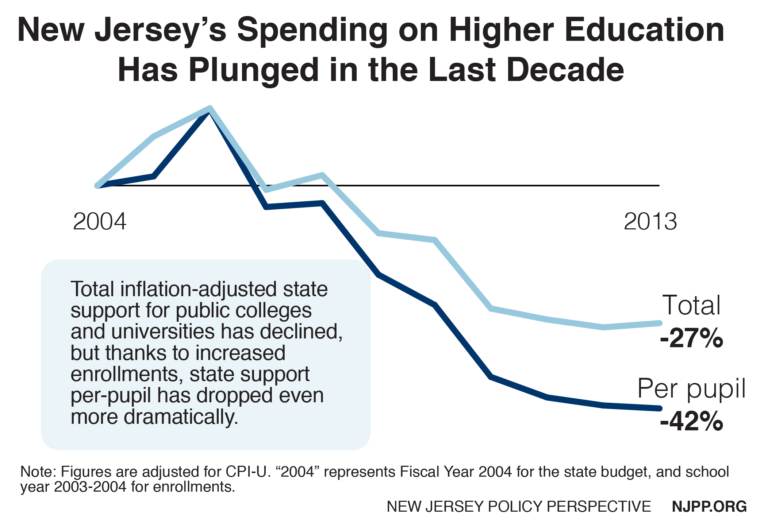
Although one sometimes sees discussion of how New Jersey underfunds higher education spending relative to itself in the recent past, eg, like this report from the New Jersey Policy Perspective, one less often sees state-by-state comparisons, nor the stark contrast between New Jersey's exceptionally high PreK-12 spending and its middling to below average higher education funding.

Not Only Does NJ Spend Less on Higher Ed
Per Student Than it Used to, It Spends Less
Than Most Other States


I'm not an expert on higher education finance, and even if I were, a single blog post couldn't be a comprehensive analysis of state-by-state higher education funding.  However, I'm an enthusiastic researcher and I hope this post sheds at least some light on the insufficiency of New Jersey's funding for its public colleges and universities.

I've already made the point many times on this blog that New Jersey cannot fully fund SFRA just through new money and that therefore redistribution is necessary.  The point of this post is that even if we could stretch ourselves and fully fund SFRA either, since to do so would deprive other essential state services like higher education of the resources they need.

----------

There are several different valid methods to make state-to-state budget comparisons for higher ed:

  • Higher ed funding in per student terms.
  • State funding as a percentage of the public higher ed system's total budget.
  • Higher ed funding in per capita terms.
  • Higher ed funding as a percentage of total state budget.
The bottom line is that New Jersey does average-to-badly in all categories.  We would do even worse if you considered our cost of living and unusually high taxes.

1.  Funding Per Student

Without local cost adjustments, New Jersey's spending basically equal to the unweighted national average ($6,982 versus $6,954) and is in 17th place, so slightly above the median.  We rank beyond much poorer states such as New Mexico and are just above Arkansas.

Source: "State By State Wave Charts"
http://www.sheeo.org/projects/shef-fy16

However, if you use local costs adjustments, New Jersey's per student higher education funding is only in 30th place.

2.  State funding as a percentage of the public higher ed system's total budget.

New Jersey's higher education system is more reliant on tuition than most other systems, with 59.5% of resources coming from tuition, putting us at the 17th most tuition reliant, versus a national average of 49.9%.


Source: "State By State Wave Charts"
http://www.sheeo.org/projects/shef-fy16

Like most other states, New Jersey has become more tuition-reliant over time, but we have lost ground relative to the rest of the country and our ranking has declined.

For example.

  • In 1991, only 26.6% of NJ higher education spending came from tuition, which put New Jersey 27th from the top, so slightly below average in tuition-reliance.
  • In 2000, 32.4% of NJ higher education spending came from tuition, which put New Jersey 23rd from the top and above average in tuition reliance.

Source: : "State By State Wave Charts"http://www.sheeo.org/projects/shef-fy16


3.  Spending Per Resident

Yeah, we're below average here too.

In the most recent data I could find, from 2011, New Jersey spent $232 per capita on higher education, which is close to the national average of $242 per student, but only enough to put New Jersey in 30th place again.

4.  As a Percentage of the State Budget

We're even more below average here.

According to the Center for Budget and Policy Priorities, the average state devotes 13% of its budget to higher education.

What does New Jersey devote?

6%.  ($2.2 billion out of $35.5 billion)

Source vary, but a picture still emerges that New Jersey is below average.  According to the Kaiser Foundation, the national average is 10% of a state's budget, with New Jersey at 7%, still putting us in 40th place.*

I don't consider spending as a percentage of state budget to be the most valid comparative measure of funding though, since budgets differ in proportion to dollars per capita, percentage of GDP etc.  Perhaps New Jersey's devoting 6%-7% of its budget to higher education shouldn't be seen as low funding for higher ed so much as high spending for other purposes.  After all, 6%-7% of a high-tax state's spending could equal the same amount of money as 12% of a low-tax state's spending.

----------


Our PreK-12 Spending is at the Country's Peak

The Great Paradox of New Jersey is that while our higher education funding is average, our PreK-12 spending is incredibly high.

For FY2014, New Jersey's spending per K-12 student was the country's third highest, at $17,907 per student, behind New York at $20,610 per student and Alaska at $18,416 per student.

One might attribute that high spending solely to our superior wealth, but that would be significantly incomplete because New Jersey spends the second highest percentage of its GDP on education, 4.6%, in the country too. (after Vermont).

Source: Education Law Center/Rutgers Graduate School of Education
https://drive.google.com/file/d/0BxtYmwryVI00VDhjRGlDOUh3VE0/view

Yes, while the Education Law Center constantly denounces Chris Christie for underfunding SFRA, it also recognizes that, all-in, New Jersey's "Tax Effort" is almost the country's second highest.

This K-12 Funding Effort comparison factors in local taxes too, so comparing K-12 school spending, which is  local+state, to higher ed funding, which is almost entirely state isn't a perfectly apples-to-apples comparison, but, according to Kaiser and other public data, the state government's own efforts for K-12 aid are above average in per student terms, high in per capita terms, and average as a percentage of our (high) state budget.

In the Era of the Pension Crisis and Slow Growth,
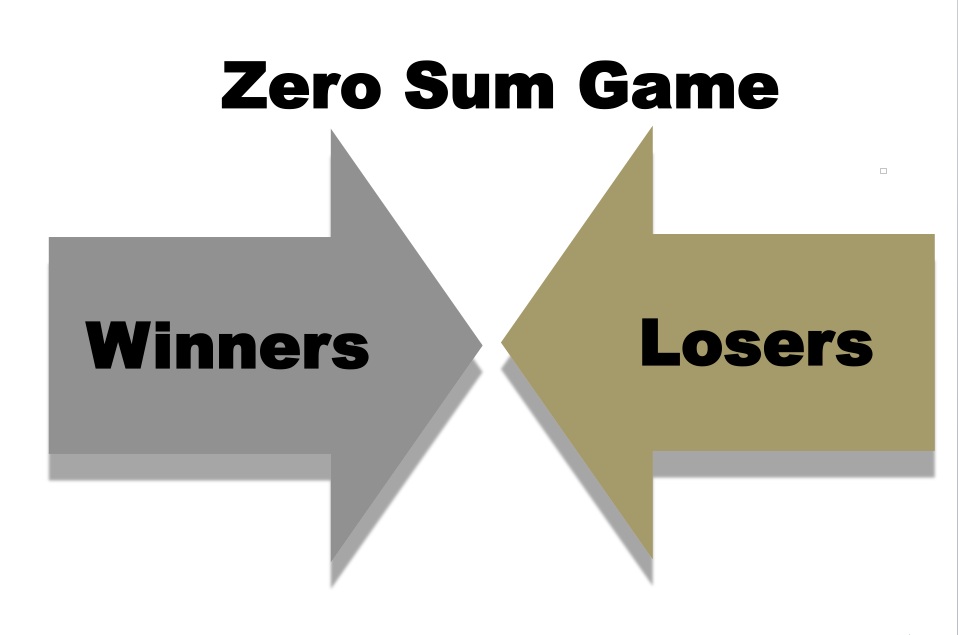
Budgeting is Zero-Sum
Conclusion:

There are several reasons for New Jersey's higher education funding to be so low proportionally other than that our PreK-12 spending is the country's highest.  A major reason would be low federal assistance for Medicaid that the state must compensate for, but, despite the Medicaid factor and others, it would not be credible to deny that our extremely high PreK-12 spending (and the Abbott Regime is one reason for the neglect of our higher education system.

Since higher education is a middle-class service par excellence, our long-term abandonment of it is yet another instance of how New Jersey's middle class has been under siege since the early 1990s.

I take it to be self-evident that New Jersey's underfunded higher education harms the state. According to the SHEEO, tuition here $10,263 per student, the country's 7th highest for in-state students, compared to a national average of $6,305.  The sticker shock of our state universities is probably one reason New Jersey has the country's worst student outmigration.  It's undeniably a reason 60% of Rutgers grads have debt, with an average debtload of $25,000.  It's probably a reason that many students don't even attempt college and our public college enrollment peaked in 2011.  At some level, our starved higher education system hurts our economic competitiveness too, although New Jersey's educational attainment remains among the country's highest.

In any case, in the era of the Pension Crisis something has to change.  New Jersey has to increase K-12 education aid overall, but we must use our dollars the most efficiently and fairly as possible and that means eliminate Adjustment Aid, in order to free up money for our many other government obligations.


* Something I wasn't able to address in this blog post is that New Jersey's funding per student at different colleges and universities is totally irrational too.

** Kaiser's data has NJ spending $2.4 billion on higher ed, not the $2.2 billion that appears in NJ's budgets for the past few years.  I don't know where they get that extra $200 million, although I don't think it affects their finding.