When Phil Murphy is asked how he will deal with New Jersey's enormous debts, pay for his agenda, and even stabilize property taxes, his answer is a vague "you prioritize" and then a statement that New Jersey can fund its needs by growing the economy. Murphy's argument is that his platform of increased taxes on the rich, increased investment, STEM-focused education, a $15 / hour minimum wage, and a state-owned bank is what New Jersey needs to get its economy moving again.
Here's an example:
Question: What's he going to do about our sky-high property taxes?
Answer: "There's no signing ceremony on the deck of the battleship to solve this," Murphy said. "But the biggest step we can take is to grow our economy. If we can grow the economy aggressively, we can get our revenues the right way," and property taxes start to "melt away," at least, a bit.
In the same interview, Murphy said economic growth (and cutting hedge fund investments) would fully fund the pensions:
Murphy always says "I'm an optimist," and points to Jerry Brown in California as a beacon of fiscal turnaround:
How to fund such payments? Murphy said a combination of economic growth and reassessing whether the hefty fees New Jersey pays hedge funds to manage its retirement funds will be the solution.
Murphy always says "I'm an optimist," and points to Jerry Brown in California as a beacon of fiscal turnaround:
Jerry Brown inherited a state five years ago with a $25 billion deficit; this year? And $8 billion surplus. It can be done.
A Democratic governor. Progressive values. Can get a state turned around.
But I am extremely doubtful that Phil Murphy (or any of the Republican candidates either) can turn
 New Jersey's economy around. Even a president's control over the national economy is very limited and a governor's is more limited still.

Although Chris Christie's economic-budgetary management has been very bad, the fact that Connecticut has continued to flounder under a Democratic governor with progressive policies makes me skeptical that Phil Murphy can produce a genuine "Jersey Comeback" either.
Like New Jersey, Connecticut has very high average income and one of the country's most uneven distributions of wealth. Compared to a national average of "only" $389,436 per year to be in the top 1%, in Connecticut you would need $659,979 per year; in New Jersey you would need $547,737 per year. . In both New Jersey and Connecticut the top 1% captured all of the income gains in the rebound from the Great Recession from 2009-2013.
Neither Connecticut nor New Jersey has a large, dynamic city, but both have populous suburban belts where towns range from incredibly wealthy to indistinguishable from decayed industrial cities. Both New Jersey and Connecticut are in the orbit of New York City and are affected by New York's successes and failures. Both Connecticut and New Jersey have very high spending and very high performing public schools. State school aid is very progressively distributed as well -- each state gives the majority of its state school aid to just 30 districts. Each state has one ultra-prestigious Ivy League university.
Like New Jersey, Connecticut is extremely indebted. Mercatus lists Connecticut as the country's most fiscally distressed state:
On the basis of its fiscal solvency in five separate categories, Connecticut ranks 50th among the US states and Puerto Rico for its fiscal health. Connecticut�s fiscal position is poor across all categories. With between only 0.46 and 1.19 times the cash needed to cover short-term liabilities, Connecticut�s revenues matched only 94 percent of expenses, producing a deficit of $505 per capita. The state is heavily reliant on debt to finance its spending. With a negative net asset ratio of -0.88 and liabilities exceeding assets by 34 percent, per capita debt is $9,077. Total debt is $20.88 billion. Unfunded pensions are $83.31 billion on a guaranteed-to-be-paid basis, and other postemployment benefits (OPEB) are $19.53 billion. Total liabilities are equal to 53 percent of total state personal income.
According to Pew, Connecticut's debts equal 30.2% of personal income, whereas New Jersey's debts are 31.2% of personal income. According to Pew, of states in the Lower 48, only Illinois is more indebted.

Like New Jersey, Connecticut has a highly-progressive income tax structure to go along with that extremely unequal distribution of wealth. The consequence of these facts is that Connecticut and New Jersey are highly dependent on a few hundred ultra-wealthy people to finance their state governments. In New Jersey, 0.5% of the population pays a third of state income taxes, or 400 families pay $1.4 billion. In Connecticut, in 2011, the top 357 households accounted for 11.7 percent of the state's income tax.
Due to this reliance on the ultra-wealthy for tax revenue, when the ultra-wealthy have any dip in income, each state's revenues crash. Whereas the national average for state revenue loss during the Great Recession was only 12.9%, Connecticut's revenues fell by 19.8% and New Jersey's revenues fell by 18.9%.
I'm not saying that it is morally wrong to tax the super-rich at high rates, but the dependence on high-earners exposes a state to higher volatility than a state that is less income-tax dependent or does not have a progressive income tax structure.
Yet, Connecticut and New Jersey have a major difference in that Connecticut's governor, Dannel Malloy, is a progressive whereas our Chris Christie is a conservative.
Chris Christie refused to renew NJ's high-income tax surcharge in 2010, but Dannel Malloy has increased taxes twice. In 2011 Malloy increased taxes by $1.5 billion on dozens of items and in 2015 Malloy increased taxes by another $1.5 billion. The 2011 tax increase affected the middle class and made Malloy the country's most unpopular Democratic governor. The 2015 tax increases contributed to GE's decision to leave Connecticut for Boston.
Other major progressive victories in Connecticut that have no equivalent in NJ are Malloy's increase Connecticut's minimum wage to $10.10 and his $100 billion, 30 year infrastructure plan. Malloy has implemented mandatory paid sick leave.
Other than not creating a state-owned bank and not wanting to legalize marijuana, Malloy's agenda for Connecticut is extremely similar to what Phil Murphy says he wants to do for New Jersey.
Well Murphy-backers, so with all that money to pay down debt, that higher minimum wage, new "investment" Connecticut is doing well, right?
NO.
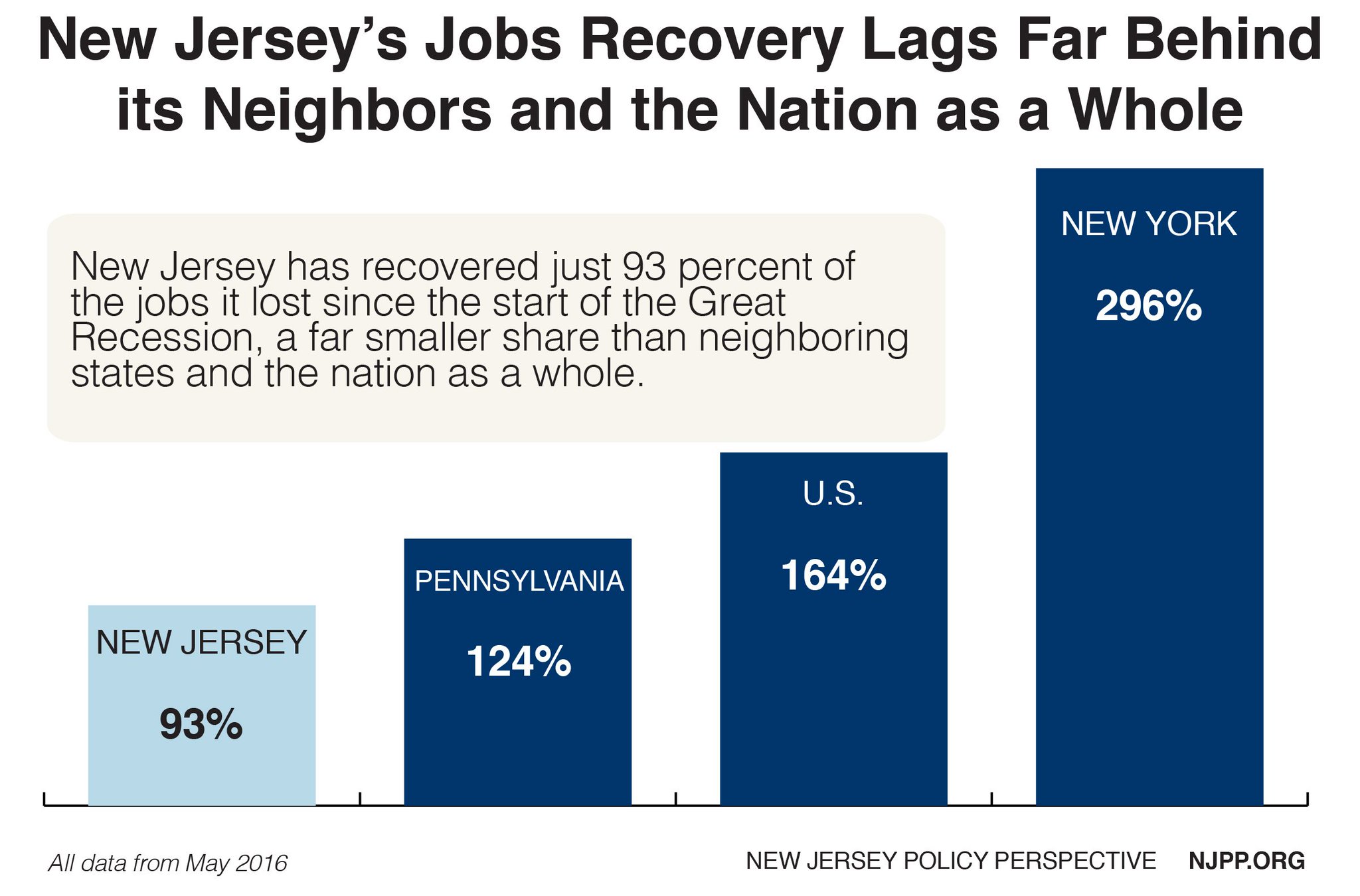
Whereas New Jersey has slowly (and barely) recovered the number of jobs it lost in the Great Recession, Connecticut has only recovered 72% of the jobs it lost in the Recession.

As bad as New Jersey's economic "recovery" is, Connecticut's "recovery" is significantly worse.
The job market in Connecticut is struggling, with more jobs cut than created for three consecutive months, and just 5,000 jobs created over nine months....
According to the Connecticut Department of Labor report released Thursday, government layoffs and private sector layoffs both hit hard in September. State government employment fell by 2,900 and private sector employment fell by 2,700. First-time filers for unemployment claims in September increased by nearly 4 percent compared to August, and were up more than 8 percent compared to a year ago.
By contrast, national first-time claims for the last half of September and the first two weeks of October were the lowest in 42 years.
Pete Gioia, vice president and economist at the Connecticut Business and Industry Association, said, "You can't look at a report like this and not feel some sadness."
In comparison, he said, Massachusetts has not only gained back all the jobs it lost during the recession, but it's added twice again that many in recent years. It recovered all the lost jobs by September 2012. Connecticut has 28,300 fewer jobs now than it did in February 2008.
"Probably the biggest anecdote I've got from this was when we went around to our board of directors in September," Gioia said. The board of directors is heavy on mid-sized local manufacturers, but also includes international giants like United Technologies, Travelers, Boehringer Ingelheim and PricewaterhouseCoopers.
"Company after company company was doing OK," Gioia said. "But they're all saying, 'We're growing in Massachusetts, we're growing globally, but we're pretty flat in Connecticut.' They were doing better elsewhere than they were in Connecticut.
"They just don't see the activity and they don't see the imperative to invest when they see better opportunities to invest elsewhere."
Even Stamford is "suffering," with a 30% office vacancy rate!
Malloy's two tax increases have pushed Connecticut's revenue (barely) above its pre-Recession peak, but Connecticut's revenues peaked in the winter of 2014, despite the 2015 tax increase.
States that have cut taxes dramatically, like Wisconsin and even Kansas, have had better revenue performances than Connecticut.
 |
| Source: Pew Fiscal 50 http://www.pewtrusts.org/en/multimedia/data-visualizations/2014/fiscal-50#ind0 |
Now, for FY2018 things are looking worse, as Connecticut faces yet another $1.5 billion deficit.
Aside from its stagnant economy, Connecticut's deficit is due to declining incomes of Connecticut's superrich.
[Legislative budget chief Neil Ayers] noted that the state's top 50 individual taxpayers had $2.9 billion less in combined income in 2015 � meaning that they earned an average of $60 million less per tax filer. As a result, they paid $217 million less in state taxes � helping to cause the deficit.
"Fifty people represented almost a quarter of the problem," Ayers said, referring to the size of the previous deficit.It also appears that Connecticut is losing its ultra-rich to other states, just as New Jersey has lost David Tepper and Leon Cooperman. Former Connecticut billionaires Edward Lampert, Thalius Hechsher, Thomas Peterffy, and C. Dean Metropoulos all moved to Florida, the latter two were worth over $10 billion each.
"I know for a fact that it's about taxes and it's about the state of the fiscal house in Connecticut," [State Senator Scott] Frantz said, referring to the unfunded pension liability.
Peterffy, who made headlines in 2012 by personally funding political ads for Republicans, told Greenwich First Selectman Peter Tesei in late 2014 that he "had pretty much given up on the state of Connecticut," Tesei said Wednesday.
"He was holding out that there would perhaps be a change in direction, and when that didn't materialize, he took the position that he was out of here," Tesei said.
Six months after that conversation, Connecticut's tax on the highest earners rose from 6.7 percent to 6.99 percent, up from 4.5 percent just a few years ago. Florida has no income tax, and more importantly, Connecticut taxes estates when wealth transfers between generations; Florida does not.
"Mother Aetna" Almost Out the Door
GE left Connecticut in 2015 and now Aetna has one foot out the door.
Aetna's CEO refuses to promise to stay in Hartford and Aetna has continued its long-term trend of reducing Connecticut employment. Since 2012, Aetna has reduced Connecticut staffing from 6,700 to 6,000, during a time it expanded its staffing nationally. During the period when Aetna's merger with Humana looked likely, Aetna's CEO spoke very favorably of Louisville, Kentucky (where Humana was headquartered) and said that all its government-related work would be done in Louisville.
It's Not All Dan Malloy's Fault, But Connecticut is Getting Worse
I'm not trying to say that Connecticut's intractable problems are all Dan Malloy's fault. It is not Malloy's fault that CT put virtually nothing into its pension funds from the 1930s-1980s and Connecticut's job growth has been very poor for decades too.
It isn't Malloy's fault that Connecticut is so dependent on hedge fund millionaires for tax revenue either.
Malloy is also doing more to face up to Connecticut's debt crisis than Chris Christie is. If Christie were willing to actually balance New Jersey's books, we would need to be taxing more/spending less to a tune of $4 billion a year.
But Malloy's progressive policies haven't ignited growth either and Malloy has resisted pension reform.
But this brings me back to Phil Murphy.
Phil Murphy cannot even fund NJ's pensions with a "Millionaire's Tax" (which would bring in $600 million per year) and a marijuana excise tax ($300 million per year), let alone the rest of his agenda. Given the intractable budgetary-economic crisis in Connecticut, I fail to see any reason why anyone in New Jersey would be optimistic about New Jersey under very similar policies. Murphy's beacon is California, but New Jersey and California are nothing alike. New Jersey and Connecticut are quite alike.
There are, of course, parts of New Jersey that are doing very well, eg, Hudson County and train-line suburbs such as South Orange-Maplewood, Millburn, Summit, Montclair, and Madison. Ironically, Phil Murphy's vision of public-transit centered-growth, seems like it would (unintentionally), if anything, further benefit the "haves" of the NJ economy.
And the likelihood that New Jersey will be in for another four years of budgetary pain underscores the need to think pragmatically about state aid (which Murphy does not do), and how we need to have achievable funding targets for high-FRL (i.e., Abbott) districts, and the need to redistribute state aid.

----
Update: Paul Tudor Jones also took his hedge fund out of CT to Florida.
----
See Also:
And: "Connecticut and New Jersey: Rich States, Poor Economies"
I'm not trying to say that Connecticut's intractable problems are all Dan Malloy's fault. It is not Malloy's fault that CT put virtually nothing into its pension funds from the 1930s-1980s and Connecticut's job growth has been very poor for decades too.
It isn't Malloy's fault that Connecticut is so dependent on hedge fund millionaires for tax revenue either.
Malloy is also doing more to face up to Connecticut's debt crisis than Chris Christie is. If Christie were willing to actually balance New Jersey's books, we would need to be taxing more/spending less to a tune of $4 billion a year.
But Malloy's progressive policies haven't ignited growth either and Malloy has resisted pension reform.
But this brings me back to Phil Murphy.
Phil Murphy cannot even fund NJ's pensions with a "Millionaire's Tax" (which would bring in $600 million per year) and a marijuana excise tax ($300 million per year), let alone the rest of his agenda. Given the intractable budgetary-economic crisis in Connecticut, I fail to see any reason why anyone in New Jersey would be optimistic about New Jersey under very similar policies. Murphy's beacon is California, but New Jersey and California are nothing alike. New Jersey and Connecticut are quite alike.
There are, of course, parts of New Jersey that are doing very well, eg, Hudson County and train-line suburbs such as South Orange-Maplewood, Millburn, Summit, Montclair, and Madison. Ironically, Phil Murphy's vision of public-transit centered-growth, seems like it would (unintentionally), if anything, further benefit the "haves" of the NJ economy.
And the likelihood that New Jersey will be in for another four years of budgetary pain underscores the need to think pragmatically about state aid (which Murphy does not do), and how we need to have achievable funding targets for high-FRL (i.e., Abbott) districts, and the need to redistribute state aid.
----
Update: Paul Tudor Jones also took his hedge fund out of CT to Florida.
----
See Also:
And: "Connecticut and New Jersey: Rich States, Poor Economies"